Showing posts with label special effects. Show all posts

Wednesday, June 21, 2023

camouflage / everyone's doing it, including hollywood

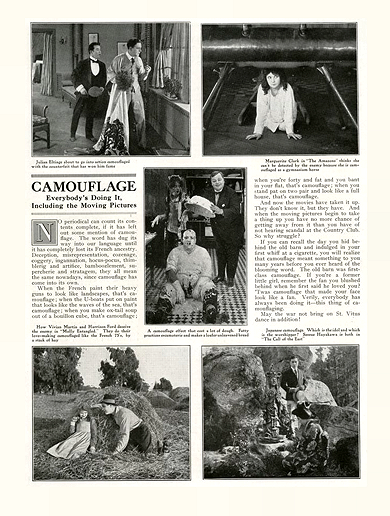
Above A page from Photo-Play Journal, December 1917, p. 25, featuring an article called CAMOUFLAGE: Everyone’s Doing It, Including the Moving Pictures. In an earlier blog post, we reproduced the article’s text, but not this image of the page.

SEE ALSO

Nature, Art, and Camouflage (35 min. video talk)

Art, Women’s Rights, and Camouflage (29 min. video talk)

Embedded Figures, Art, and Camouflage (26 min. video talk)

Art, Gestalt, and Camouflage (28 min. video talk)

Wednesday, July 8, 2020

Don Jules Camou | Ye Olde Checkerboard Technique

Full-page article on Don Jules Camou (1932)
Five years ago, I ran across a news article that claimed that modern camouflage was originated in the 19th century by a French general named Jacques Camou (1792-1868). At first, I thought it was a joke. The coincidence of the person’s name and the Modern-era military term (which did not come into common use until 1914) was bizarre.

But I have now found a more detailed news article from 1932 that provides an account of the life of Don Jules Camou (not Jacques Camou), described as a major landowner (“a dictator, almost”) in the Mexican state of Sonora. Written by Oren Arnold, the article is titled INVENTED CAMOUFLAGE A CENTURY AGO TO SAVE HIS RANCH FROM THE APACHES: Fooling the enemy with paint was not originated by modern war strategists after all—for wily Jules Camou used it against his Indian foes in 1832 (Arizona Daily Star, May 22, 1932).

Accompanying the article are several surprisingly clear photographs of the then surviving structures on the Camou estate, located in Sonora, 250 miles south of the Mexican-American border. When the article came out, it was claimed that “more than 100 alleged heirs” were “still squabbling over his estate, and romantic yarns about him are becoming a vital part of Sonoran folklore.” Reportedly, part of the interest was due to the possibility of ore deposits, and, less credible, the rumor that a cache of gold was hidden somewhere on the property. “The courts at Hermosillo, the capital city of Sonora,” the article notes, “are crowded with matters concerning the Jules Camou estate.”

Jules Camou’s purported use of camouflage took place in 1832. His cattle ranch was huge; according to the article, “a horseman can travel in a straight line for two days” and never leave the estate. Each year he raised as many as 16,000 head of cattle, the success of which required dependable access to water. He decided to construct a dam with which to form a 400-acre lake. But he was plagued by frequent attacks by neighboring Apaches, who regarded him as an intruder.

In order to construct the dam, Camou first devised a large ranch fortress, with a cylindrical stone tower at each end. When attacked, the workers could flee to the towers, and fire at the attackers from above through five-inch square-shaped portholes. But the portholes themselves were a target. It was Camou’s innovation to make the portholes hard to see by randomly locating them within a surface pattern of painted squares. As a result, the article claims, “where any one Indian might before have seen four or five targets, he now could see only a confusing picture of colored squares.”

Did Camou actually do this? It seems that he did, but even so, it’s unlikely that he was the first. A comparable checkerboard pattern (to conceal the location of gun ports) had long been used by ships at sea. In an earlier posting about camouflage and checkerboards, we referenced the aforementioned Jacques Camou, who appears to have had no connection to Mexico. In Paris, there is a street called rue Camou, named in his honor.

In the article on Jules (not Jacques), historian John McPhee is quoted as saying—

…Jules Camou originated what we now call “camouflage.” I don’t know whether he named it or not, but it is at least a coincidence that the names—Camou and camou-flage—should be so similar, isn’t it?

Related to this is an earlier news article with the headline GERMAN CONSUL MADE TO PAY HEAVY RANSOM: Sonora Rebels Abuse Max Muller and Extort $10,000 From Him, in the Los Angeles Call (April 4, 1913). The article tells the story of the threat to wealthy residents of Sonora, who are in danger of being kidnapped and held for ransom. One of the victims was Max Muller, who was vice president of the Bank of Sonora and the German consul at Hermosillo. After paying the ransom and being released, Muller fled to safety in Los Angeles, where other Sonorans had already fled. The article adds—

Among the refugees now here [in LA] are thirty-two wealthy members of the Camou family, headed by Fermin Camou and Albert Camou. This family owns practically all of the state of Sonora, and is rated as worth more than three million dollars.  

RELATED LINKS    

Dazzle Camouflage: What is it and how did it work?Nature, Art, and Camouflage / Art, Women's Rights, and CamouflageEmbedded Figures, Art, and Camouflage / Art, Gestalt, and Camouflage /  Optical science meets visual artDisruption versus dazzle / Chicanery and conspicuousness /  Under the big top at Sims' circus
Monday, June 22, 2020

Earl B. Wooden | Hollywood designer and camoufleur

Earl B. Wooden (1893-1952) was a Kansas-born scenic film designer, who (as a "set decorator" and "set dresser") produced scenery for Hollywood films. One of those was Corpus Christi Bandits (1945), the poster for which is shown above. During World War I, he also served as a US Army camouflage artist, as described in the news article below.

•••

Stockton Review and Rooks County Record (Stockton KS), January 31, 1918—

Mr. and Mrs. E.B. Wooden received a letter this week from their son Earl, notifying them that he had arrived safely in France, where he went from California recently to work in the Camouflage Corps. His particular work will be the planning and architectural construction of camouflage for artillery and other things at the front that must be concealed from enemy airplanes. In this, he is an adept, as he has been engaged for the past four years in the creation of artificial scenery for a big film company at University City in Los Angeles. He says his work has hitherto ben to deceive the public at the movies; now it will be the pull the wool over the Bosche's eyes. His parents knew of his going and were surprised as well as pleased over getting word from him so promptly.

Saturday, February 29, 2020

Jasper | dappled dog with white chicken on backside

Above A vintage news photograph of a dog that appears to have the shape of a white chicken on its backside.

•••

A Conscientious Objector in The Ogden Standard (Ogden UT), September 7, 1918, p. 23—

The art of camouflage was resorted to in one instance in making a scene for [a motion picture titled] Young America… Jasper, the pet dog of the leading boy character, refuses to chase chickens. He was brought up among chickens and carefully trained from puppyhood not to molest them. When he was “ordered” to do this in the [filming], he positively refused.

It was necessary to get another dog [to use as a stand-in] for Jasper, and, while a canine was found of the same size and approximate type, it did not have the correct spotting. The double was turned over to the scenic artist.

Friday, February 14, 2020

Dust to dust / Dali, skulls, and reminders of death

C. Allen Gilbert, All Is Vanity
Ten years ago, we blogged about an American illustrator named C. Allan Gilbert (1873-1929), who was also an early contributor to animated films. Unfortunately, if and when he is remembered, it is inevitably because of the continuing popularity of one of his illustrations, a memento mori (reminder of mortality) titled All is Vanity (1892). It is a double image or visual pun in which the scene of a woman admiring herself in a mirror appears instead to be a skull when viewed from a greater distance. During World War I, Gilbert was also among a number of US artists who worked for the US Shipping Board (the Emergency Fleet Corporation) in applying dazzle camouflage to US merchant ships.

Gilbert's skull illusion is skillfully made and undoubtedly deserving of its popularity. But it is somewhat less than original. Throughout history, there have been repeated attempts at designing scenes of daily life that, from a distance, change into icons of death. Below is an example of one made by a German artist in 1866, in which two young people take on the shape of a skull when viewed from a distance. When translated, the label beneath the image reads "blood and decay." The Spanish surrealist Salvador Dali alluded to the same symbolism when he devised a "double image" (in a 1940 painting called Slave Market with the Disappearing Bust of Voltaire) that at first appears to be a bust of the French philosopher Voltaire, and then, at other times, perhaps an image of two nuns.

Anon, Blood and Decay

And at last, below is another example, also German, from the 19th century.


Wednesday, February 12, 2020

Quaker guns and non-functioning decoy cannons

Wooden artillery used for training purposes
During World War I, non-functioning imitation cannons served two purposes. If they were more or less accurate models of actual battlefield artillery (above), they could be used to train soldiers to become accustomed to their use.

At the same time, there was also a need for non-functioning dummy cannons, traditionally known as “Quaker guns,” to throw off the enemy’s estimates of the size and location of forces. These were often crudely built from scrap lumber, since they would only be seen from a distance. Others (like the one below, probably made from papier maché) were more convincingly modeled. Once assembled and put into position, it was important to camouflage them as if they were genuine functioning guns.

Non-functioning decoy cannon, not yet camouflaged

Tuesday, February 11, 2020

WWI German version of a dummy trench observer

This is one example of the use of the same camouflage trick by the two opposing sides during World War I. Snipers stationed at the front were poised and ready to shoot at anyone in the enemy’s trench who was foolish enough to look over the edge. As a result, both sides made dummy imitation soldiers’ heads (made of papier-mache or plaster), which were mounted on sticks and held up above the top of the trench.

If the dummy was shot at, it might enable the targeted side to determine the sniper’s location. This public domain photograph, which was initially published in Le Miroir on January 28, 1917, shows a French Army corpsman examining a captured German version of a dummy trench observer (complete with a German helmet and duplicitous field glasses), mounted on a wooden stick.

Tuesday, December 31, 2019

A small camouflaged cement house in Los Angeles


Engineering and Cement World (c1918)—Walter S. Davis of Los Angeles is now in the camouflage service with the United States Expeditionary Forces in France. Mr. Davis went to France as an interpreter attached to a regimental staff and later secured a transfer to the camouflage service.

•••

Walter Swindell Davis (1887-1973), architect, A SMALL CEMENT HOUSE IN LOS ANGELES, CALIFORNIA in House Beautiful (September 1920)—

There has been so much speculation as to the sources of inspiration for this house [as pictured here] that we are only glad to “reveal.” While in the camouflage section of the Army Engineer School, Fort de Saint Menge, France, we were greatly impressed with the effects of time, the weather, and vegetation on the tile and thatch roofs. The whole rainbow was there in mosses, lichens, grasses, time-stained tile, and weather-bleached thatch: all blending together in an indescribably beautiful medley of color. Being camoufleurs, we speculated upon just how we could imitate in Los Angeles the colorful work of kindly time. And we have succeeded! The exterior was a memory materialized of the charming cottages of Cote d’Or. The interiors—the gold bathroom, the vaulted chambers, the mural decoration belie our faltering pen. The garden in front is planted informally with wildflowers and pungent-smelling native shrubs. A winding path of flagstones winds across the sunken garden to the grandsward. The wide-spreading sycamore covers the entire front garden and with its time-gnarled branches protects the picturesque little garage nestling at its base.


Friday, November 1, 2019

Drawing enemy fire and fake clouds of cotton wool

How to draw the enemy's fire | Ken Kling
These are two of my favorite wartime cartoons, both of which were published in Cartoons Magazine (c1917). Above is a drawing by American cartoonist Ken Kling, with the caption: Cartoonists in the Trenches could be Used to Draw the Enemy's Fire. Below is an ingenious proposal for airplane camouflage by British artist Bernard Hugh, originally published in The Bystander (London), in which he recommends the use of large clumps of cloud-like cotton wool, with the caption: Camouflage for Aeroplanes in the Form of Clouds.

An approach to airplane camouflage | Bernard Hugh

Tuesday, October 29, 2019

Disruptive camouflage patterns applied to vehicles

In the last years of World War I, it was common practice in the US to paint disruptive patterns on vehicles, both military and civilian, but for different purposes.

The government photograph below shows a disruptive pattern being applied to military equipment, for the purposes of camouflage. On the right, the boundaries of the areas to be colored are being marked out with chalk and labeled with the first letter of the color. On the left, the color is actually being applied. There were sometimes disagreements about the wisdom of clearly separating the colored areas with dark boundary lines, as shown here. 


In the top photograph, a bus has been painted with disruptive patterns for the purpose of attracting crowds at a wartime fundraising rally, as was also frequently done at recruiting events. In this case, soldiers recovering from injuries are seated on top of the bus. This pattern was most likely painted by the Women's Reserve Camouflage Corps. As Bessie Rowland James explained in For God, For Country, For Home (NY: G.P. Putnam's Sons, 1920)—

Tanks, ambulances, and trucks were camouflaged at the request of different branches of the government to encourage recruiting, for wherever the camoufleurs went in their uniforms, spreading their bright paints, a crowd was sure to gather.

US Government photographs (1918), with hypothetical coloring added.

Saturday, January 12, 2019

WWI Camouflage, Motion Pictures and Surrealism

Charlie Chaplin disguised as tree trunk in Shoulder Arms (1918)
Above Screen grab from Charles Chaplin's famous film, Shoulder Arms (1918) about the surrealist dimension of being a doughboy during World War I , in the process of which he disguises himself as a tree trunk. In fact, it wasn't entirely absurd, since it was not unheard of to make use of steel-lined imitation tree trunks as elevated observation posts (see close-up below).

Phony tree trunk observation post (c1918)

Camouflage has everything to do with film-making, from costumes and make-up, to camera work and scenic design. Elsewhere we have talked about a few of the contributions made by Hollywood-based special effects designers, but there are many (many) more points of connection (in both World Wars), the majority of which are waiting to be documented.

Speaking of Surrealism (which I tend to think of as Dada + Freud, thanks to André Breton), the German-born American photographer and designer Erwin Blumenfeld (1897-1969) once made a Dada-inspired photo collage portrait of Chaplin (below), in which he appears to be wearing an image-adorned WWI trench helmet. The image on the helmet is from a well-known Dadaist poster from 1922.

Erwin Blumenfeld, collage portrait of Charlie Chaplin


•••

Melvin W. Riddle, CAMOUFLAGE! Concerning One of the Major Arts of Motion Pictures. The Atlanta Constitution. Sunday, October 24, 1920—

CAMOUFLAGE!
A new word—coined during the great war by the French, to denote an art which was highly developed during the war. A new word, but an age-old art—old as war itself, older than mankind, for even Nature made use of it as a means of protection for animals and plants. Truly, an age-old idea, but only in the last few years has it been developed by mankind to that state of perfection wherein it might be called an art.
    

Camouflage saved from distruction during the war innumerable lives and properties of inestimable value. Now that the war is over, one might think that the word and the art would temporarily become passé and useless until another war should come along to revive them. But such is not the case, for camouflage is an art without a knowledge of which, one of the greatest industries of today—the motion picture industry—could hardly exist.

Camouflage and the Movies
The art of camouflage is a vital factor—in fact, it might be said, almost a prime factor in the production of motion pictures, and it is with that phase of camouflage that this article is concerned.
    

It is the general impression, perhaps, that the war itself first developed the art of camouflage. This impression, however, is erroneous. For long before the war began, the art had been developed to a high degree by the industry of motion picture production, but as developed by this industry, it was an unidentified art because it was an art without a name. The truth of this assertion is proven by the fact that when America entered the war, men from the motion pictures studios, who had gained a knowledge of the art of scenic deception, formed an important part of the ranks of special camouflage corps which were sent over there. This was because these men had already a practical knowledge of this great study and had only to adapt this knowledge to the particular requirements of defense in war.
    

The one great difference between camouflage as practiced in motion pictures and as practiced in war is that war camouflage, although deceiving to the human optics, is readily detected by the camera, while in motion pictures the camouflage is especially arranged and prepared to deceive the eye of the camera, although it sometimes also deceives the human eye, unless a very close-up view is obtained. Primarily, it is the camera lens upon which the deception is practiced, however, for the eye of the camera is ultimately the eyes of the motion picture audience.

Vital Necessity
Motion pictures, before the beginning of the war, did more and are now doing more to develop the art of camouflage on a large scale than any other industry or even possibly could do. Camouflage is the very life of a motion picture—a vital necessity. Of course, the art has been employed from time immemorial in the theatrical profession—in the dressings of stage settings for legitimate productions, but camouflage, as used on a stage, is very limited in its scope, and is admittedly camouflage, for this reason loses its very effectiveness. It is when camouflage is mistaken for the genuine and the delusion is unquestioned, that it really serves the purpose for which it is intended.
    

Examples of some of the numerous instances where camouflage is employed in motion pictures might be of interst. At the Lasky studio, for instance, which is one of the largest of west coast film plants, one might see on every hand the evidences of this great art.
    

To begin with, the very make-up of the players is often the most perfect camouflage. The feeble-looking old man or the dissipated, rum-soaked hobo might be, in reality, one of the most gentle and best-appearing young men on the lot, hiding his real identity under a skillful application of camouflage.…
   

Even the most conscientious, exacting and painstaking producers, who fairly dote on realism in their productions and always secure it whenever possible, are never slow to admit the importance and the value of the art of camouflage, and the great frequency and regularity with which it is employed in the production of motion pictures.