Sunday, November 4, 2012

Camouflaged Mauretania | Jim Baumann

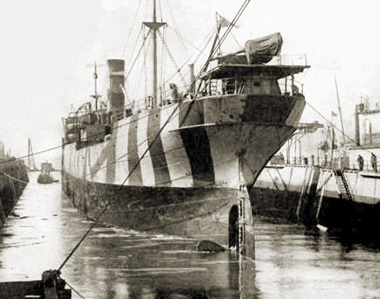
RMS Mauretania (December 1918)


Above I haven't seen this particular photo before (although I've seen plenty of others, almost identical). I found it in an issue of the American Review of Reviews. Vol 59 No 1 (January 1919), p. 19. The caption reads—

THE GREAT TRANSATLANTIC LINER MAURETANIA ARRIVING AT NEW YORK ON DECEMBER 1 [1918] WITH THE FIRST AMERICAN TROOPS RETURNING FROM EUROPE. For more than a year, and particularly since the German offensive of last spring, British as well as American transports had been making eastward voyages crowed with human freight in khaki, through a submarine-infested ocean. Now their peculiar war, to deceive German submarine commanders, is unnecessary. When the Leviathan arrived, two weeks later than the Mauretania, the war paint had been removed. While war was on it was not considered advisable to print picture showing these so-called "camouflaged" vessels.

For more about the RMS Mauretania, I recommend a website called Atlantic Greyhound RMS Mauretania (1907-1935). It offers an extensive history of the ship, but even more fascinating are its dozens of photographs (scroll down the page to see them) of an exquisitely detailed model (numerous in-process views as well as the finished work, two of which are shown below) built by ship modeler Jim Baumann. What an amazing accomplishment.

RMS Mauretania (model by Jim Baumann ©)


RMS Mauretania (model by Jim Baumann ©)

Saturday, November 3, 2012

Philadelphia Ship Camouflage Artists

Philadelphia ship camoufleurs (c1918)
Above This photograph was published in an essay by William Bell Clark, titled "Camouflage Painting on the Delaware."• It is an artfully posed group portrait of some of the Delaware River-area artists who contributed to ship camouflage during World War I. The people are positioned to look as if they are studying the colored lithographic camouflage plans (sent out by the US Navy from Washington DC), while others are applying dazzle camouflage schemes to wooden ship models, or discussing the appearance of already painted models. I am not familiar with many of the Philadelphia artists from that era, but I have identified two of them: Arthur B. Carles ( the father-in-law of graphic designer Herbert Matter) is standing on the right, with black hair and beard, smoking a cigarette, while, directly below him, seated in the front, smoking a pipe, is Frank Vining Smith. Someone else who is well-acquainted with that era and region of the country might be able to name the rest.

In the same article, there is a list of some of the artists who camouflaged merchant ships for the Navy and the US Shipping Board. It may be that someone will be able to match the names with the men who are shown in the photo. Here are the names (in no particular order): Paul [Bernard] King, Harold E. Austin, Frank V[ining] Smith, George W[arren] Lawlor, Albert Rosenthal, Oscar de Clerk, Earl Selfridge, George McLaughlin, Harry W. Moore, Fred J. Thompson, Wilson V. Chambers, Ralph P[allen] Coleman, Franklin C. Watkins, Leo Kernan, Hamilton D. Ware, Worden [G.] Wood, Robert D[avid] Gauley, Mitchel R. Buck, and Arthur B[eecher] Carles [Jr.]. Henry C. Grover (whom we talked about in the previous post) is also mentioned as Manager of the Camouflage Department. Twenty names are listed in the article, while there are thirteen people in the photograph. (Other possibilities are Adolphe Borie, Jean Knox, Waldo Peirce and Carroll Tyson.) Does anyone recognize them?

• Clark's essay was first published in Philadelphia in the World War 1914-1919. NY: Philadelphia War History Committee, 1922, pp. 318-322. It has since been reprinted in SHIP SHAPE: A Dazzle Camouflage Sourcebook (2012).

Camouflage Artist | Henry C. Grover

We wish we knew more about Henry C. Grover (above). Described as being from Boston, during World War I he was—

in direct charge of camouflage painting of all vessels—those of the United States Shipping Board and the United States Navy, the work for the Navy being done in coordination with the proper official in each naval district corresponding to each of the districts of the Shipping Board. The camouflage painting of all vessels by the baffle system [an alternative name for dazzle camouflage] is necessary and obligatory. It supersedes all other methods.•

We recently found an essay by him, titled "Developing Methods of Ship Protection"•• in which he writes that—

Camouflage painting was considered so important [during WWI] that it became a part of the construction division of the [Emergency Fleet] corporation. A nationwide organization was built up, there being district camoufleurs in 11 different districts of the country, distributed according to the requirements of the work. The organization was started at the home office in Washington under the management of Henry C. Grover, and within a short time about 150 men were actively at work and graded as district camoufleurs, camoufleurs and assistant camoufleurs. There were also subdistricts in charge of resident camoufleurs who were stationed at Portland OR, Los Angeles, Norfolk VA, Providence RI, and Montreal, Canada.

Early in 1918 a training school for camouflage painters was started [by William Andrew Mackay] in New York. From this school graduate camoufleurs were detailed to other districts when they were competent to apply designs to ships and had a thorough understanding of the dazzle theory.

Reproduced below are four photographs of dazzle-camouflaged ships that were published with Grover's essay. From top to bottom, they include (1) the USS Isanti camouflaged, (2) a dazzle camouflage pattern on the starboard side of the SS Crawl Keys, (3) and (4) camouflage patterns on two other US ships (not identified).


• Edwin D. Twombley, "How the Paint Box Baffles the Submarine," New York Tribune (August 25, 1918), p. 6, reprinted in SHIP SHAPE: A Dazzle Camouflage Sourcebook.
•• William Courtney Mattox, ed., Building the Emergency Fleet. Cleveland OH: Penton Publishing, 1920, pp. 89-97. 

Thursday, November 1, 2012

The Color Revolution and Camouflage

Ad in Ladies Home Journal, October 1929


The Color Revolution
by Regina Lee Blaszczyk
The MIT Press, Cambridge, MA, 2012
368 pp., illus. 121 col. Trade: $34.95
ISBN: 9780262017770.

Reviewed by Roy R. Behrens

THE PHRASE in this book’s title initially appeared in print in a 1929 issue of Fortune magazine, a few months after the huge financial crash that launched the Great Depression. It announced that there was an ongoing “color revolution,” a widespread adoption of color in industrial products, resulting in “apricot autos, blue beds, and mauve mops.”

Ironically, this book also documents that, in another sense, this was not so much a “revolution” as an “evolution,” the stirrings of which can be traced to the early nineteenth century. It was massively encouraged by the Industrial Revolution, in the interior uses of color at the Crystal Palace Exhibition (the first World’s Fair in 1851), the invention of synthetic dyes, and chromolithographic prints and packaging.

It was also about “evolution” because in part it was empowered by the theories of Charles Darwin, whose much-debated writings about natural selection prompted an increase of interest in the survival function of colors and patterns in natural forms. Was conspicuous coloration a means by which to find a mate? At the same time, did subdued coloration contribute to concealment? One consequence of this exchange was the rise of modern theories about ”protective coloration” in nature, which in World War I acquired the name of “camouflage.” In turn, this led to chatter about “warning coloration,” such as zoologist Hugh B. Cott’s remark that the traffic commission “has adopted a system of coloration whose copyright belongs by priority to wasps and salamanders.”

A recurring theme throughout this book—which the author plays up from beginning to end—is that modern applications of color have developed hand in hand with advances in camouflage. Indeed, it is even contended that, at the end of WWI, it was former camouflage experts (both army and navy) who “applied their knowledge of visual deception to product design and created a new profession: the corporate colorist.” If a person has the wherewithal to conceal an object, he or she can also make that same object conspicuous, through reverse engineering. As this book points out repeatedly, the uses of color in product design were based on the inversion of camouflage techniques—in the words of American artist (and WWI camoufleur) H. Ledyard Towle, it was “reverse camouflage.” More>>>

Wednesday, October 31, 2012

Poop Mimic Camouflage


Above Photographs of swallowtail butterfly larvae in our backyard in Iowa, affectionately referred to as "poop mimics." Photo by Mary Snyder Behrens. The "poetry mimic" below is another stinker.

Gene Fowler, "Camouflage" in Our Paper. November 10, 1917, p. 533 (originally published in the Denver Labor Bulletin)—

The shades of night were falling fast
As through a busy street there passed
A dame dressed up like seventeen,
But fifty years, at least, she'd seen—
     Camouflage!

An old sport, with a foxy vest,
Wears one huge diamond on his chest.
His friends admire him for his taste.
They do not know it is of paste—
     Camouflage

The actress with the Titian hair
Makes hearts beat hard and fond eyes stare.
Ah! Those rare tints of auburn locks
Rise deftly from some drugstore box:
     Camouflage!

The bunk man seeketh him a hick
And slippeth him a neat gold brick.
The sucker thinks he's bought in snug.
Ho, Warden, ho! another bug—
     Camouflage

The girl you woo is small and sweet
You lay your love there at her feet
A year you're married. Ring, bells, ring.
Ah! tell me. Death, where is thy sting?
     Camouflage!

And so, in every vale of life.
(Look out, you're eating with your knife),
You find the things that are, just ain't!
(Get out another coat of paint)—
     Camouflage

Sunday, October 28, 2012

More on Camoufleur H. Ledyard Towle


In earlier writings, we've documented the contributions of American women to camouflage, in connection with their service in the Women's Reserve Camouflage Corps during World War I. In the photo above, published in the Evening Public Ledger Philadelphia (May 13, 1918), four women camoufleurs are demonstrating their camouflaged "observer's suits." These had been constructed as part of a camouflage course, taught by a New York portrait painter, named H. Ledyard Towle, whom we wrote about recently with regard to his prominent later career as an industrial color consultant for DuPont, General Motors and Pittsburgh Plate Glass. Below is most likely a news publicity photograph of Towle at the time he was teaching this camouflage course.

More recently, we ran across an Associated Press news article in the Waterloo Courier (IA) (Wednesday, April 10, 1929, p. 14), which reproduces a photo of Towle, and describes him as a "chief color expert for the General Motors corporation" and "a pioneer in the movement which has brought lavender tea boxes, turquoise alarm clocks and a host of vivid motor cars."

Towle is briefly quoted about his experiences as an army camoufleur and camouflage instructor. "I went into the war thinking that art belonged to the chosen few," he recalls, but "I came out knowing that beauty belonged to every urchin in the street. Working on war-time camouflage problems taught me how to use color with a purpose. I saw the futility of painting portraits to collect dust in museums, and turned to camouflaging industry and its products of everyday life."

In June 1928, according to this news account, General Motors established an "art and color section," and Towle was appointed its "chief color expert." The article concludes: "He is now studying the 'color consciousness' of each section of the country, hoping to perfect hues which will satisfy the particular desires of each district." As we observed in an earlier post, the story of Towle's contributions (and other camoufleurs as well) to the uses of color in commerce has recently been published in Regina Lee Blaszczyk's The Color Revolution (2012).

Camouflage Artist | Frederick J. Hoertz


Above These news photographs of unidentified American dazzle-camouflaged ships were published in The Morse Drydock Dial (April 1919), p. 4. They accompanied an article by C. Stewart Wark titled "Why Camouflage?" Here are a couple of excerpts—

We all remember the first camouflaged ship that came into the dry dock. How grotesque it looked and what a strange sight it was to our eyes. Then the number of them began to increase with such amazing rapidity that the sight no longer had any charms, and we began to regard the zigzag and whatnot painting designs without any particular regard.

Later in the article, Wark talks about having seen the camouflage of an American troopship the USS Von Steuben, which bore a dazzle camouflage scheme on its starboard side, while on its port side was painted a ship silhouette, making it seem escorted by a destroyer. It is highly probable, the article continues—

that this idea originated with Mr. [Frederick J.] Hoertz [1889-1978], the artist who drew the cover for this issue of The Dial. Mr. Hoertz submitted designs to the government which were exactly duplicated on the Von Steuben. His idea also called for smoke pots just over the dummy funnels to make the painted destroyer seem more realistic.

This idea of deception in regard to the character of the craft was used more extensively and to better effect by the Italians than by the naval authorities of our country, where that system could not be said to have gotten above the experimental stage.

A favorite effect employed by the Italian navy was to camouflage a ship so that from a distance it looked like two or three vessels, all heading in different directions. The Italian battleships at our docks some time ago showed that method of camouflaging.

Saturday, October 27, 2012

Camouflage Poster | Daniel O'Shea


Above One of ninety posters designed by graphic design students at the University of Northern Iowa, to advertise an upcoming talk on WWI ship camouflage by RISD scholar Claudia Covert. This is one of three posters designed by Daniel O'Shea. Copyright © 2012 by the designer. All rights reserved.

***

Wallace Stevens—

From time immemorial, the philosophers and other scene painters have daubed the sky with dazzle paint.

Camouflage Poster | Cassie Onnen


Above One of ninety posters designed by graphic design students at the University of Northern Iowa, to advertise an upcoming talk on WWI ship camouflage by RISD scholar Claudia Covert. This is one of three posters designed by Cassie Onnen. Copyright © 2012 by the designer. All rights reserved.

***

E.S., “Impressions of the Fifth Year” in The Atlantic Monthly. December 1918, p. 808— 

[WWI ship camouflage] is so incredible to rational thinking that even its remoter manifestations seem grotesque. One thinks of it as of a prodigious joke, in which the world conspires to conduct the neophyte through some solemn farce of preposterous initiation. To the summer tourist, what could be more unreal than the ostentatious secrecy of sailing, the ships painted in whorls or cubes or checkers, as a child would paint his Noah’s Ark or a vorticist his exhibition canvas; the cruisers, destroyers, balloons, and hydroplanes enveloping the convoy; the passengers, with life-preservers on their shoulders, looking for all the world like stage figures in some masque of Pilgrim’s Progress; and at night the blackened ports and the secret flashings from bridge to bridge, as if the ships were winking at each other in enjoyment of some monumental humbug? Gradually the sense of illusion weakens. The decks, crowded with khaki, moving bands of gray-green topping the camouflage of the ship’s side, grow very real.

Camouflage Poster | Randy Timm Jr.


Above One of ninety posters designed by graphic design students at the University of Northern Iowa, to advertise an upcoming talk on WWI ship camouflage by RISD scholar Claudia Covert. This is one of three posters designed by Randy Timm Jr. Copyright © 2012 by the designer. All rights reserved.

***

C.M. Holland, “Brief Review of Experiences with the AEF…” in Northwestern Dental Journal. Vol 13 Nos 2-3. June-October 1919, pp. 52-53—

Each ship was well camouflaged by various, freakish designs in gaudy colors which to our critical eyes seemed less beautiful and logical than the old reliable battleship gray. Until the principle of marine camouflage had been explained it was difficult to conceive how such bold grotesque designs could render any degree of protection from submarines, but we learned that it required science, research, consultation and good judgment, to arrive at conclusions for effective camouflaging, and our eyes were soon dimmed to the beauty of the battleship gray for it had been shown that within the effective range of the submarine no ingenuity could render its gray invisible so that idea had given way to the idea of confusing the enemy.

Saturday, October 20, 2012

Poster Artist Adolph Treidler


Above In an earlier post, we featured a World War I poster by American illustrator Adolph Treidler (1886-1981), showing a dazzle-camouflaged ship, with the heading "Shoot Ships to Germany and help America Win." Treidler and other prominent illustrators designed wartime propaganda, recruiting and Liberty Loan posters. But, as shown here, it was also not unheard of to use the same illustration on more than one poster, with a different text and headline. Both of these posters were printed and distributed by the Publications Section of the US Shipping Board, Philadelphia (c1917), which regulated merchant ships.

Camouflage Poster | Curt Wery


Above One of ninety posters designed by graphic design students at the University of Northern Iowa, to advertise an upcoming talk on WWI ship camouflage by RISD scholar Claudia Covert. This is one of three posters designed by Curt Wery. Copyright © 2012 by the designer. All rights reserved.

***

Anon, “Admiralty’s Humor” in the Breckenridge News (Cloverport KY), May 14, 1919, p. 7.

An old sea captain wrote to the [British Admiralty] complaining, more in sorrow than in anger, of the way in which his ship had been dazzle-painted: "First you make me look like a parrot, and then you make me look like a haystack, and I don’t want to look like either." He got back the official reply: "We don’t want you to look like either a parrot or a haystack, but we do want you to look as if your stern was where your head ought to be."

***

Mingo White (a former Alabama slave, paraphrased from an interview by Levi D. Shelby, Jr., in 1937 as part of the Federal Writers Project, now in the Library of Congress)—

[Confederate President] Jeff Davis was as smart a man as you ever want to see. During the [American Civil] war he sheered his horse in such a way that he looked like he was going one way when he'd be going the other.

Camouflage Artist | H. Ledyard Towle

Dazzle camouflaged USS Recruit (1918)

Published in recent weeks is a fascinating (and beautifully illustrated) new book by historian Regina Lee Blaszczyk, titled The Color Revolution (MIT Press). It is a well-researched study (as stated in the publisher's notes) of "the relationship of color and commerce, from haute couture to automobile showrooms to interior design, describing the often unrecognized role of the color profession in consumer culture," encompassing the period of 1850 to 1970. Of particular interest are recurrent references to the pivotal involvement of various WWI-era camouflage artists (especially H. Ledyard Towle) who, after the war, "applied their knowledge of visual deception to product design and created a new profession: the corporate colorist."

During the war, Towle had initiated a training course on camouflage for members of the Women's Reserve Camouflage Corps in New York (on the grounds of the current museum The Cloisters). As we have mentioned in earlier blogs, this unit of 35 to 50 women used camouflage as a publicity stunt, in support of recruiting, making early use of "reverse camouflage," as had been suggested by navy camoufleur Everett L. Warner. Overnight, in July 1918, they applied a dazzle camouflage scheme (designed by camoufleur William Andrew Mackay) to a wooden recruiting station aptly named the USS Recruit. This landlocked mock battleship was purposely not hidden—it was conspicuously located in Union Square in NYC (see photo above from the US Naval Historical Center, NH 41722).

Wednesday, October 17, 2012

Camouflage Poster | Chelsey Mcnamee

Above One of ninety posters designed by graphic design students at the University of Northern Iowa, to advertise an upcoming talk on WWI ship camouflage by RISD scholar Claudia Covert. This is one of three posters designed by Chelsey Mcnamee. Copyright © 2012 by the designer. All rights reserved.

***

Francis Rolt-Wheeler, The Wonder of War at Sea. Lothrop, Lee and Shepard, 1919, pp. 346-347—

“Do you suppose, Chief," asked the lad, as they were standing on deck, rejoicing in the capture of the submarine and looking at her checkerboard colored conning tower, "that this marine camouflage is really useful? Some of it looks so absurd?"…

[The Chief replies] "The ‘dazzle’ system o’ camouflage, which is British, is designed to puzzle the eye. At a mile and a half or two miles, ye can’t tell whether a ‘dazzled’ ship is comin’ or goin’. Ye can’t tell if she’s high out o’ the water, or low. Ye can’t tell, sometimes, if she has one, two, or three funnels. For a soobmarine, with a periscope maybe four to six feet out o’ the water, a ‘dazzled’ ship is like shootin’ at a ‘now ye see it an’ now ye don’t’ target. Soobmarines have been known to fire torpedoes as much as eight degrees out o’ line, when thinkin’ they were firin’ straight at a dazzled ship, even at close range. The human eye, after all, is no’ a pairfect mechanism.”

Camouflage Poster | Kellie Heath

Above One of ninety posters designed by graphic design students at the University of Northern Iowa, to advertise an upcoming talk on WWI ship camouflage by RISD scholar Claudia Covert. This is one of three posters designed by Kellie Heath. Copyright © 2012 by the designer. All rights reserved.

***

Anon, “‘Fresh Red Salmon Proves to Be Old Catch Camouflaged ” in the Washington Times, Wednesday, March 6, 1918, p. 3—

A local food inspector discovered by accident that all camouflage artists are not at the front.
Salmon so "red" that it blushed like a rouged lady in the chorus, had every indication to the eye of being this year’s catch, but was contradicted by the sense of smell, indicating that the salmon was taken from David Jones’ locker some time previous.


The slabs of fish, after a thorough coat of red paint, had been put through a smoking process to destroy the odor.


Health experts are making a diagnosis of the "paint," and if found injurious to the health the "camouflager" will be sent over the top.

Camouflage Poster | Stephanie Davison


Above One of ninety posters designed by graphic design students at the University of Northern Iowa, to advertise an upcoming talk on WWI ship camouflage by RISD scholar Claudia Covert. This is one of three posters designed by Stephanie Davison. Copyright © 2012 by the designer. All rights reserved.

***

Anon, “Vision and Cubist Art” in the New York Tribune, May 8, 1918, p. 10 (quoted from the Chicago Tribune)—

While aboard a ferry boat that ploughed the raging North River we observed several liners camouflaged to resemble cubist paintings. A great light dawned on us. The object was to render the ships invisible. Suddenly we realized why we never were able to see anything in the cubist exhibit.

***

Arthur Stanley Riggs, With Three Armies On and Behind the Western Front. New York: Bobbs-Merrill, 1918, pp. 17-18—

The ship herself was not painted a uniform war gray, but with a bluish-gray as a background, she was literally covered, hull, superstructure, funnels, spars, boats, everything with bilious green and red-lead square, set damond-wise—camouflage at sea. When coming aboard a young airplane engine expert, with the rank of a Lieutenant-Commander of the Royal Naval Reserves, shivered at this hideous pleasantry, and all the way across missed meals and kept away from the bluest part of the smoking room.

Camouflage Poster | Elise Drewson


Above One of ninety posters designed by graphic design students at the University of Northern Iowa, to advertise an upcoming talk on WWI ship camouflage by RISD scholar Claudia Covert. This is one of three posters designed by Elise Drewson. Copyright © 2012 by the designer. All rights reserved.

***

Hugh Hurst, "Dazzle-Painting in War-Time" in International Studio. September 1919, pp. 93-99—

Those who were not fortunate enough to see the docks at one of our great ports during the war may imagine the arrival of a convoy—or, as frequently occurred, two at a time—of these painted ships, and the many miles of docks crowded with vessels of all sorts, from the stately Atlantic liner to the humbler craft bearing its cargo of coal or palm oil, each resplendent with a variety of bright-hued patterns, up-to-date designs of stripes in black and white or pale blue and deep ultramarine, and earlier designs of curves, patches, and semicircles. Take all these, huddle them together in what appears to be hopeless confusion, but which in reality is perfect order, bow and stern pointing in all directions, mix a little sunshine, add the varied and sparkling reflections, stir the hotchpotch up with smoke, life, and incessant movement, and it can safely be said that the word “dazzle” is not far from the mark.

Camouflage Poster | Danielle Shearer

Above One of ninety posters designed by graphic design students at the University of Northern Iowa, to advertise an upcoming talk on WWI ship camouflage by RISD scholar Claudia Covert. This is one of three posters designed by Danielle Shearer. Copyright © 2012 by the designer. All rights reserved.

***

John F. Parker, “‘Art and the Great War” in International Studio, November 1919—

[In World War I] the cubists certainly had their grand opportunity, were backed financially by the government and, in the navy, the extent of their "canvases" limited only by the length and height of the ships. Thus, the ocean became a perpetual Salon des Independents, upsetting the gravity of sober old tars by the jazz and dazzle of many streaks of color, and introducing altogether a hitherto unknown gaiety into life on the ocean wave.

Camouflage Poster | Gina James


Above One of ninety posters designed by graphic design students at the University of Northern Iowa, to advertise an upcoming talk on WWI ship camouflage by RISD scholar Claudia Covert. This is one of three posters designed by Gina James. Copyright © 2012 by the designer. All rights reserved.

***

William Marion Reedy, “Hosiery and Skirts, Etc.” in Goodwin’s Weekly (1919), p. 9—

We want a [J. Edgar] Hoover to regulate skirts and waists and stockings—yes and the cosmetics of the ladies. The paint one beholds! And the ladies are all past impressionists. Their faces rival the works of Matisse or Nevinson or Picabia. They are as barbaric as Gauguin, as cubist or vorticist as Gaudier Brezska. Some of them look like the camouflage ships on the river or in the bay.

Camouflage Poster | Grace Tuetken


Above One of ninety posters designed by graphic design students at the University of Northern Iowa, to advertise an upcoming talk on WWI ship camouflage by RISD scholar Claudia Covert. This is one of three posters designed by Grace Tuetken. Copyright © 2012 by the designer. All rights reserved.

***

Home Economics Division at Iowa State College (Ames), “The High School Clothes Line” (script for a fashion show in the form of a play) in Journal of Home Economics. Vol 13. April 1921, p. 171—

ADA: "…Mother is an old peach at fixing things up. She is a regular camouflage artist."

***

Anon, “Women Knew About It” in the Hartford Herald, Wednesday, December 19, 1917, p. 3—

Paint is used to deceive the eye. That is camouflage. But is it a new thing under the sun? Go to! It is not so. Are we all not distressingly familiar with the camouflage girl? The idea is just the same when applied to faces, we take it, as in the case of submarines and tanks—to deceive the eye of the critical observer. Camouflage as applied to ships and armored tanks may be more or less a success, but as applied to the ladies it doesn’t fool even the wayfaring man.

Camouflage Poster | Samantha Schilmoeller


Above One of ninety posters designed by graphic design students at the University of Northern Iowa, to advertise an upcoming talk on WWI ship camouflage by RISD scholar Claudia Covert. This is one of three posters designed by Samantha Schilmoeller. Copyright © 2012 by the designer. All rights reserved.

***
 
Anon, “Cubist Art and Filigree Designs Make Manufacture of Drums a Difficult Task” in Music Trades. September 2, 1922, p. 31—

The production force today [in manufacturing drums] must be greatly enlarged since jazz happened along and turned things topsy-turvy in the music world. In addition to others necessary for the production end, there must be an artist, an authority on cubist designing, a camouflage expert and others who are both numerous and expensive. The jazz orchestra, with its craze for something different, has affected the drum making business.

"In addition to a good drum in the strict sense of the word [said a company executive], the musician wants a lot more…

What are you going to do when such an order comes in?…[Maybe a member] of the jazz fraternity wants a drum head done in a cubist design to match his uniform. The average artist knows little and cares less for cubist art. So we must look among such Bohemians as may be found in Indianapolis and ferret out one who has studied along those lines.


Others want stripes, large and small, around one way; and others want stripes, small and large, around the other way. What’s the poor manufacturer to do? …Believe me, styles are getting more uncertain in the drum business than for women’s hats."

Camouflage Poster | Stephanie Mathena


Above One of ninety posters designed by graphic design students at the University of Northern Iowa, to advertise an upcoming talk on WWI ship camouflage by RISD scholar Claudia Covert. This is one of three posters designed by Stephanie Mathena. Copyright © 2012 by the designer. All rights reserved.

***

Arthur Guiterman, “Camouflage” published originally in Life magazine, then reprinted in the Iron Country Record (Cedar City UT), January 11, 1918, p. 2—

What’s Camouflage?—The juggler’s trade;
Delusion, glamour, masquerade;
The mummer’s artifice, designed
To make the Sense betray the Mind;
The tint of rouge, the scent that clings,
The curl that grew not where it swings,
The touch that thrills the blood of man,
The soft, shy glance behind the fan;
The sweet, low laugh of badinage—
That’s Camouflage.
What’s Camouflage?—A web for flies;
The mist that blinds the lover’s eyes;
The dainty scrap of this or that
Which ransoms yester-season’s hat;
The sauce that turns the humble stew
To some delectable ragout;
The motor-builder’s happy scheme
To make the humble chariot seem
A car from Croesus’s garage—
That’s Camouflage.
What’s Camouflage?—The printed lure
That promises the wondrous cure;
The caster’s fly of colors gay,
The mining stock, the smooth toupée,
The bluff that screens the empty purse
Or masks untidy prose as verse,
The veil of picturesque romance
That changes theft to High Finance
And treachery to Sabotage—
That’s Camouflage.
What’s Camouflage?—Oh, many things!
The pomp and pride of thrones and kings;
The gambler’s hope; the rosy wreath
That fades and leaves the thorns beneath;
A wrecker’s light; the phosphor glow
Some mocking star has cast below
To make the eye of men behold
Their gold as dross, their dross as gold;
The zealot’s vision, Fame’s mirage—
That’s Camouflage.


Camouflage Poster | Melanie Walde


Above One of ninety posters designed by graphic design students at the University of Northern Iowa, to advertise an upcoming talk on WWI ship camouflage by RISD scholar Claudia Covert. This is one of three posters designed by Melanie Walde. Copyright © 2012 by the designer. All rights reserved.

***

Anon, “Jazz and Dazzle” in The Independent. May 3, 1919, p. 160— 

What we are coming to in the way of costume was indicated by the Dazzle Ball given by the Chelsea Arts Club at Albert Hall, London. Four British naval officers, distinguished for their success at camouflage, had charge of designing the dresses, and the ballroom looked like the Grand Fleet with all its warpaint on ready for action. The jazz bands produced sounds that have the same effect upon the ear as this "disruptive coloration" has upon the eye.

Who would have thought a dozen years ago, when the secessionists began to secede and the cubists to cube, that soon all governments would be subsidizing this new form of art to the extent of millions a year? People laughed at them in those days, said they were crazy and were wasting their time, but as soon as the submarines got into action, the country called for the man who could make a dreadnought look like [Marcel Duchamp’s painting] A Nude Descending a Staircase. They dipped into the future far as the human eye could see—and then some. They converted sober freighters into objects that were exempt from the proscription of the Second Commandment. The submerged Hun with his eye glued to the periscope could not tell whether it was a battleship or a post-impressionist picture bearing down upon him. So he fired his torpedo at random and generally hit it.


The term "camouflage," now a part of all languages, originated in the French greenroom where it was applied to the actor’s make-up. Now, after its brief discursion into the army and navy, it is demobilized and returns to the toilet. But in its new and dazzling guise it may cause collisions in the ballroom as it did on the sea. In these days when dancers do the one-step, two-step, three-step and on up to eight-step simultaneously to the same tune, it is becoming difficult to keep the necessary leeway and seaway. When a ship or a woman is disguised by dazzle decoration one is likely to be more than fifteen points off in judging her course.

Camouflage Poster | Dusty Kriegel


Above One of ninety posters designed by graphic design students at the University of Northern Iowa, to advertise an upcoming talk on WWI ship camouflage by RISD scholar Claudia Covert. This is one of three posters designed by Dusty Kriegel. Copyright © 2012 by the designer. All rights reserved.

***

Anon, “Camouflage Dance Tonight” in the Evening Public Ledger-Philadelphia, Thursday, February 6, 1919, p. 18—

The annual dance of the Three Arts Club will be held at the Hotel Rittenhouse tonight. Artists from New York and Baltimore, as well as from the Philadelphia colony, will be here for the "camouflage dance."

Every phase of naval work will be portrayed In the "stunts" which will form the entertainment between dances. Three members of the Three Arts Club were "camoufleurs," as the navy called the women camouflage experts, and they have planned much of tonight’s program.


Miss Dorothea Fischer, chief yeo-woman in the League Island Naval Hospital and one of the first to enter the camouflage work, is the author of "Sea, the Vampire," one of the stunts to be presented. Miss Fischer is known as dean of the camouflage squad, because she served till the end of the war.

Camouflage Poster | Kimber Bates


Above One of ninety posters designed by graphic design students at the University of Northern Iowa, to advertise an upcoming talk on WWI ship camouflage by RISD scholar Claudia Covert. This is one of three posters designed by Kimber Bates. Copyright © 2012 by the designer. All rights reserved.

***

Anon, “The Woman’s Exchange” in the Evening Public Ledger-Philadelphia, October 21, 1918, p. 10—

Some of the new up-to-the-minute costumes for Halloween are the camouflage girl, the farmerette, the munition worker, Liberty or the Belgian girl. The camouflage girl wears a little camouflaged boat for a hat. This can be made of cardboard and fits right down close on the head. The rest of her costume is made up of various shades of cambric sewn in zigzag stripes just as a boat is painted in camouflage style.

Tuesday, October 16, 2012

Camouflage Poster | Ian Tucker


Above One of ninety posters designed by graphic design students at the University of Northern Iowa, to advertise an upcoming talk on WWI ship camouflage by RISD scholar Claudia Covert. This is one of three posters designed by Ian Tucker. Copyright © 2012 by the designer. All rights reserved.

***

Gerald H. Thayer, "Camouflage in Nature and War" in Brooklyn Museum Quarterly. Vol 10 (1923), p. 161—

Whereas concealment has to do mainly with motionless objects, distortion is concerned for the most part with objects in motion. The moving object cannot, as a rule, be hidden, but it can be made less definite, more puzzling, a more "tricky" and difficult target, by certain arrangements of color and pattern. This my father [artist and naturalist Abbott H. Thayer] and I pointed out in 1909 in our book Concealing Coloration in the Animal Kingdom; and we there used the terms "dazzle" and "dazzling" very much as they have since been used in connection with the camouflage of ships.

Monday, October 15, 2012

Camouflage Poster | Rachel Matlack


Above One of ninety posters designed by graphic design students at the University of Northern Iowa, to advertise an upcoming talk on WWI ship camouflage by RISD scholar Claudia Covert. This is one of three posters designed by Rachel Matlack. Copyright © 2012 by the designer. All rights reserved.

***

Preston Slosson, The Great Crusade and After. New York: Macmillan, 1931—

Dazzle camouflage aimed at deception rather than obscurity. Transports and cargo ships were decorated in huge zigzag designs, like so many floating cubist paintings, until American ports resembled nightmare harbors beyond the gates of ivory and horn.

***

C.R.M.F. Cruttwell, A History of the Great War 1914-1918. Oxford UK: Oxford University Press, 1936)—

Twenty or thirty ships elaborately camouflaged with streaks and blotches of violently contrasting colors, all zigzagging in formation, presented an uncertain and bewildering target.

Camouflage Poster | Autumn Hall


Above One of ninety posters designed by graphic design students at the University of Northern Iowa, to advertise an upcoming talk on WWI ship camouflage by RISD scholar Claudia Covert. This is one of three posters designed by Autumn Hall. Copyright © 2012 by the designer. All rights reserved.

***

Hugh Hurst, "Dazzle-painting in War-time" in International Studio (September 1919), pp. 93-99—

[To see the formation of a convoy of dazzle camouflage ships] was a kaleidoscopic effect as each vessel passed slowly down the river to take up her appointed station outside the bar; stripes crossing stripes, blue, black, green, and gray appearing and disappearing. At times a large patch of some strong color would detach itself from the side of a vessel, as if by a miracle, and eventually disclose the fact that it belonged to another vessel lying unsuspectedly alongside; and when, finally, all were in position and were viewed from a distance, there appeared again nothing but an interesting confusion.

Friday, October 12, 2012

Camouflage Poster | Morgan Moe


Above One of ninety posters designed by graphic design students at the University of Northern Iowa, to advertise an upcoming talk on WWI ship camouflage by RISD scholar Claudia Covert. This is one of three posters designed by Morgan Moe. Copyright © 2012 by the designer. All rights reserved.

***

Anon, "Ship Has Marine Tremens" in the Washington Times, October 14, 1917, p. 5—

An American passenger ship has arrived at an Atlantic port looking like a serious case of "marine delirium tremens," for she was camouflaged in many colors, among which pinks, pale greens, horizon blues and grays predominated. No two of the color patches were of the same size or shape, and they looked much like a rug 0f autumn leaves tossed indiscriminately over hull, decks, cabins and masts. The ship is said to present the most effective camouflage yet devised, for at a short distance she is practically invisible.

Thursday, October 11, 2012

Camouflage Poster | Brandi Weiss


Above One of ninety posters designed by graphic design students at the University of Northern Iowa, to advertise an upcoming talk on WWI ship camouflage by RISD scholar Claudia Covert. This is one of three posters designed by Brandi Weiss. Copyright © 2012 by the designer. All rights reserved.

***

Charles DeKay, "Ships That Fade Away" in The Nation. Vol 107 No 2769 (July 27, 1918), pp. 105-107—

That this kind of cubist painting [dazzle ship camouflage] on a colossal scale should have proved useful in the world war is only one example more of that fact—that you can never tell! What could be duller, more trivial and tiresome—one is tempted to say imbecile—than the pictures so-called of the cubists, with their broken lines, ugly corners, wretched colors, and long-winded explanations that signify nothing? Yet some of their extravagances can be made use of, it seems, in such marine and moving deceits. If indeed it cannot be said that the practitioners of Cubisterie have suffered a sea change into something rich and strange, at any rate they have found some place to stand upon.

Camouflage Poster | Christian Gargano


Above One of ninety posters designed by graphic design students at the University of Northern Iowa, to advertise an upcoming talk on WWI ship camouflage by RISD scholar Claudia Covert. This is one of three posters designed by Christian Gargano. Copyright © 2012 by the designer. All rights reserved.

***

S.J. Duncan-Clark, "The Impressions of a Landlubber" in The Recruit: A Pictorial Naval Magazine. Vol 5. Great Lakes Athletic Association, 1919—

Imagine a lunatic cubist painter turned loose with three brushes and a pot each of black, white and blue paint, and the results would be much like those that were visible on the hulls of our sister ships [during World War I].

Camouflage Poster | Megan Guldenpfennig


Above One of ninety posters designed by graphic design students at the University of Northern Iowa, to advertise an upcoming talk on WWI ship camouflage by RISD scholar Claudia Covert. This is one of three posters designed by Megan Guldenfennig. Copyright © 2012 by the designer. All rights reserved.

***

Anon, a poetic commentary on the reputed craziness of WWI dazzle ship camouflage, first published in The Independent. Vol 56 No 3645. October 12, 1918—

O blend of emerald wild and drunken amethyst,
O wild, hysteric nightmare of psychoanalyst,
O purple cow of Burgess, O blazing tiger of Blake,
O neo-impressionist lily, O super-Barnumcular fake,
What madman out of Potsdam, what loon from
    Blagovetschenskgeorgsrknlintvoff,
What Bolshevik or sideshow freak or Greenwich Village toff,
Told you that the way to hide was with vivid gobs of blue,
Cutting athwart green triangles and gray gridirons askew,
All done on a painted background of most unearthly hue,
Like a sunrise up at midnight dabbled with evening dew?

Camouflage Poster | Abbey Dentel


Above On Wednesday, October 31 (Halloween), Claudia Covert (scholar and librarian at the Fleet Library, Rhode Island School of Design) is coming to our university to talk about World War I dazzle ship camouflage, and the wonderful RISD collection of 455 color lithography diagrams of marine camouflage plans from that era. We're so excited about the event. In anticipation, about thirty of our graphic design students have each designed three posters (90 different posters!) to celebrate her visit. Over the coming weeks, a selection of these will be posted on this blog. This one (which features a dazzle camouflage plan by Everett L. Warner) is by Abbey Dentel. Copyright © 2012 by the designer. All rights reserved.

***

G.F. Norton, quoted in Norman Wilkinson, A Brush With Life. London: Seeley Service, 1969, p. 78—

Captain Schmidt at the periscope.
You need not fall and faint.
For it's not the vision of drug or dope,
But only the dazzle paint.

Thursday, October 4, 2012

Loyd A. Jones and Ship Camouflage Models


Above These three designs for World War I ship camouflage are in the collection of the National Archives and Records Administration, in the Records of the Bureau of Ships. Described as "American dazzle camouflage cutouts by an unknown artist, ca. 1917-18," they were made with watercolor on board, each measuring 6" high by 29.25" wide. They are on the Designs for Democracy website here.

No one seems to know who designed these particular ship silhouettes, but most likely they were made for the purpose of testing their visibility in a viewing apparatus (referred to as a "model rack") that was set up outdoors on the shore of Lake Ontario, near Rochester NY, by a civilian team of camoufleurs, headed by Eastman Kodak physicist Loyd A. Jones. In testing them, each cutout was suspended in the viewing frame with eye hooks and piano wire (as shown below), at a height that made it seem to be resting on the water.

A detailed account of the science behind this approach to ship camouflage (illustrated by photographs and diagrams, including this one) was published in Lindell T. Bates and Loyd A. Jones, The Science of Low Visibility and Deception. New York: Submarine Defense Association, 1918. More>>

Monday, September 3, 2012

Camouflage Ice Jackets | Stone Island

Ice Jacket Camouflage from Stone Island

In recent weeks, Paul Dezentjé, a writer from the Netherlands, has been sharing information with us about a variety of camouflage based developments in clothing design. Dezentjé writes for an interesting Dutch magazine called Bright. He is especially interested in the work of an Italian graphic designer named Massimo Osti (1944-2005), who thirty years ago initiated a line of functional garments he called Stone Island, a brand that is still in existence. Dezentjé has published a fascinating article on Osti's innovations, an English translation of which is available here online. 

Of particular interest are Osti’s experiments with adaptive clothing. One example is his use of a fabric (invented in Japan) to produce garments (called Camouflage Ice Jackets) that automatically change color in response to changes in temperature, in concert with seasonal changes. Dezentjé himself has a waistcoat “that changes color in the summer sun.”

In 2008, the Stone Island brand came out with a series of jackets in which each garment was one-of-a-kind. Each was a unique hand-painted camouflage scheme, with a richness of color and gesture that reminds us of the surfaces of abstract expressionist paintings.

In the meantime, two new books are being released: One if a 415-page monograph titled Ideas from Massimo Osti; while the other is a 644-page book on the history of the first three decades of Stone Island, titled Stone Island Archivio 982-012.

Stone Island hand-painted camouflage jacket

Sunday, September 2, 2012

Camouflage for the Tin Man

WWII US Army camouflage suit (c1942)

Shown above is an eccentric experiment in disruptive coloration for a World War II US Army sniper that appeared in the popular press (c1942). The costume is admittedly confusing, but it must have been a challenge to wear. Most likely, it was a stunt for journalists, a "photo opportunity" for the purpose of publicizing the war effort.

Tuesday, August 14, 2012

Isla Forsyth on Camoufleur Hugh B. Cott

H.B. Cott illustration, Adaptive Coloration in Animals (1940)

We've been fortunate in recent weeks to run across a new, major research document on zoology in relation to military camouflage. Titled From Dazzle to the Desert: A Cultural-Historical Geography of Camouflage, it is a 316-page doctoral dissertation by Isla Forsyth, who completed her PhD earlier this year at the School of Geographical and Earth Sciences at the College of Science and Engineering at the University of Glasgow, Scotland.

The study's central figure is a man we've blogged about before—the widely admired British zoologist and military camouflage expert named Hugh B. Cott (1900-1987). He was in addition wonderfully skilled as a scientific photographer and illustrator, and indeed one of the virtues of his authoritative book about animal camouflage, titled Adaptive Coloration in Animals (London: Methuen, 1940), is that he himself provided all its illustrations, whether photographs, stippled pen-and-ink drawings, or (as in his depiction of various frogs and a salamander, reproduced above) a full-color painting.

While Forsyth's dissertation was not intended as a standard biography of Cott, it nevertheless reveals a lot about a leading contributor to the theory and practice of camouflage. "This study on camouflage," as Forsyth explains, "draws attention to moments, places, sites, networks and spacings of [Hugh B.] Cott's life, not in an effort to close in around the individual and know him fully, but rather, as a means to extend the breadth and to cast greater clarity on the history of military camouflage. …it is a geographical biography of camouflage through Cott."

It is a fascinating document, supplemented by equally interesting photographs that pertain to camouflage. Let's hope it soon becomes a book. In the meantime, the entire dissertation is available online at this link.

Monday, August 6, 2012

Camouflage Artist | Barry Faulkner

New Hampshire muralist and camoufleur Barry Faulkner

In a number of earlier posts, we've talked about New Hampshire muralist Barry Faulkner (1881-1966) and the extent of his involvement (along with sculptor Sherry Edmundson Fry (1879-1966)) in organizing artists to serve in the American Camouflage Corps during World War I. Faulkner later talked about his wartime experiences in his autobiography, Sketches From An Artist's Life (Dublin NH,: William Bauhan, 1973), in which was also reproduced the above photograph.

Earlier this year, a substantial article by historian E. Malcolm Parkinson (associate professor emeritus of history at Worchester Polytechnic Institute) was featured in Prologue, a publication of the US National Archives and Records Administration (NARA), Vol 44 No 1 (Spring 2012). In the article, titled "The Artist at War: Painters, Muralist, Sculptors, Architects Worked to Provide Camouflage for Troops in World War I," Parkinson notes that while Faulkner is remembered for his commissioned murals—including two large paintings in the Rotunda of the National Archives Building (as shown below)—few people are aware of his role in the army. The entire article can now be accessed online. more>>

Faulkner's murals in the Rotunda of the National Archives Building