Tuesday, July 25, 2023

now you see ‘em, now you don’t / Alexander Sprunt Jr

Above Title page from "Masterpieces of Navy Camouflage" by Lloyd Seaman. Popular Mechanics, 1919, pp. 217-219.

•••

Alexander Sprunt Jr, Now You See ‘Em, Now You Don’t. American Legion Monthly, June 1932, pp. 14ff—

During the World War much attention was directed to what was commonly called “camouflage.” Guns, munition dumps, airdromes, roads and ships were decked out in astounding color schemes of broken lines, circles and angles. It was not always the aim to render the camouflaged object inconspicuous, but rather to break up its actual shape and outline as to thoroughly confuse the observer. This was particularly true of marine camouflage. It was not possible to make such a huge vessel as the Leviathan inconspicuous at sea, but it was possible to render it so confusing an object in a combination of angles and tangents that a submarine observer could not be certain of its direction and vital parts. It might appear shorter or longer than it actually way; it might appear to be taking a course varying from the real one followed. At any rate, camouflaged ships so frequently misled the enemy that the firing of a torpedo could very well result in a miss and often did, whereas, without the weird color combinations employed, a hit would have been the case.

RELATED VIDEO SERIES

Dazzle Camouflage: What is it and how did it work?

 Nature, Art, and Camouflage

 Art, Women's Rights, and Camouflage

 Embedded Figures, Art, and Camouflage

 Art, Gestalt, and Camouflage

dazzle-camouflaged corporate interior in West London

The headquarters of the British Broadcasting Corporation (BBC) is located in White City, West London, in a cluster of buildings commonly known as the BBC Media Village. Near the inside entrance of the Broadcast Center is an “art wall” that, in part, is a reminder of World War I-era dazzle-camouflaged ships. Designed by British artist Simon Patterson, its disruptive black and white stripes (as shown here) also includes the names of various people who have worked “behind the scenes” at that corporation.  For more information, see Karen Dale and Gibson Burrell, The spaces of organization and the organization of space. London: Bloomsbury, 2008.

Saturday, July 22, 2023

to conceal and reveal / tandem aspects of camouflage

In 1917, when the US entered World War I, it was decided that artists, architects, set designers, and others would be recruited as camouflage practitioners. As a result, various civilian US schools began to offer courses in camouflage design. In this government photograph from 1918, a camouflage instructor at Columbia University is shown at work on a demonstration of “high difference” or “disruptive” ship camouflage, also known as “dazzle.” The same policy was continued during WWII.

•••

Donald Oenslager, The Theatre of Donald Oenslager. Middleton CT: Wesleyan University Press, 1978, p. 12—

Then came those barren years of World War II. My abrupt transfer from my private world of stage design to the defensive world of camouflage was dramatic. I discovered that the temporary characteristics of stage design and camouflage are synonymous. With the same tricks one conceals what exists and by the corollary reveals what does not exist.

Friday, July 21, 2023

Russian Constructivism, ballet and dazzle camouflage

Ballets Russes performers
During the years 1909 through 1929, there flourished a popular European ballet company, known as the Ballets Russes or the Russian Ballet. Beginning in Paris, it performed throughout Europe, and toured in North and South America. Despite its name, the company did not perform in Russia, where the Russian Revolution was ongoing. It was wildly popular and much talked about because of the highly unusual manner in which it made use of choreography, costumes, music, as well as strangely stylized poses in dance.

Coincident to some extent with the Ballets Russes was the rise of Russian Constructivism, a branch of Modernist abstract art, of which the leading practioners were El Lizzitsky, Alexandr Rodchenko, Vladimir Tatlin, and others, both men and women.

They saw themselves not as “artists” but as something more akin to architect-designers, or what might be called “constructors.” It was not their intention to imitate or “make images of” existing phenomena, but to invent or “construct” new configurations, that tended to resemble abstract diagrams. When one compares iconic examples of Russian Constructivism—such as El Lizzitsky’s famous self-portrait with a compass, or his photograph of a hand with a compass (shown here)—with the all but abstract poses of performers in the Ballets Russes, their resemblance is undeniable.


El Lizzitsky, self-portrait photomontage


At the time, others saw a connection between the stylized movements of dancers in the Ballets Russes and the colorful, geometric designs that were applied to merchant ships as camouflage during World War I (called “dazzle camouflage”). In a 1918 news story about ship camouflage, it was said that some of the camouflaged ships in the war zone were “made up like [the] Russian ballet.” Another journalist described dazzle painting as “a Russian toy shop gone mad.”

One of the funniest portrayals of the Russian Ballet was a cartoon (shown here) by British artist W.K. Haselden that appeared in the Daily Mirror on November 24, 1924. Titled “Twentieth century ballet for everyday use,” it illustrates how peculiar daily life might be if everyone moved about in the manner of Ballets Russes performers. It is poking fun at the famous performers of course, but it is clear that the cartoonist admires them. The caption at the bottom reads: “The return of the delightful Russian Ballet suggests a new form of amusement for country-based parties. The advantage would be that the costumes would be [at hand and ready to use].”

There is available online a two-hour film documentary on the Ballets Russes. Of late, I have been building a series of digital montage artworks that commemorate the Ballets Russes, as in the example below. But I also talk about Russian Constructivism (and El Lizzitsky) in my own video on the Bauhaus and problem-solving. 

Ballet Russes digital montage © Roy R. Behrens 2023

RELATED LINKS    

Dazzle Camouflage: What is it and how did it work? /  Nature, Art, and Camouflage / Art, Women's Rights, and Camouflage /  Embedded Figures, Art, and Camouflage / Art, Gestalt, and Camouflage /  Optical science meets visual art /  Disruption versus dazzle / Chicanery and conspicuousness /  Under the big top at Sims' circus

Saturday, July 8, 2023

dazzle camouflaged troop ship arrives from europe

Above Cover illustration for the sheet music for Will D. Cobb and Gus Edwards, “Welcome Home, Laddie Boy, Welcome Home” published by M. Witmark and Sons, 1918. Notice the dazzle-camouflaged troop ship in the background (labeled L'Marne).

FULL TEXT ONLINE BOOKLETS

Optical science meets visual art

Disruption versus dazzle

Chicanery and conspicuousness

Under the big top at Sims' circus

Wednesday, July 5, 2023

WWI / camouflage events and The Graphic magazine

Cover / Louis J. Treviso (1917)
Above Cover illustration for The Graphic (Los Angeles), December 20, 1917, as designed by Louis J. Treviso (also signed by sometime collaborator Ray Winters). Born in Phoenix AZ in 1888, it is believed that Treviso's Mexican parents were enroute from Mexico to Phoenix when he was born in a covered wagon. It is said that he grew up among Native Americans, then moved to Los Angeles as a teenager. As a young illustrator, he achieved national attention for his posters for the Santa Fe Railway, which may have led to his cover illustrations (this may be the finest) for the much admired (if little-known) Los Angeles arts and culture magazine, The Graphic (1884-1918). The history of that magazine is discussed in detail online here.

•••

There is an additional curious aspect of this same issue of The Graphic, a periodical that typically reported on the activities and achievements of notable citizens in Southern California society. There is in this issue a column titled “This Week in Society,” which includes a detailed account of an elborate “camouflage-themed” wedding celebration for a prominent couple in San Diego, in which Lapham Loomis Brundred married Jean Miller. 

In December 1917, the US had only just entered World War I, and had only begun to recruit artists, designers and architects to serve as camouflage artists, also known as camoufleurs. Among civilian society groups, it soon became common to encourage support of the war, increase enlistments, and engage in fundraising through "camouflage-themed" costume balls, rallies, and other public and private events. The article excerpted here provides a description of an early example of those events in 1917 at the Hotel del Coronado in San Diego—

Among the many artistic affairs given at the famous watering place [Hotel del Coronado] was the unique dinner Friday evening with which Mr. John J. Hernan entertained, honoring Miss Jean Miller and her fiance Captain Lapham Loomis Brundred, whose wedding in St Paul’s Church, San Diego, was one of the brilliant military and social events in the seaside city. The settings for the affair were all “camouflage,” from the entrance into the communicating trench, where boughs of trees lined the walls. An immense airplane of crimson roses and foliage was suspended overhead, and great baskets and vases of pink rosebuds and foliage added a touch. The first line trench, marked by an immense sign, led into the fortifications (in the green banquet room). Here the entire room was transformed into a wooded valley, the immense fort “camouflaged” with canvas, and strewn with leaves and branches of eucalyptus, tiny electric lights glowing through the foliage. As the party emerged through the connecting door, the “immense guns” boomed forth a welcome, followed by tiny machine guns, and the orchestra, also camouflaged behind banks of trees, played “Over There.” When the immense white “camouflaged canvas” was removed, the table represented a miniature scene of the valley, hills, mountains and desert, at one end Balboa Park camp and at the other “Brundredville,” the sign posts reading “Some City Somewhere in America.” In the center of the plain rose the Rocky Mountains with cactus and rocks, the desert stretch of country reaching to “Brundredville.” On the other side was sunny California, with its wealth of roses and flowers, while around the whole ran the bridal train of its steel tracks bearing the bridal couple to their destination in “Brundredville.” Pink rosebuds and foliage ordered the tracks, and telegraph poles with their slender lines carried messages of congratulation, while tiny electric globes on tall posts lighted the way to happiness. The menu was especially camouflage, from the soup hidden beneath tin cans, butter pats under immense green bell peppers; crab Ravigotti, in Hearts of Lettuce; salted almonds in walnuts; olives in tomatoes; tenderloin of beef under crab shells; sherbet in rosy apples; Mallard duck beneath cabbage leaves; celery salad in carrot shells; creams in oranges, cakes in bread rolls and the demi-tasse in cocoanut shells. The hand-painted sketches of Coronado scenes marked covers for thirty guests. The whole affair was one of the most artistic ever given at the famous watering place. In the child’s vernacular “Everything was what it wasn’t,” being a clever explanation of the menu and entire effect. 

SEE ALSO

Tuesday, July 4, 2023

was Cleopatra's Barge first case of ship camouflage

Above Cover of Paul F. Johnston, Shipwrecked in Paradise: Cleopatra's Barge in Hawai’i. College Station, TX: Texas A&M University Press, 2015.  

Cleopatra’s Barge was the name of a lavish Egyptian-themed popular lounge (now permanently closed) at Caesars Palace in Las Vegas. 

But long in advance of that, it was also the name of an oceangoing yacht, a “pleasure yacht,” built in Massachusetts in 1816 for George Crowninshield Jr. Six years later, it was sold to the King of Hawaii, Kamehameha II. A detailed account can be found online. It was known for its extravagant furnishings, indoor plumbing, and other features, including (as shown above in the cover of a book about it) surface patterns that (some have said) might have functioned like the confusing zigzag patterns applied to World War I ships for camouflage (called dazzle painting). Colorful horizontal stripes were painted on the starboard side, with a herringbone pattern on the port side (as shown in the painting). 

An article discussing this—Ernest S. Dodge, “Cleopatra’s Barge: America’s First Deep-Water Yacht”—was published in Motor Boating, December 1954, of which the following is excerpted (p. 104)—

In the early nineteenth century ships were brightly painted. Monotonous black topsides and painted ports were not yet generally fashionable. But Cleopatra’s Barge exceeded her contemporaries in the gaiety of her paint job as in most other things. Her starboard side, decorated with many horizontal stripes, in a variety of colors, was the more conventional. But to port she reflected her owner’s fancy and unorthodox taste with an unusual herringbone design. When seen from opposite sides she resembled two different vessels—the first case of ship camouflage on record. It is doubtful, however, if the camouflage was deliberate as has been claimed by those who believe that George [Crowninshield Jr] actually built the yacht to attempt a rescue of Napoleon from St. Helena. Rather was it one more example of his taste for the startling and unusual. 

Anon, portrait drawing of Kamehameha II

RELATED VIDEO SERIES

Dazzle Camouflage: What is it and how did it work?

 Nature, Art, and Camouflage

 Art, Women's Rights, and Camouflage

 Embedded Figures, Art, and Camouflage

 Art, Gestalt, and Camouflage

artist Alan Collier / whose training was on civvy street

Above Alan Caswell Collier (1911-1990), All Is Green and Gold, 1974, oil on canvas. Collier was a Canadian landscape artist. Born in Toronto, he studied at the Ontario College of Art and the Art Students League, New York. During the final years of World War II, he served in the Canadian Army. The statement below is from an interview of Collier by Paul Bennett, conducted in an exhibition catalog, Retrospective. Oshawa, Ontario CA: Robert McLaughlin Gallery, 1971, pp. 14-15—

When I was drafted into the army they asked me, when they saw my background if I wanted to go into camouflage. I decided that if I wasn't going to be a war artist, with a commission and so on, to hell with it; my training was on Civvy Street and I wasn't going to go in and be a private in the army and do art work as a private. I felt that I wanted something better than that, so I just said no, I did not want to go in the camouflage; I don't regret that I went into artillery survey. 

Monday, July 3, 2023

ship camouflage artist remembers Norman Wilkinson

Rogers' ship camouflage proposal
Good news!  A long-lost camoufleur has now been rediscovered. I have only now unearthed a British-American writer and illustrator, named Stanley R.H. Rogers (1887-1961), who wrote about thirty books (a differing source says fifty), many of which are his illustrated accounts of maritime history and exploration. 

Of further interest is the fact that he contributed to ship camouflage, American and British, in both world wars. I discovered this in one of his books, Freak Ships (New York: Greenberg Publishers, 1936), a book about odd aspects of maritime history. In that book, he includes three of his drawings of WWI-era ship camouflage, as reproduced in this blog post.

In the first drawing, he shows a plan for ship camouflage (above) that he himself submitted to the US Navy Department, early in the war (c1917-18). His proposal was turned down—he says thankfully—as being ineffective.

I was not sorry my designs were rejected [he states, because] they were based on the general rule that vessels show dark against the skyline, and by painting them in wavy horizontal dazzle bands of pale hues, the bands near the water being darker than those on the superstructure which tried to effect a compromise with the tone of the sky. Obviously a compromise, since the changing light of the sky makes it impossible for a ship to meet every condition. Thus a pearl-gray ship against a hazy bright sky would be practically invisible, but with a dark cloud behind her she would stand out a clear white silhouette. Likewise a dark gray hull against a black storm cloud is practically invisible, but against the skyline of a normal day her presence would be advertised for twenty miles. Youthfully, and erroneously, I thought a working compromise could be reached. The initial mistake was to imagine that a vessel could be made invisible or nearly so under most conditions.

Wilkinson's ship camouflage proposal (approximate)
Instead, the American Navy adopted an approach to ship camouflage that had earlier been proposed by a British artist, Lieutenant Commander Norman Wikinson, called “dazzle-painting,” as portrayed (if not exactly) in Rogers’ second and third illustrations. The second is the profile of the starboard side of a Wilkinson dazzle-style design; while the third is a very rough rendering of the camouflaged ship’s appearance through a U-boat periscope. Wilkinson saw how futile it was, Rogers notes, to stress low visibility, 

and concerned himself with perfecting a camouflage that, while making no claim to rendering a ship invisible, did however so break up its familiar shape that a distant observer, especially at the eye-piece of a submarine’s periscope, could not accurately estimate its course or speed. 

He goes on to say quite a bit more about the development of ship camouflage, especially during WWI, when the dazzle system was first adapted—

Naval camouflage was not new in 1914…In 1917 when the German submarine menace made it imperative to find more efficient protection to British shipping, both naval and mercantile, Norman Wilkinson, the famous marine painter, with temporary quarter-deck rank in the RNVR, put forward a set of designs for ship camouflage that was later adopted by all the Allied navies. I have already indicated the nature of this plan. The scheme was something entirely new and became known to the public as camouflage and to the Admiralty as dazzle painting. The inventor’s sole claim was to distort the shape of a vessel sufficiently to confuse the enemy as to her course, though it also disguised her type and size to a great extent. A submarine commander, peering through the watery lens of a periscope, found it almost impossible to judge the victim’s course accurately enough to justify his risking a costly torpedo on her. The illustration is handicapped by the limitations of black and white, but may convey an idea of how this deception was achieved. It will be noticed that the violently contrasting patterns and colors immediately break up the lines of the vessel, making it difficult, even in a drawing, to decide exactly the ship’s orientation. The laws of perspective are set at naught. As soon as the virtues of the artist’s scheme were thoroughly grasped by some of its more conservative objectors in the Admiralty an emergency act was passed making it obligatory for all British ships to be so painted.

Rogers' drawing of periscope view
There was nothing haphazard about the plan or the method of carrying out the dazzle-painting. For purposes of camouflage, merchant ships were divided into thirty-seven different types, and a model of each type was studied through a periscope set up in a prepared workshop. Each model was set up on a turntable and revolved again painted sky backgrounds, while the artist studied them to decide on the maximum design for distortion. The Admiralty, from lukewarm indifference, came to regard dazzle-painting sufficiently important to send representatives to all the principal ports to instruct the American, French, Belgian, Italian and Japanese admiralities on this new art of dazzle-painting, to so disguise 4,000 merchant steamers and nearly 400 warships and spend over two and a half million pounds carrying it out.

A dazzle-painted ship looked like nothing on sea or land. The distortion, a better word than disguise, was almost perfect. To a new arrival from another world the sight of a dazzle-painted ship would give him reason to think terrestrial folk were crazy. For the essence of dazzle-painting is to follow no logical lines of pattern. Dazzle-painting, while being profoundly logical, owed its value to its apparently senseless chaos of lines. The art is to conceal the art. The adage might have been written especially for dazzle-painting.

title page of Rogers' book (1936)

Stanley R.H. Rogers was born in Nottingham, England, but his family moved to Olympia WA, when he was still an infant. He returned to England in advance of WWI, and studied art in London at Goldsmith’s College. At school he met his future wife, also an illustrator, named Franke (née Woodhouse) Rogers, who illustrated about 50 children’s books in her lifetime. The couple resided in England from 1920-1945, and during WWII, Stanley Rogers served as a Royal Navy camoufleur, as a civilian. After the war, the couple lived in the vicinity of New York, where Rogers died in 1916.

Also see this earlier post, in which Norman Wilkinson's granddaughter, British architect Camilla Wilkinson, is interviewed about ship camouflage.

Wednesday, June 28, 2023

elegant patterns / allied with deplorable wartime death

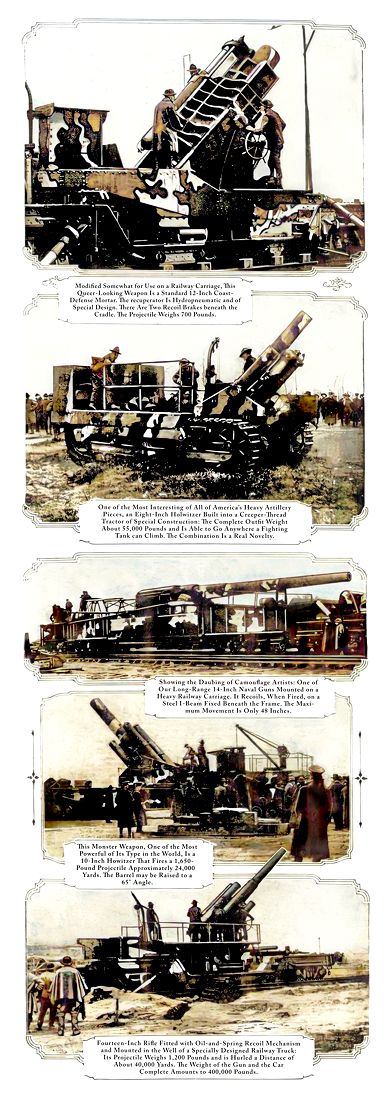
Above A sequence of magazine photographs (black-and-white originally, but cleaned-up and AI colorized here) from an issue of Popular Mechanics, Vol 31 Issue 2 (1919), published with the title Some of America’s Big Artillery Batteries on Mobile Mountings Seen at Close Range. The destruction caused by high tech guns and other killing machines will always be deplorable (as happened earlier this week in Ukraine, when a Russian rocket hit a pizzeria, killing ten civilians, including children). It is a cruel irony that these retouched World War I photographs, enlivened with camouflage patterns, are nonetheless strikingly beautiful as images.

RELATED VIDEO SERIES

Dazzle Camouflage: What is it and how did it work?

 Nature, Art, and Camouflage

 Art, Women's Rights, and Camouflage

 Embedded Figures, Art, and Camouflage

 Art, Gestalt, and Camouflage

iowa trickster makes photographic camouflage / 1919

Antonius J. Viken, Waterloo IA / 1919
Above These three photographs were a reader’s contribution to Popular Mechanics, where they were published in Vol 31 Issue 2 (1919) of that magazine. The photographs were taken by A.J. Viken of Waterloo, Iowa, as examples of makeshift camouflage. Here is the text he submitted—

Practical examples of “camouflage” are shown in these three photographs. In the upper left-hand corner the man has adopted an effective, if somewhat strenuous means of making his appearance blend with his surroundings [by standing on his head, his belt line coincides with the horizon]. To the right, the small rider on the horse’s back is almost indistinguishable against the background of sky and trees, while the lower picture shows how difficult it may be to distinguish such a striking object as a goat.

A.J. Viken (Antonius Johnson Viken) [Skinderviken] was a Norwegian-American photographer. Born in Norway on October 4, 1885, he came to the US in April 1911, and became a naturalized citizen (in Chicago) in 1924. He registered for the draft on September 12, 1918, at Waterloo, where he and his wife Johanna (nee Hansen) Viken lived at 1123 Mulberry Street. As a photographer, he was employed by Louis A. Wangler at 227 East 4th Street in that city. In 1919, when his humorous camouflage photographs were published, his residence was listed as Waterloo, but in later years he also lived in Sioux City IA, Chicago, Jackson Heights NY, and on Long Island, New York. He died in Nassau NY on September 26, 1959.

Among Viken’s associates was photographer and inventor Donald Cameron Biedler (1885-1943). In 1924, both men listed their residence as 864 Buckingham Place, Chicago, in the vicinity of Wrigley Field. 

Beidler was a well-known photographer of wealthy, socially prominent clients (and their children) in Chicago, and later in Manhasset, Long Island NY. Originally from Mt. Pulaski IL, Beidler was a grandson of Jabez Capps, the town's founder. In collaboration with A.J. Viken, he was also invented a special motor-driven children's portrait twin camera, called the Beidler-Viken camera (see below), which they patented in 1925. Although it consisted of two cameras, side-by-side, it was not designed to make stereoscopic images. Instead, it was operated by two photographers, one of whom maintained exact focus on the (squirming) child being photographed, while the other tripped the shutter at the opportune moment. Beidler's Chicago studio was in the Lyon and Healy Building at 64 East Jackson Boulevard, circa 1920. In 1929, he and Viken established the  Beidler-Viken Studios in Manhasset on Long Island. Fourteen years later, Beidler died of a sudden heart attack, while Viken lived until 1959. In Biedler’s obituary, his partner Viken was described as “a man highly skilled in the mechanical end of photography.”

Between the years 1925 through 1936, Antonius J. Viken and Donald C. Beider worked together on a number of technical devices related to photography, including various camera stands (1925, 1930), a camera tiltback adjustment (1931), and their Beidler-Viken camera (1931). But Viken obtained patents independently for other inventions, such as a film hanger (1926), a hood for camera finders (1929), a tripod head (1931), and a film holder and hanger (1936). In 1931, Viken also worked with a bacteriologist, acetone expert, and Chicago physician named Dr. Nathaniel Frutkow (described in a research document as “a somewhat quackish physician specializing in pneumonia”) in patenting a diagnostic table and therapeutic lamp. 


The following is a list, arranged by date, of some (probably not all) of the patented inventions that are attributed to Viken, Beider and Viken, or Viken and Frutkow. Full pdf patent documents can be found online by searching Google Patents.

Stand for camera and the like, 25Aug1925, w/Donald C. Beidler. Film hanger, 4May1926, 1,583,708. Hood for camera finders and the like, 26Nov1929, 1,737,038. Camera and camera stand, 14Jan1930, w/Donald C. Beidler, 1.743,184. Tripod, 10Mar1931, 1,795,747. Tiltback for cameras and the like, 17Mar1931, w/Donald C. Beidler, 1,796,315. Tripod head for portrait camera, 30Jun1931, 1,812,614. Diagnostic table, 15Sep1931, w/Nathaniel Frutkow, 1,823,534. Therapeutic Lamp, 15Sep1931, w/Nathaniel Frutkow, 1,823,535. Camera and the like, 24Nov1931, w/Donald C. Beidler, 1,833,668. Film holder and hanger, 21Jan1936, 2,028,262.

Friday, June 23, 2023

Wednesday, June 21, 2023

camouflage / everyone's doing it, including hollywood

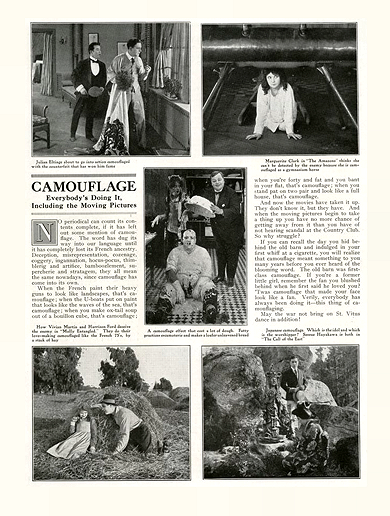
Above A page from Photo-Play Journal, December 1917, p. 25, featuring an article called CAMOUFLAGE: Everyone’s Doing It, Including the Moving Pictures. In an earlier blog post, we reproduced the article’s text, but not this image of the page.

SEE ALSO

Nature, Art, and Camouflage (35 min. video talk)

Art, Women’s Rights, and Camouflage (29 min. video talk)

Embedded Figures, Art, and Camouflage (26 min. video talk)

Art, Gestalt, and Camouflage (28 min. video talk)

Tuesday, June 20, 2023

Ellsworth Kelly in relation to overhead garnished nets

Above Cover of Art News magazine (restored), November 1942, with a photograph of personnel and artillery broken up by the shadows of an overhanging net, in which canvas strips (or other materials) have been interwoven. This was widely practiced during both World Wars, and was sometimes known as "umbrella camouflage." For more information on this technique, see "Kelly and Camouflage" (p. 115) in E.C. Goossen, Ellsworth Kelly. New York: Museum of Modern Art, 1973 (as shown below). Kelly was a US Army camoufleur during WWII.

SEE ALSO

Nature, Art, and Camouflage (35 min. video talk)

Art, Women’s Rights, and Camouflage (29 min. video talk)

Embedded Figures, Art, and Camouflage (26 min. video talk)

Art, Gestalt, and Camouflage (28 min. video talk)


intentional duality for concealment and differentation

Deyan Sudjic, The Language of Things. London: Allen Lane, 2008, pp. 152 and 154—

Camouflage is ostensibly a functional, practical phenomenon, adopted by the armed forces of every country for the purposes of concealment. But over the years it has in fact been transformed into a pattern for differentation. Every national army has its own camouflage pattern, and uses it to tell friend from foe. At the same time that camouflage tries to make its wearers invisible, it is also generating a highly visible signal, intended to identify them to their own side.

patterns in nature as sources of camouflage design

Crazy Lace Agate (Pixabay)
Jean-Philippe Lenclos, as interviewed in Supergraphics: transforming space: graphic design for walls, buildings and spaces. London: Unit Editions, 2010, p. 293—

Q: Your work has alway encompassed strong graphic elements, where does this interest come from?

A: From the start of my studies at the École Boulle, I was fascinated by the graphic elements I found in the urban landscape, such as signs and road markings on the street. The broad stripes used in road markings, for example, are graphical elements that I admired: despite their extreme simplification, I liked their strength of expression. Furthermore, we would go to the aquariums in Paris to draw all sorts of strange fish, which, by their colors and their fabulous “graphism,” made me aware of the extreme freedom of patterns on their bodies. Similarly, the rhythms and forms found on the surfaces of minerals and plants have always inspired artistic creation. | have always observed my surroundings. This brings us also to camouflage used in military hardware. All these observations are at the source of my own research and contribute to a visual mythology that has fed my work.

Bark mimic moth (Pixabay)


Monday, June 19, 2023

concealment of a california aircraft plant during WWII

Above View from above of the spurious suburban neighborhoods that covered the Donald Douglas Aircraft plant in Southern California during World War II. Below in this post is a view of the same structure, as seen from the concealed factory level.

•••

Donald Albrecht, World War II and the American Dream. National Building Museum, and MIT Press, 1995, p 196—

Because the [Donald Douglas Aircraft] plant was dangerously near the coast, its buildings were camouflaged so that enemy aviators would see only what appeared to be an unbroken stretch of suburban subdivisions. Paint was applied to simulate streets and houses, and nearby trees were trimmed to the height of the plant buildings to present a uniform appearance from the air. The Santa Monica factory featured an even more elaborate deception scheme, with canvas houses, fake trees, and camouflage netting covering the entire plant. 


Sunday, June 18, 2023

cubist style condemned as too germanic or boche

Monument by WWI camoufleurs Mare, Süe and Jaulmes
Mary Sperling McAuliffe, When Paris sizzled: the 1920s Paris of Hemingway, Chanel, Cocteau, Cole Porter, Josephine Baker, and their friends. Lanham MD: Rowman and Littlefield, 2016, page 52—

Given the [Paris WWI Victory] parade’s many admirable qualities, it was unfortunate that the work of art meant to commemorate the war’s fallen soldiers at the Fétes de la Victoire came to a bad end. The privilege of creating a memorial for the war dead had gone to three men: the painter André Mare, along with his associates, architect Louis Süe and designer Gustave Jaulmes, all three former members of wartime camouflage units at the front. Their creation [shown above, on July 14, 1919, to the right of the Arc de Triomphe], a huge gilded cénotaph, or tomblike monument, thrust upward in the form of a gigantic bier, its sides decorated with Winged Victories, each backed by a pair of real wings from French warplanes. It had been a mammoth undertaking and was unquestionably meant to be patriotic, but critics fiercely derided it as Germanic or “Boche” art. Mare was known for his Cubist style—indeed, he had been painting French artillery with Cubist designs when he was badly wounded at the front—and “l’affaire du cénotaphe” was immediately perceived by Mare’s supporters as an attack by traditionalists on Cubism. 

RELATED LINKS

Nature, Art, and Camouflage (35 min. video talk)

Art, Women’s Rights, and Camouflage (29 min. video talk)

Embedded Figures, Art, and Camouflage (26 min. video talk)

Art, Gestalt, and Camouflage (28 min. video talk)

Henry Miller on Abraham Rattner as WWI camoufleur

Abraham Rattner and Henry Miller (c1930)
Henry Miller, Remember to Remember. New York: New Directions, 1947, p. 55—

It was in the second battle of the Marne, at Chateau Thierry, while directing the camouflage operations of the 75’s, that [American artist Abraham] Rattner was rendered hors de combat by a concussion which sent him flying into a shell hole. The injury to his back which he then received he still suffers from. Transferred to Camp [de] Souge (near Bordeaux) he took charge of the School of Camouflage which had just been started. All the camouflage work undertaken at the front, and at the experimental field near Nancy, had to do with the utter absence of paint and painted color shapes (known as dazzle painting). His job was to construct actual concealments, structures made of poles, chickenwire netting, garlands of tinted burlap, trees, mud, plants, dummy cannons, and so on. Dazzle painting proved to be too limited a form of deception, ineffective because it did not conceal the basic structural shadow forms. The basis of camouflage was to fool the camera’s eye. 

I mention this phase of his [Rattner’s] war experience because, studying some of his earlier work, I had naively concluded that elements of the camouflage technique had crept into his painting. A quality which I often described as “flou” made these canvases contrast sharply with his later work in which the structural element is prominent. It was perhaps the prepossession with disturbing and often dislocating effects of light and shade which created the association. I am particularly fond of the work of this period in which it seems that his watery nature gains the ascendance, for Rattner is a strange mixture of fire and water. In these canvases the human figure blends with the patterns of nature in a sort of shadowy, translucent marine-scape.…

to camouflage the inside—so I don't know where I am

Roland Davies
Above Roland Davies, WWII British Short Sunderland Flying Boat.

•••

James Thrall Soby, “Genesis of a Collection” in Art In America, Vol 49 No 1, 1961, p. 79—

[Abstract Expressionist artist] Matta [Roberto Sebastián Antonio Matta Echaurren] was born in Chile and therefore presumably exempt from American military service. Nevertheless, he worried about being drafted, and came to me in the Museum [of Modern Art]  to ask whether he could be assigned to camouflaging tanks if he were called up. I explained that this sort of camouflage was less commonly used in the Second World War than in the First because of improvements in aerial reconnaissance. “You don’t understand,” he said. “I don’t want to camouflage the outside of a tank so the enemy can’t find it. I want to camouflage the inside, so I won’t know where I am.”

RELATED LINKS

 Cubism and Camouflage

Cook: The Man Who Taught Gertrude Stein to Drive

Art, Design and Gestalt Theory: The Film Version

Thursday, June 8, 2023

new three-part film series on the Ames demonstrations

Del Ames / The Man Who Made Distorted Rooms / Part 1


officer's headquarters disguised as refreshment stand

Above Photograph of a post-World War I British mobile refreshment stand to which a dazzle camouflage pattern has been applied. Unemployed navy veterans were recruited as cafe staff.

•••

CAMOUFLAGE ARTIST CONVERT LEAR’S POST INTO ROAD STAND in Reading Eagle (Reading PA) September 12, 1941—

Somewhere in Louisiana with the Second Army (AP)—People just walk up and demand service—the place looks exactly like a refreshment stand. But the structure, on closer inspection, turns out to be Lieutenant General Benjamin Lear’s headquarters, artfully camouflaged in cloth.

It solves the problem of placing the directive headquarters of the Second Army in a spot close to telephonic communications without being too conspicuous.

The make-believe soft drink stand can be moved quickly and the general with it. So it violates no secret to reveal this fact as the enemy would have to inspect every refreshment stand in Louisiana to find it.

The job brought to light the work of the heretofore highly specialized group of soliders—the 8th Engineers Battalion, the first camouflage engineer unit ever formed in the army. It is quartered regularly at Fort Belvoir VA and commmanded by Major Ralph Lincoln.

Half-Skilled Workers
Now, the goal of virtually every artist and sculptor taken into the army, the battalion already has 50 per cent of its personnel professionally skilled workers. Each of the nation’s four armies will have similar units within the next few months.

The prize project in camouflage now underway is one by Private First Class Joseph Arasimowicz [1917-], of Pittsburgh, which he calls “new fall colors for snipers’ suits.” This consists of baggy, pajama-like uniforms dyed various shades of reds, browns and green to match the seasonal foliage the sniper picks to hide in. Arasimowicz claims a man in one of these suits is almost invisible at 30 yards.

To reduce worry for soldiers sleeping in the field, Corporal Constantine Dallas [b.1915], of Pittsburgh, who exhibited paintings throughout the East, is trying to figure out how to camouflage a pup tent so airmen overhead can’t spot it.

To cover up an entire sawmill, Corporal F[orest] C. Bess [1912-1977], former Bay City TX landscape gardener, has a crew busy stretching wires from tree to tree, from which bushes are suspended to look like the top of a forest.

The camouflage troops look on these jobs as those of “life savers,” for the reason the less the enemy can see the soldiers the less their chance of killing them.


Tuesday, June 6, 2023

1928 tassle camouflage women's beach wear in france

Anon (signature unreadable)
CAMOUFLAGE FOR SHAPELESS LEGS in The Boston Advertiser, September 9, 1928—

A new Deauville* fashion is for women to wear tassels eight inches long hanging from the kneecap. Maiden ladies must wear pink tassels, while married women wear blue.

* a seaside resort in Normandy in northwestern France

new camouflage method devised by french lieutenant

Above French camouflaged auto cannon (Peugeot 1915), c1916. Wikimedia Commons.

•••

Below I have no idea what this cryptic news article is talking about. It sounds fascinating—if it were only true.

NEW CAMOUFLAGE INVENTED in Greensburg Daily Tribune (Greensburg IN), April 13, 1932—

PARIS (UP)—A French lieutenant who served through the World War [WWI] has just demonstrated the advantages of his new camouflage invention whereby in a short time, a pedestrian or soldier can be transformed into a shock of grain, heap of leaves, a bunch of newspapers, tree stump or what not while walking. His names is George [probably Georges] Félix, and his invention consists of a kind of net that weighs less than a pound, and when not used for camouflage purposes can be employed in numerous other ways.

camouflage, infrared photography, aerial surveillance

Above Page 2 of the Color Feature Section of the Boston Sunday Post, December 27, 1936. It discusses wartime camouflage in relation to infrared photography, and credits the achievements of Albert William Stevens (1886-1949), US Army Air Corps, a balloonist and aerial photographer. 

In a Wikipedia biography, it is noted that (in 1930) Captain Stevens “took the first photograph of the Earth in a way that the horizon’s curvature is visible,” and that, two years later, he “took the first photograph of the Moon’s shadow projected onto the Earth during a solar eclipse…”

Friday, June 2, 2023

WWI Ship Camouflage Artist Puts Bullet Into Brain

Magazine Cover, Arthur Hutchins
CAMOUFLAGE MAN SUICIDE, Naval Artist Puts Bullet Into Brain, in Boston Post, March 27, 1919—

The body of Arthur Hutchins [1887-1919], 32 years old, a talented young artist, who had been missing from his home in Wollaston since early Monday, was found lying in his studio at 52 Dorchester Avenue, Dorchester, yesterday morning, with a bullet wound in his head.

The discovery of his body was made by a boy in the office of Joe Mitchell Chapple, who occupies an office in the same building, and to whom Mrs. Hutchins telephoned yesterday in an endeavor to locate the missing man, after a search for him among relatives and friends had proved fruitless.

Mr. Hutchins had done camouflage work in the service of the navy during the war and since his dicharge a short time ago, had been engaged in making drawings for several magazines. Twice during the past few months he had suffered from attacks of influenza, and his general health had been poor since leaving his work in the navy. A wife and two children survive.


See other accounts of same incident here

Saturday, May 27, 2023

the tragic life of a taxidermist, camoufleur and convict

Above An assemblage by Romainian surrealist Viktor Brauner (1903-1966), titled Wolf Table (using taxidermy bits from a fox, not a wolf), 1939. Other than their shared interest in taxidermy, there is no explicit connection between Brauner and the story of Arthur J. Coleman below.

•••

In the 1921 Indianapolis city directory, Arthur J. Coleman is listed as a taxidermist (he was the curator at the Indiana Statehouse Museum) and a custodian, with the home address of 337 South State Avenue. James A. Coleman, his father, shared the same residence, as did Arthur’s mother, Nancy S. Coleman.

In connection with his museum position, Coleman was allowed to carry a gun, a revolver in a shoulder holster. In May 1920, he and three companions (including an eighteen-year-old woman named Floy Minck) were returning to Indianapolis at night, when Coleman, who was driving, noticed that an automobile tire was blocking the road. When he stopped to look more closely, he saw that a rope was attached to the tire, and that it was being pulled off from the side. He heard voices in the dark, and saw six men approaching the car. He drew his revolver and fired two rounds. The men fled and Coleman hurriedly drove off.

In September 1920, Floy Edna Minck (1902-1976) married an Indianapolis carpenter named Bernard B. Bartlett. Ten months later, Arthur J. Coleman married a young woman (the same age as Minck) named Elizabeth (Libby) Schmitter. In November of that same year, there was a jury trial in Indianapolis, in which Coleman was accused of threatening to kill Bartlett, because of a dispute about “a girl whom Bartlett later married” (presumably Floy Minck Bartlett). The jury could not agree on a verdict.

Coleman’s marriage to Libby Schwitter Coleman was an unfortunate pairing. It was troubled from the start, and they agreed to separate at the end of the first year. Coleman moved to New Harmony IN, on the Wabash River, while his wife lived twenty miles west in Crossville IL. They had lived apart for about a year, when, according to Coleman, he received a phone message and a letter from his wife, suggesting that they talk about living together again.

On April 26, 1923, Coleman (this is based on his account) drove to Crossville, to talk to his wife about reconciliation at a house where she was then staying (apparently owned by someone named Jeff Young). When he entered the front door, he was struck on the head from behind and fell to the floor unconscious. When he regained consciousness (he testified), he was lying in a room, with a revolver in his hand. His own revolver was still in his shoulder holster. Nearby was the body of his dead wife, who had died from three or four bullet wounds. In a 1923 news article, it was noted (without explanation) that the owner of the house, Jeff Young, is “an inmate of a hospital for the insane in Illinois.” It was also claimed that a man (unnamed) who was in the house at the time of the shooting had “left immediately and was away from [that area] for a year.”

Despite Coleman’s account of what happened, he was arrested at the site for his wife’s murder, and jailed in Carmi, the county seat. On the day after his arrest, his mother visited him at the jail. She later said: “When I pulled Arthur’s head down to kiss him, I felt a bump on his head and noticed blood on my hand as I left the jail.” But that injury was not mentioned in the documentation for his appeal.

Coleman said that, while he was in jail for three weeks, awaiting his court appearance, the sheriff brought a “professional hangman” to his cell, to describe the agony of dying that way. He was then taken to a window, and shown where the scaffolding would be built. He was told: “That’s where we will stretch your damned neck.” He was also warned about the horror of being lynched if an angry mob would storm the jail.

Coleman later described his condition, while awaiting his court date, as being “sick and nervous.” Inspite of having no memory of the shooting, he decided to plead guilty (to avoid the death penalty) when he appeared before a judge on May 19. He was then sentenced to life in prison for a term of ninety-nine years. He spent the next 21 years at the Illinois state prison at Joliet as well as on a prison farm.

[So what does any of this have to do with camouflage? Aha, I thought you’d never ask.]

It seems that during his confinement, Coleman continued his interest in taxidermy, including animal camouflage, sculpture, landscape design, and museum exhibitions. Various people, including other inmates, congressmen, and well-known citizens (soprano Mary Garden being one) spoke in favor of his work. He was permitted to open a shop inside the prison, and “because of his genius,” a campaign was started to allow him to be pardoned. It did not succeed.

When the US entered World War II, following the attack on Pearl Harbor, there was a further effort to secure Coleman's release in exchange for advising the army on wartime camouflage. An article described him as “one of the best camouflage artists in the United States.” According to another account, he was “a nationally-known taxidermist and artist” who has “taken up camouflaging” and whose “services were wanted to help camouflage coast artillery batteries.” But that appeal was also denied.

In the end, Arthur J. Coleman was not pardoned, but he was released on parole on July 27, 1944, having served 21 years of his life sentence. Thereafter, he earned his living as a professional taxidermist. As late as April 1960, he owned a taxidermy shop (specializing in “game fish and big game mounts”) in Boca Raton FL. 

Below is the most complete source of information about Coleman's life, consisting of two pages in the Indianapolis Times, September 12, 1932, pp. 1 and 3.


SEE ALSO

Nature, Art, and Camouflage (35 min. video talk)
Art, Women’s Rights, and Camouflage (29 min. video talk)

Embedded Figures, Art, and Camouflage (26 min. video talk)

Art, Gestalt, and Camouflage (28 min. video talk)