Tuesday, September 20, 2011

Two Sides of a Camouflaged Ship


During World War I, it was standard practice in Allied ship camouflage to apply markedly different camouflage schemes to the two sides of any ship. Shown here for example are the port (top) and starboard (bottom) sides of an American freighter, the SS West Galoc, as photographed in 1918.

Sunday, September 18, 2011

Dazzle Camouflaged Duo


These are two British dazzle-camouflaged ships from World War I. At first glance they may appear to be two photographs of the same ship, partly because of position of course, or even two prints of one photo. On closer look, it becomes apparent that not only are these two distinctly different photographs, the two ships and their camouflage schemes are also different. The one at the top is the SS Empress Russia, while shown below that is the SS Osterley. An original print of the top photograph is in the collection of the Merseyside Maritime Museum in Liverpool, England. The printed source for the other image is uncertain, but it seems a safe assumption that both were made in 1918 by a Liverpool photography firm called Stewart Bale Ltd. The Merseyside Maritime Archives and Library houses a Stewart Bale Collection. It is also a safe assumption that the camouflage for both ships was designed by British naval camoufleurs, headed by marine painter Norman Wilkinson. Below is a later photo of the starboard side of the SS Osterley, taken on November 11, 1918 in New York Habor, when the ship was wearing victory flags.


Friday, September 16, 2011

Ghost Army Film Screenings

Click here to see film trailer


For more than six years, documentary filmmaker Rick Beyer has been working on a film about a World War II secret US Army unit that specialized in deceiving the enemy on the battlefield, using inflatable decoys (tanks, trucks, jeeps and so on—including the phony tank shown here), sound effects,  misinformation, and other tricks. Officially known as the 23rd Headquarters Special Troops, they referred to themselves as the Ghost Army. Among its members were a number of people who later became well-known designers and artists, including Ellsworth Kelly, Bill Blass and Art Kane.

The film is nearly finished now. It's being screened at various locations around the country, and a trailer has been posted online. Click above to access that, and to learn about the screenings.

Sunday, September 11, 2011

Camouflaged Olympic

Jerry Vondeling's drawing of the starboard side of the Olympic


One of the sheets of modeling parts


A card model-maker named Jerry Vondeling has produced printable pages (available online) of all the parts of a 1:1200 scale model of the HMT Olympic (sister ship of the Titanic), as it appeared during World War I, adorned in dazzle camouflage. The tiny (9-inch) model is pretty astonishing; and just the uncut cards themselves are wonderfully elegant layouts. Through the courtesy of Currell Graphics, you can download this and other free card models (of all sorts of things) as printable full-color pdfs at this webpage.

Cubism Meets Camouflage

John French Sloan, Cubist Cartoon (1913)


It is usually claimed that cubism began around 1907 in Paris, but it was not widely introduced to the American public until 1913, when an International Exhibition of Modern Art (known as the Armory Show) premiered in New York from February 15 to March 15, then traveled on to Boston and Chicago. On the day after its opening, a headline in the Magazine Section of the New York Times read “Cubists and Futurists Are Making Insanity Pay.” Cartoons and jokes about cubism became epidemic, as in this example by American artist John French Sloan (1871-1951), first published in 1913. Throughout World War I, cubism, futurism, vorticism and camouflage  (dazzle ship camouflage in particular) were said to be related, and were all commonly compared to crazy quilt patterns, harlequin outfits, aerial views of cultivated land forms, and the hallucinations of absinthe drinkers.

Friday, September 9, 2011

Camouflage and Patrick Hughes

Patrick Hughes, Vanishing Venice (2007)


For many years, I've been interested in the paintings (as well as the writings) of British artist Patrick Hughes (1939-). As early as the mid-1960s, he began to paint perspective scenes (such as the one shown above, titled Vanishing Venice), not on flat canvases, but on odd-shaped board constructions, as shown in the line drawing above. In the process, he developed a method of painting he calls “reverspective.” In these mesmerizing paintings, features that appear to recede (visually) in space are in fact physically nearer. As a result, as you walk past one of them, it appears to move in astonishing ways (much as did the rotating trapezoid window that Adelbert Ames II invented in the 1950s). You have to experience this to believe it. Fortunately, there are online film clips as well as other notes about these bewildering images.

What does this have to do with camouflage? It has everything to do with a certain variety of disruptive camouflage, called dazzle painting, which was widely used in World War I for ship camouflage. Much as in Hughes' paintings, in dazzle-painted ships, certain surfaces appeared more distant when in fact they were physically closer. The intention was to interfere with the targeting calculations of the German U-boat gunners in their efforts to torpedo ships.

Hughes' paintings are visual paradoxes, a subject that has interested him since childhood. In fact, my first introduction to him was through his writing, not his art. I recall that the first of his books that I bought was Vicious, Circles and Infinity: A Panoply of Paradoxes (co-authored with George Brecht in 1975). In subsequent years, I also found Upon the Pun: Dual Meaning (1978), and More on Oxymoron (1984). Now, he has come out with a new, more comprehensive look at the same subject (a book I highly recommend) called Paradoxymoron: Foolish Wisdom in Words and Pictures (London: Reverspective Ltd, 2011).

Animal Camouflage


In recent years, Martin Stevens, Sami Merilaita, Roger Hanlon and dozens of other biologists have turned to empirical investigations of the appearance of animals, and especially what is commonly called "adaptive coloration" or natural camouflage.

Hanlon (at the Marine Biology Laboratory at Woods Hole MA) and his associates have focused on the extraordinary capabilities of cephalopods (octopus, squid and cuttlefish), which can rapidly change their appearance in complex, amazing ways—producing disguises beyond belief. There's a wonderful NOVA program about this research called Kings of Camouflage.

In the meantime, Stevens and Merilaita (biologists at the University of Cambridge and Abo Akademi University, respectively) have edited an anthology of recent studies related to this, titled Animal Camouflage: Mechanisms and Function (UK: Cambridge University Press, 2011). ISBN 978-0-521-15257-0. In the volume, there are seventeen papers on the widest range of aspects of adaptive coloration. It amounts to a fascinating survey of a rapidly expanding research area. As the only non-scientist to be represented, I was delighted to see the inclusion of my essay on "Nature's Artistry: Abbott H. Thayer's assertions about camouflage in art, war and nature."

Sunday, August 28, 2011

Dazzle Camouflage Sourcebook

SHIP SHAPE: A Dazzle Camouflage Sourcebook (2012)


"To most people, the word 'camouflage' is synonymous with low visibility, mostly through background matching. But in World War I, when the primary threat to the Allies was the hugely successful torpedo attacks by German submarines (called U-boats), it was decided that low visibility was insufficient, and other approaches to ship camouflage were introduced.

Foremost among these was 'high difference' or 'disruptive' camouflage, a counter-intuitive method in which ships were painted in brightly-colored abstract shapes, which made them conspicuous but difficult to aim at. This is because the torpedo was slow, and the ship was a moving target. To fire a torpedo, the U-boat commander had to 'lead the target'; he had to aim not at the ship, but at the location the ship would reach by a given time. Accordingly, Allied camouflage artists made use of misleading shapes and vivid hues that made it difficult to determine the speed and direction of a distant ship.

This practice (which captured the imagination of the public) became known by various names, including 'dazzle camouflage,' 'baffle painting' and 'jazz painting.' This book is a collection of little-known writings about this and other approaches to ship camouflage during World War I.

Did dazzle camouflage actually work? It is often assumed that it did not because, if for no other reason, there is supposedly no scientific evidence from that era to prove it was effective. But among the documents in this book is confirmation that there were postwar 'laboratory experiments' at the Massachusetts Institute of Technology that suggest that it almost certainly worked."

Thursday, June 2, 2011

Dazzle Camouflage at Rockwell Center

Joyce K. Shiller's article on dazzle ship camouflage on the Rockwell Center website


At the website for the Norman Rockwell Museum, and the Rockwell Center for American Visual Studies, Curator Joyce K. Schiller has posted a wonderful article on World War I dazzle ship camouflage, called The Dazzling Ideas of Science. Included as visual examples are two magazine covers (Popular Science Monthly and Everybody's Magazine) and a US Government poster from that era, each featuring dazzle-painted ships. The identities of only two of the artists are known, Leon Alaric Shafer (1866-1940) and Rockwell Kent (1882-1971). Kent's cover painting for Popular Science Monthly is especially amazing, and is of additional interest because he was a student of Abbott Handerson Thayer (1849-1921), who was among the first to claim that visual art and camouflage were derived from the same principles of vision. While Kent was Thayer's student, he contributed a painting of a copperhead snake, which was used as an illustration in Thayer's now-famous  book, Concealing Coloration in the Animal Kingdom (1909, 1918). The book's author of record was Thayer's artist-naturalist son, Gerald Handerson Thayer. more>>>

Monday, May 9, 2011

Architectural Camouflage in WW2

Cover of Architecture in Uniform. Canadian Centre for Architecture, 2011.


From Jean-Louis Cohen, Architecture in Uniform: Designing and Building for the Second World War. Book and exhibition at the Canadian Centre for Architecture (Montreal 2011) from April 13 through September 18, 2011—

During the Second World War, architects almost completely supplanted painters in the field of camouflage. Studies into the technique had continued uninterrupted since 1918, and camouflage departments now occupied an important place in all the armed forces. more>>>

Sunday, May 1, 2011

Edward Wadsworth | Camouflage

Wadsworth in process of painting (1919)
What a glorious find! In an old issue of the New York Herald on April 20, 1919 (p. 13), we've located a news photo of British Vorticist painter Edward Wadsworth (1889-1949), poised on a stepladder, in process of painting his famous large-scale painting of camouflaged ships, called Dazzle-ship in Drydock at Liverpool (1919), now in the collection of the National Gallery of Canada. The news caption reads as follows—

Mr. Ernest Wadsworth [sic], a British artist, paints a portrait of a camouflaged ship which is a study in Cubism. Mr. Wadsworth, during the war, was in charge of ship camouflaging at Bristol and Liverpool, where he designed the futurist coat in which disguise the Aquitania eluded U-boats.

Not only is the artist misnamed, the facts are probably also skewed. Wadsworth had been handpicked by British head camoufleur Norman Wilkinson to supervise not the design of ship camouflage but the painting of the ships. For the most part, he followed prepared diagrams that were designed, tested and distributed by a small team of artists under Wilkinson's supervision. For further information, see the "Edward Wadsworth" entry in Camoupedia: A Compendium of Research on Art, Architecture and Camouflage (2009).

Saturday, April 30, 2011

Camouflage Artist | McClelland Barclay


From the McClelland Barclay entry in CAMOUPEDIA: A Compendium of Research on Art, Architecture and Camouflage, pp. 40-41—

American illustrator McClelland Barclay (1891-July 18, 1943) [see top right photo above] was originally from St. Louis MO. He studied at the Art Institute of Chicago, then with George Bridgman and Thomas Fogarty at the Art Students League in New York. As early as 1912, his work was often featured in major US magazines, including Cosmopolitan, Saturday Evening Post and Ladies’ Home Journal.

During World War I, he produced recruiting posters for the US government, and worked with William Andrew MacKay in designing ship camouflage for the US Shipping Board.

In the 1920s and 30s, Barclay was widely known as an advertising illustrator, designing posters for the film industry, painting “pin-up girl” illustrations, and developing marketing images for leading manufacturers, the most popular of which were his paintings of sexy models for General Motors’ Body by Fisher sales campaign.

In 1938, he was appointed an Assistant Naval Constructor with the US Naval Reserve. He again worked on camouflage, and in 1940 he obtained a patent titled “Camouflaging” (US Patent No. 2190691) [top left above] for dazzle-like aircraft camouflage. In that year, an article in the New York Times reported that his patent was “for the camouflaging of airplanes by painting the wings with designs that were said to conceal the shape and make it difficult to judge the position of an airplane.” Some of his designs were applied to prototypes and tested [photos of three prototypes are pictured here], but were never actually implemented. During World War II, Barclay continued to experiment with camouflage and to design recruiting posters. Appointed a Lieutenant Commander, he was a passenger on a US Navy vessel that was struck by a torpedo near the Solomon Islands on July 18, 1943.

Also pictured above (in the bottom photo) is an earlier example of dazzle-like airplane camouflage (unrelated to Barclay's work), as published in the New York Herald in 1919, in which it was described as "an upside down flyer" and "a weirdly camouflaged airplane that was a feature in the recent aerial pageant at Hendon, England. Note the dummy landing carriage atop the upper plane and silhouetted pilot's head beneath the fuselage designed to puzzle the spectators as to whether or not the plane is flying rightside up."

additional sources

Friday, April 29, 2011

Alon Bement | Georgia O'Keeffe's Teacher

Camouflage Article by Alon Bement in Washington Times, June 15, 1919


Alon Bement was born in Ashfield MA on August 15, 1876, and died in 1954. He studied in Paris with Leon Bonnat and Jean-Joseph Benjamin-Constant, then went on to teach drawing, painting and design at Columbia University, the Maryland Institute of the Arts, and the University of Virginia. His interest was not just in the practice of art, but in art theory and education as well. In 1921, he wrote an influential book titled Figure Construction, editions of which are still available.

He was especially interested in the design theories of Arthur Wesley Dow, whose book on Composition (1899) was widely used in art schools in the early 20th century. Bement is mostly remembered today as a pivotal influence on Georgia O’Keeffe. She met him in 1912, took courses from him at Columbia University (where Dow was Art Department Head), and was even his teaching assistant. It was Bement who introduced her to Dow’s Japanese-influenced approach to design, which O’Keeffe made use of in her work. As documented by Robinson (1989), “the encounter with Bement, and with Dow’s theories, altered Georgia’s life.”

It is less commonly known that Bement was an active participant in ship camouflage during World War I. He served as a camoufleur for the US Shipping Board, and was probably part of a New York-based camouflage team that was headed by William Andrew Mackay. In addition, in 1917-1919, he published four substantial articles on the artistic underpinnings of camouflage. His involvement in the subject is noted in the biographical entry in Behrens (2009). There is a file of newspaper clippings and other ephemera about him in the Watson Library at the Metropolitan Museum of Art, New York.

Writings by Bement include—
Bement, Alon (1921). Figure Construction: a brief treatise on drawing the human figure for art students, the costume designer, and teachers. NY: Gregg Publishing Company.
___(1917). “Camouflage,” in Teachers College Record 18 No 5, pp. 458-462.
___(1919a). “The Report of the U-16,” in St Nicholas XLVI (November 1918-April 1919), pp. 495-498.
___(1919b). “Tricks by Which You Can Camouflage,” in American Magazine 87 (May), pp. 44-46.
 ___(1919c), “’Camouflage’ for Fat Figures and Faulty Faces,” in Washington Times. American Weekly Section, June 15.

Other sources—
Roy R. Behrens (2009). Camoupedia: A Compendium of Research on Art, Architecture and Camouflage. Dysart IA: Bobolink Books.
Roxana Robinson (1989). Georgia O’Keeffe: A Life. Lebanon NH: University Press of New England.

Thursday, April 28, 2011

O Blazing Tiger of William Blake

Cover illustration of a dazzle-painted ship (1918)


On the cover of the October 12, 1918, issue of The Independent (Vol 56 No 3645) was featured a painting of a dazzle-camouflaged ship (the image shown here is a detail), with no mention of the artist's name. Inside, on the contents page, an equally uncredited subscriber contributed this poetic lament—

O blend of emerald wild and drunken amethyst, 
O wild, hysteric nightmare of psychoanalyst, 
O purple cow of Burgess, O blazing tiger of Blake, 
O neo-impressionist lily, O super-Barnumcular fake, 
What madman out of Potsdam, what loon from Blagovetschenskgeorgsrknlintvoff. 
What Bolshevik or sideshow freak or Greenwich village toff 
Told you that the way to hide was with vivid gobs of blue 
Cutting athwart green triangles and gray gridirons askew 
All done on a painted background of most unearthly hue 
Like a sunrise up at midnight dabbled with evening dew?

Prohibition Camouflage

Prohibition Camouflage


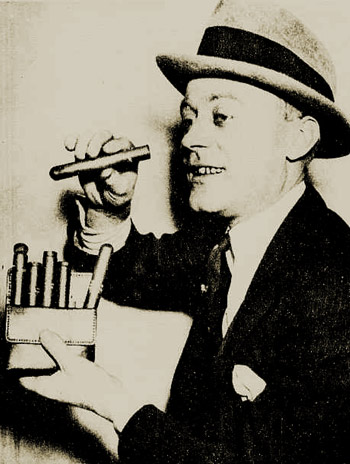
This is a wonderful photograph from a pictorial page in The New York Tribune on April 2, 1922. The title is "A Bit of Prohibition Camouflage," and the caption reads—

"Have a smoke, er, that is, I should say, a drink?" The latest stunt to fool the dry agents is this innocent looking cigar case filled with glass cigars, each corked and containing a real he-drink. Another device, this one for the fair sex, to be put on the market recently is a pair of alcoholic opera glasses, each half of which hold a cocktail of pre-Volstead proportions. Have you seen 'em?

Saturday, April 23, 2011

Camouflage Artist | Ben Kutcher

Ben Kutcher, book illustration


There was a note published in The Bookman, a New York-based literary journal, in 1919 about a Russian-Jewish book illustrator named Ben Kutcher (1895-1967) who served as a camouflage artist in the US Army during World War I (Vol 48 (1919), p. 381)—

Ben Kutcher, a young Russian artist whose illustrated edition of “A House of Pomegranates” has just been published, is now with the camouflage corps at Washington [DC]. 

The full title of the book referred to is Ben Kutcher’s Illustrated Edition of A House of Pomegranates: And the Story of the Nightingale and the Rose (Moffat, Yard and Company, 1918). It consists of earlier writings by Oscar Wilde, with a wonderful introduction by H.L. Mencken, who says of Wilde—

What he did with words was a rare and lovely thing. Himself well nigh tone-deaf, he got into them a sonorous and majestic music. Himself hideous, he fashioned them into complex and brilliant arabesques of beauty. Himself essentially shallow and even bogus, he gave them thunderous eloquence, an austere dignity almost Biblical, the appearance of high sincerity that goes with all satisfying art. In these stories, I believe, he is at his best. 

The full book, including Kutcher’s illustrations (reminiscent of Aubrey Beardsley), is available online here.

A painter, designer and illustrator, Kutcher was born in Kiev c1895 and emigrated to the US in 1902. His papers, which date from 1926 through 1967, are in the Magnes Collection of Jewish Art and Life, in the Bancroft Library at the University of California, Berkeley. According to an online summary, “The collection contains an autobiographical manuscript describing Kutcher's arrival in the US, the early years of his career, his experiences in the US Army, and his associations with artists and designers.” He designed books, bookplates and stage sets.

Other books illustrated by Kutcher include editions of Shakespeare’s Venus and Adonis, Andersen’s Fairy Tales, and The Aztec Treasure House for Boys, in which appeared the illustration on this page. A retrospective of his book illustrations, drawings and paintings was held in the year of his death, April 5 through May 18, 1967, at the Judah L. Magnes Memorial Museum in Berkeley.

Sunday, April 10, 2011

French Camoufleurs in Huge Diorama

Panthéon de la Guerre (1918), detail


From Roy R. Behrens, Camoupedia: A Compendium of Research on Art, Architecture and Camouflage (2009), p. 279—

In 1916, seventeen French artists collaborated on a huge circular diorama, as a tribute to the heroes on the Allied side of World War I. Called the Panthéon de la Guerre, it contained about five thousand full-length figures, with a circular expanse of four hundred feet. It was completed in 1918, and displayed in a custom-made building until 1927. As documented in Mark Levitch, Panthéon de la Guerre (2006), of relevance to camouflage is the fact that among those depicted on its “staircase of heroes” are a handful of identifiable World War I French camoufleurs. In 1927, the panorama was sold to US businessmen and shipped in a ten-ton crate to New York, where it was displayed at Madison Square Garden and at subsequent expositions. In 1956, it was donated to the Liberty Memorial [now the National WWI Museum] in Kansas City MO, where, two years later, selected sections were cut up and reassembled [by Missouri artist and camoufleur, (Leroy) Daniel MacMorris] to make a smaller mural, only sixty-nine feet wide.

WWI Umbrella Camouflage

Disruptive shadows in a Spanish street festival (c1909)


For whatever reason, there was increased interest in the disruptive effects of shadows among photographers, painters and other artists near the close of the 19th century. This is especially evident in the paintings of certain European and American painters. See for example, John Singer Sargent's Breakfast on the Loggia or The Hermit. In some cases, no doubt it was inspired by patterns of disruption in the protective coloration of animals, as confirmed by demonstrations by Abbott H. Thayer and others. During World War I, comparable techniques were adopted for concealing from aerial observation personnel and equipment on the ground.

According to James E. Edmonds (in History of the Great War, Vol 1, London: Macmillan, 1932, pp. 83-84), “Concealment from the air was first attempted by the use of canvas sheets painted to represent the ground as seen from an airplane. Experience proved these to be heavy to erect and difficult to maintain in position. On the suggestion of Mr. [Solomon J.] Solomon, they were replaced by a lighter and more manageable article [called “umbrella camouflage” or "garnished nets"], in the form of old fish nets or wire netting, garnished with tufts of painted or dyed raffia (gardener’s bast). For the Somme thousands of rolls of wire netting were supplied to the divisional engineers who, when raffia was lacking, wove grass into it. In the course of time all batteries were equipped with these overhead covers. As the demand increased and the supply of raffia became inadequate, canvas strips were substituted for it, and were found to be less flammable.”

But apparently long before the war, there was a civilian tradition of doing more or less the same, as shown here by this photograph from a 1909 issue of The Strand Magazine (p. 719) of a Spanish street festival. Submitted by Edmund Pöhler of Barcelona, the article states: "This strange effect, produced by sunshine and shade, is a common scene in Spanish towns, where, once every year, about eight days are set apart as the Fiesta Major (Grand Holidays). During this period each district vies with its neighbor in adorning the streets. Dancing at night to the music of hired musicians, under the fantastic canopy overhead, illuminated by the many lights of every open window and door, invites one and all to participate in the gaiety and animation of the scene."

Saturday, April 9, 2011

WWI Ship Camouflage Teams

 
Location of WWI Ship Camouflage Teams © Roy R. Behrens
When the US entered World War I, the design of all ship camouflage, including that of civilian commercial (merchant) vessels was taken over by the US Navy. The Navy's camouflage section, consisting of two subsections, was administrated by architect Harold Van Buskirk. Physicist Loyd A. Jones was put in charge of a science-based Research Subsection at Eastman Laboratories in Rochester NY, while artist Everett Longley Warner was in charge of a team of artists at a Design Subsection in Washington DC. In addition, ten groups of civilian camoufleurs were set up at various US ports, as shown by this map. Using lithographic painting plans that were prepared by Warner's team, it was the responsibility of these civilian artists to apply dazzle camouflage schemes to the actual ships. There is a post-war description of this in Everett L. Warner, "Fooling the Iron Fish" in Everybody's Magazine. Vol 41. November 1919, pp. 102-109—
 
[Early in the war] An arrangement was reached with the United States Shipping Board whereby all existing types of camouflage were to be discontinued. The Navy undertook to supply dazzle designs for all American vessels and the Shipping Board agreed to organize and maintain at the ports a force of camoufleurs whose duty it should be to supervise the application of these designs to the vessels.

The Navy worked so quietly and under such close censorship that few people were aware of the leading part that it was playing in the work. There exists even today a very widespread impression that the designs which the Shipping Board camoufleurs applied to the ships originated with them. This belief is entirely without foundation. All designs were supplied by the Navy, and while it is true that at several of the ports the camoufleurs built small testing theatres copied after ours and did a certain amount of experimental model painting, this was wholly for their own education or relaxation, and none of the dazzle designs so made was ever authorized for application to any ship.

Sunday, April 3, 2011

WWI Camouflaged Machine Guns

Anon. WWI-era magazine photo.


What a wonderfully clear, sharp image this is of a WWI transport wagon for two machine guns, covered with a disruptively-colored camouflage tarp. At the time, high contrast disruptive patterns (intended to interrupt the continuity of a shape) were applied to land vehicles as well as to ships. See dazzle camouflage.

Metamorphosis and Camouflage | Visual Pun

Anon, a 19th-century visual metamorphosis


In the Victorian era, there was considerable emphasis on and appreciation of wit, including visual metamorphosis (as in this example), consisting of sequential drawings in which one thing evolves into another. Here, in a series of seemingly logical steps, a musician is transformed into a stringed instrument. This process has everything to do with what is commonly known today as creativity or metaphorical thinking (cf. Arthur Koestler's The Act of Creation), but it also pertains to camouflage, which frequently works by disguising a thing so that it resembles another, called mimicry. Perhaps the best book on natural mimicry is Wolfgang Wickler, Mimicry in Plants and Animals. NY: McGraw-Hill, 1968.

Thursday, March 10, 2011

Camouflage and Everett Warner's Cousin

I recently found an old memoir by an American clergyman named John B. Ferguson, a graduate of Miami University of Ohio (1903), who was pastor for fourteen years at two Presbyterian churches in Indiana, in the towns of Howe and Hopewell, then later at the American Union Church in Manila in the Philippines. During World War I, he also served in France with the YMCA, an experience that he later described in Through the War with a Y Man (1919). It turns out that Ferguson was a relative of Everett Longley Warner, an American Impressionist painter who played an especially pivotal role in the development of US Navy ship camouflage during that war. In the book, Ferguson writes this about the day of his departure from New York Harbor for Europe on the SS Chicago (pp. 46-47)—

As was the case with most boats we did not sail immediately. It was exceedingly interesting to see all the camouflaged ships in the harbor. My artist cousin, Everett Warner, very graciously came to see me off. When I saw him come on deck, my first question was, "How did you get on this boat without a passport." He showed a little silver badge which meant the naval board, and I saw that ranks and badges were very important things in the army. From him I took my first lesson in the interesting art of camouflaging. A big freighter near us was all in gray and black. He told me how important it was to have the funnels properly done. There were many theories about it, and I suppose the cubists had their ideal opportunity, for the color scheme on some of the boats seemed to the layman's eye about the most conspicuous mark on any except a painted ocean.

Tuesday, March 8, 2011

Henry Adams on Art and Camouflage


[The images above are three stages in an illustration of a copperhead snake that first appeared in Concealing Coloration in the Animal Kingdom (1909) by Gerald Handerson Thayer, the son of American painter and naturalist Abbott Handerson Thayer, aka "the father of camouflage." As originally published, a cut-out overlay silhouette (center panel) could be placed on top of the painting of the snake in a forest floor setting, thereby revealing its location. The original painting, like many of the book's illustrations, was the collaborative work of Thayer, his son and his students, including (for this one) Rockwell Kent. Thayer's book in its entirety is available online through Google book search.—RB]


Ornithology, Infantry and Abstraction, by Henry Adams. Art and Antiques Magazine (March 2011). Modern camouflage was invented by artists who studied nature, and camouflage in turn influenced some of modernism's biggest breakthroughs. more>>

Tuesday, December 7, 2010

Horse Carcass Camouflage


Pictured above are US Government photographs showing the same subject from two camera angles. The top photo appears to be the carcass of a dead horse on a World War I battlefield, but the bottom photo shows that it is only a papier mâché simulation of a horse carcass, with a sniper hidden inside.  This kind of camouflage was described in a war memoir by an American soldier named Samuel Benney Benson titled Back From Hell (Chicago: A.C. McClurg, 1918)—

The system of camouflage which the French have worked out in this war [World War I], is something new also. The word has come to mean in America "dodging," "deception," "bunk," or anything that is not out in the open and above board; and that is just what camouflage means in the war in France. It is a method by which things are made to appear to be what they are not, for the purpose of fooling the enemy. It makes an artificial thing seem to be a natural thing so that it will not excite suspicion and draw his fire. When the French place a battery of guns which naturally they do not want put out of commission by the enemy's guns, they have the camouflage artist get busy with his paint and canvas and create a whole lot of little trees or bushes just like the ones which grow in the ground and then under cover of darkness when the enemy can't see them, or when his attention is distracted, they plant the trees, place the guns behind them, and they have a concealed battery.

Snipers are also often hidden in this same kind of a manner. The camoufleur with his magic art of scenery makes a dead horse. He has his head stretched way out on the ground and his legs pointing up in the air, stiff and stark. A great hole or chunk has been torn out of his body, but as it happens, it is never right through the middle part of him because this would not leave protection for the sniper. The horse "conveniently" had the shell strike him on the side. He is placed wherever he will do the most good in the night time and Mr. Sharpshooter, with his noiseless rifle and plenty of ammunition and one day's food, crawls in behind him. There he stays till daybreak. Yes, and a long while after. He must stay there all day long until darkness again draws down a curtain of safety about him, for if he attempted to move out in daylight some sniper or machine-gun artist would instantly pick him off. If he lays low till dark he may fool them and get away all right.

But the camera sometimes discovers things which the human eye would not detect, and the camera is always busy. The air flier might soar above a spot in the enemy's lines and not notice anything wrong or see that there was any object in addition to what was there the day before, but when he snapped the shutter of his camera and the photograph was developed, by comparing it with yesterday's photograph of the same place, he might see that there was an extra horse's carcass lying there. Now he knows there was no cavalry charge through the night, and so he becomes suspicious. Consequently the horse is watched. Perhaps in time, some one sees the man's arm protruding a little, or perhaps a man is picked off without any apparent cause.

 Just for luck the enemy takes a shot at the old dead horse and suddenly a man rises and tries to run back. But he stumbles and falls. He is killed. Perhaps he has accounted for a half dozen Boches during the day and the Frenchman dies happy. That's what he's there for, to sacrifice his life for France in weakening Germany's cruel hold upon his country.

…Very often they camouflage roads with evergreen trees so as to hide the view of the motor lorries and camions which are so essential in taking supplies and ammunition up to the front. An old forlorn and battered gun may camouflage a fine new field piece, and sometimes a weatherbeaten, broken-down piece of farm machinery may be counterfeited in order to hide an observer, a listener, or a sniper. Such a man must be of a stout heart and not afraid to go over the Great Divide for it is full of hazard. If he is discovered it's all over for him.

Saturday, December 4, 2010

Camouflage as Hide and Seek

According to what I’ve been able to find, Reginald John Farrer (1880-1921) was an accomplished British gardener, writer and botanist, who wrote a half-dozen books on plants and related subjects, notably My Rock Garden (1907). During World War I, that Reginald Farrer was apparently living in Asia (China, Tibet, Burma), so it seems unlikely that it was the same person who was sent to France by the British Department of Information to write about life in the trenches. The wartime letters of this latter Farrer (is it the same person?) are highly unusual views of the Front and were published as The Void of War: Letters from Three Fronts. London: Constable and Company; Boston: Houghton Mifflin, 1918. They include this lengthy passage in which he talks about camouflage (pp. 67-68)—

The real thing about the human side of the war is the sheer fun of it. In certain aspects the war is nothing but a glorious, gigantic game of hide and seek—camouflage is nothing else. It is not only the art of making things invisible, but also of making them look like something else. Even the art of inconspicuousness is subtle and exciting. What glory it must be to splash your tents and lorries all over with wild waggles of orange and emerald and ochre and umber, in a drunken chaos, until you have produced a perfect futurist masterpiece which one would think would pierce the very vaults of heaven with its yells. However, as pandemonium produces numbness in the ear, so I suppose a Lost-Dog’s-Home-at-Battersea in chromatics does deaden visibility in a dun-colored ensemble.

But disguise is an even higher branch of the art: you go on to make everything look like something else. Hermit crabs and caddis worms become our masters. Down from the sky peers the microscopic midget of a Boche plane: he sees a tree—but it may be a gun: he sees a gun—but it may be only a tree. And so the game of hide and seek goes on, in a steady acceleration of ingenuity on both sides, till at last the only logical outcome will be to have no camouflage at all. You will simply put out your big guns fair and square in the open, because nobody will ever believe, by that time,  that anything really is what it looks like. As far as the guns go, the war is developing into a colossal fancy dress ball, with immunity for the prize: wolves in sheep’s clothing are nothing to these gentle shepherdesses of the countryside. The more important they are, the more meekly do they shrink from notice under dominos of boughs or sods, or strawberry-netting tagged over with fluffets of green and brown rags. And sometimes they lurk under some undiscoverable knoll in a coppice, and do their barking through a little hole from which you would only expect rabbits, not shells. It must be the most endless joy to go on planning these disguises. One would lie awake at night wondering how to make one's gun look like a dog kennel, or a dog kennel conceal a gun. But, of course, the individual camouflage is even more exciting yet.

…And, of course, this fun sense of his [the individual] has full play in this new warfare. It is all "I spy," on terms of life and death: the other fellow must not spy, or you hear of it instantly, through your skull. Think how it must sharpen up the civilization-sodden intelligence of a man, to have to depend for dear life on noticing every movement in a bush and every opening in a bank. Now we are getting back with one hand what we had lost by giving up the other to machinery. We are growing to make the best of both worlds, the mechanical and the human, without giving up our mental balance by relying exclusively on either. I only wish I could give you an idea of the devices and ingenuities that these grown-up hide-and-seekers have elaborated. All sorts of ludicrously simple things, the more ludicrously simple the better.

Every blank-faced trench rampart of sandbags has its hidden eyes—eyes perfectly wide awake all the time, and winking at you wickedly with a rifle. But for your life you could not spot them, until you had had weeks of training, and learned the real meaning of every tiny unevenness or discoloration or bit of darkness. And even then you have to learn to guess which of these is harmless—so as to blind the others with your own fire. Or there is an innocent, untidy, earthy bank, a dump of old boots and tins and bottles and teapots without spouts. But any one of those forlorn oddments may also be the eyelid of a rifle. Only you do not know which—until you have found out! In the beginning of the war you did not find out. Everything was neat and tidy and civilized and well arranged: so you merely got killed.

It has taken us long experience to reconquer the primitive shifts and cunning of our ancestors. What would have seemed utterly childish to any soldier a few years since, is now his essential wisdom. You are bound to have eyes in every eyelash, and a wireless at the end of every nerve, if you are to come out a prize winner in this game of hide and seek. Even in this, the most mechanical and vast of all wars, it is the individual red Indian who ultimately wins.

They do not go to Napoleon and Wellington nowadays for inspiration, they go to the praying mantis and the leaf butterflies. Look at those trees in that avenue—that third tree in particular, that projecting bough, now botanically and aesthetically accurate. All is motionlessly silent: rural peace pervades the whole world. And, if you meditate on this a tithe of a second too long, out of that bough, most improperly and unexpectedly, there comes a little streak of fire through your heart. You must not put your trust in the tranquility of nature nowadays, any more than in princes or any child of man. Who knows whether that molehill really is a molehill? That corn stook among the others, does it really look quite as a normal corn-stook should? What a scandalously untidy sight that heap of potato peelings and old sacks!—until suddenly it shoots.

I tell you, it is wonderful and fearful, this game, in its fascination—keeping you on razor's edge and razor's edge of vital uncertainty. It is the very apex of sport; it makes big game shooting into a croquet tournament. All the time you are playing for your life with eyes and brains for counters. It must be a potent illumination and stimulant for the human mind—which five years ago would almost have wanted a policeman to help it across the street, or a moving stairway to get it up to the second floor of Harrod's…

Thursday, November 25, 2010

Jean Cocteau on Camouflage

During World War I, the shoulder patch insignia of the French Army's camouflage corps was a chameleon. Related to that, this is a diary entry on July 16, 1919, by Folies Bergères dancer Liane de Pougy in My Blue Notebooks: The Intimate Journal of Paris's Most Beautiful and Notorious Courtesan (Tarcher, 2002)—

One of Jean Cocteau's jokes. Talking of a chameleon, he said: "Its master put it down on a tartan rug and it died of over-exertion."

Wednesday, November 24, 2010

Puzzle Picture

Above An embedded figure drawing or puzzle picture from a turn-of-the-century issue of The Strand Magazine (c1907). Finding the footman is a matter of shifting attention or emphasis, at which point his figure emerges from what had formerly been the (back)ground.

Sunday, November 21, 2010

Embedded Figure Camouflage

Drawings for US Patent No. 2,670,961, by Charles E. Winters (1954)
Shown here are the drawings for a patented game-like invention called "Puzzle," devised by Charles E. Winters of Crawfordsville IN. US Patent No. 2,670,961 (1954). It's essentially about the detection of embedded figures (or camouflaged figures), in which a shape is hard to see because it is subdivided by other shapes (called figure disruption or dazzle) and/or because its context (or background) is distracting and complex. As seen in the lower drawing, in this game, simple drawings of animals become a challenge to detect when a larger complex drawing (printed on a transparent sheet acetate) is superimposed on them.

Saturday, November 20, 2010

Camouflage Artist | Clinton Adams

The following are excerpts from an Oral History Interview with American artist and art historian Clinton Adams, who served as a camouflage artist in World War II. The interview was conducted by Paul J. Karlstrom on August 2, 1995, at Adams' home in Albuquerque NM for the Archives of American Art. The entire interview is available online here

Clinton Adams: But filling in the wartime years, I was fortunate in that I did not go overseas, was in this country. If I had just not been given one transfer that happened out of chance, I wouldn't be in this country now or anyplace else, because the Engineer Camouflage Battalion that I was assigned to landed in Normandy on D-Day Plus One, and took about 85 percent casualties. But there were several other artists, as you might imagine, in Engineer Camouflage Battalion, because they recruited artists for utterly irrelevant reasons. They had a notion that camouflage had something to do with the visual arts. It was an interesting unit.…

Paul J. Karlstrom: I want to ask you a couple of questions, if I may. You mentioned other artists in the Engineer Camouflage group. Any that would be of special interest to us?

Clinton Adams: Two of significance. Jesse Reichek, who became my closest friend, and certainly you know Jesse and you know Jesse's work. Jesse was in the unit from early on. Jesse's a very, very willful character, shall we say. Jesse was not willing to put up with regulations quietly, and one of my jobs as assistant adjutant was to keep Jesse from being court martialed at one point. But we've had a close, close friendship over now, what, fifty years. When we get together, we argue about art and the discussion picks up just where it left off the time before. And Marshall Fredericks, who was a member of the National Academy, rather conservative traditional sculpture, was one of the company commanders. There were several fine theater people. George Izenour, the theater designer, a very prominent theater designer who did a lot of the design of Lincoln Center, etc., etc., was in the unit, and there were a number of others. Karl Bruder, who was a professor of theater in Kansas. A great number of people who eventually wound up one place or another in the arts. The only one I've kept up closely with is Jesse Reichek and Henry Klopot, K-L-O-P-O-T, who lives in Hollywood, and was one of the chief lighting designers for the studios over a period of years.

Camouflage Artist | Eric Sloane

Cover of Eric Sloane, Camouflage Simplified (New York: Devin Adair, 1942).

Eric Sloane (1905-1985) was a widely-known American artist and author, who wrote and illustrated (with exquisite pen-and-ink drawings) a 60-page overview of the principles of camouflage, titled Camouflage Simplified (New York: Devin Adair, 1942). It's a challenge to locate a copy to buy (the lowest price I found online a few minutes ago was $300), but it should be available through interlibrary loan, since, according to WorldCat, about 90 US libraries have it in their collections. Here's more about Sloane from a biographical article in Camoupedia: A Compendium of Research on Art, Architecture and Camouflage (p. 362)—

[Sloane's] name at birth was Everard Jean Hinrichs. In 1919, his family moved to Long Island, where he became friends with his neighbor, the typographer Frederic Goudy, who taught him hand-lettering. He then studied briefly at the Art Students League (where he was influenced by John Sloan, whose name he would adopt c.1934, while adding an e at the end), and at the New York School of Fine and Applied Art, where he was enrolled as a “graphic advertising major.” Due to poor attendance and failure to submit his work, he never completed his courses, yet he decided soon after to enroll at Yale University, where he lasted only several months. In the 1930s, through his interest in flying, he became friends with aviator Wiley Post, in the process of which he decided to paint “cloudscapes.” He studied meteorology at MIT, and later, during World War II, served with the Army Air Force as an instructional interpreter of complex flight-related terms. 

Camouflage Artist | Perkins Harnly

The following is an excerpt from an Oral History Interview of American artist Perkins Harnly (1901-1986), who served as a Depression-era Works Progress Administration muralist and, during World War II, as a camouflage instructor. The interview, which took place on October 15, 1981, was conducted for the Archives of American Art by Estil Pennington and Lynda Hartigan. The entire interview can be accessed online here

Mr. Harnly: …when the WPA broke up—when the war was declared, you see—we were put on defense projects. I was put in aluminum.
Ms. Hartigan: And you taught camouflage design?
Mr. Harnly: Yes. I was an…instructor of officers. Yes, I certainly was. One of my officers in camouflage was William Pahlmann, who was the famous interior decorator. Gene Davis, who was the art [director] of [Good] Housekeeping Magazine. I had big shots.
Mr. Pennington: Leslie Cheek, did you work with him?
Mr. Harnly: I know the name, I know the name. I know the—I can't place him at the moment. But they gave me the project of the people who had much experience, much background, and all that. And we went to Fort Belvoir, Virginia, the place where Homer Saint-Gaudens was, a relative, son of the great sculptor, I think.
Mr. Pennington: Yes.
Mr. Harnly: Well, anyhow, he was the head of this thing, of camouflage, until the air bombing of Cologne. It took 22,000 planes to mow the city down. All but the cathedral, they left the cathedral. And after that, camouflage, as we knew it, was not of any use. They used tactical camouflage after that.

Thursday, November 11, 2010

Ernie Kovacs and Camouflage

Ernie Kovacs' invisible girl friend


American comedian Ernie Kovacs (1919-1962) was widely known in the late 1950s and early 60s for his off-beat television programs that combined sight gags with unorthodox uses of technology. He often made use of psychology, especially visual perception, including camouflage. The segment shown here begins with a series of three full-screen signs that read: "FELLAS! Lonesome? Like a girl of your own?"; "Someone your wife can't see because she's INVISIBLE?"; and "Then—send for your INVISIBLE GIRL FRIEND!" This was followed by scenes from a living room, in which a transparent woman gradually disappears as she undresses. In the final frames, the only things visible are a hat, a glove, her dress and high-heeled shoes.