Showing posts sorted by date for query pennoyer. Sort by relevance Show all posts

Thursday, June 27, 2019

WWI Camouflage Artist | Bror Julius Olsson Nordfeldt

B.J.O Nordfeldt (c1900)

Above One of my favorite photographs is a portrait of Swedish-born American artist Bror Julius Olsson Nordfeldt, ca. 1900 / unidentified photographer. Bror Julius Olsson (B.J.O.) Nordfeldt papers, Archives of American Art, Smithsonian Institution.

Nordfeldt designed ship camouflage for the US Shipping Board during World War I, in San Francisco. He was a fascinating character, with an all but unbelievable range of interests and capabilities. The newspaper article below provides an account of the wartime camouflage work he did with William Penhallow Henderson, Maynard Dixon, A. Sheldon Pennoyer, Edgar Walter and others.

•••

SHIP CAMOUFLAGE in Albuquerque Journal (Albuquerque NM). January 12, 1919—

Most delightful as well as instructive was the talk on “Ship Camouflage,” given by William Penhallow Henderson at the new museum [New Mexico Museum of Art in Albuquerque] on Tuesday evening before a really distinguished audience that included Lieutenant Governor and Mrs. [Benjamin] Pankey and other state officials, playwrights, poets, painters, scientists, educators and the social set. Col. Ralph E. Twitchell presided and cleverly introduced the speaker who illustrated his talk with the model of a camouflaged ship made by [Bror Julius Olsson] Nordfeldt, and with blackboard drawings. Mr. Henderson and Mr. Nordfeldt had been in charge of the work of camouflaging the ships on the Pacific coast at San Francisco and shipyards north and were so successful in developing the technique and devising patterns that their work became standard for the rest of the country. It was a significant statement that up to two weeks before the signing of the armistice not one ship camouflaged according to the method adopted was sunk. Mr. Henderson described how the first theory adopted, that of low visibility, proved unsatisfactory because of its limited application. It was followed by a brief period of experiments with a transition method of “impressionism,“ which was succeeded by the successful “cubist” or “distortion” patterns. Four basic patterns for that method were adopted on the Pacific coast, a combination of several of these being developed into the most successful patterns by Mr. Nordfelt and Mr. Henderson. The latter described how practical steps were taken to save the government large sums on paint and labor developing an efficiency which permitted them to accomplish with three men what it elsewhere took sixty to do. It was explained that the enemy submarine made three observations in order to get the range for the torpedo, these observations being taken at a distance of from 2,000 yards to several miles. For the last and nearest observation only eight seconds, at the most, were available to the submarine observation officer and if he was deceived by the camouflage pattern as to the location of his third sighting point, the location of the vitals of the ship and its superstructure, then the object for which the ship was camouflaged was attained for the torpedo was certain to go wild or at the most would strike only such portion of the ship as was amply protected by bulkheads. Mr. Henderson made his talk doubly interesting by the relation of incidents at the shipyards and detailed explanations of the science of camouflage which gave his listeners a far different idea than most of them had formed by casual reading.

Below William Penhallow Henderson and his wife, the writer and editor Alice Corbin. While they were living in Chicago, she was an associate editor for Poetry Magazine, while he was commissioned by Frank Lloyd Wright to design murals for Midway Gardens. He also designed the scenery for an innovative Chicago-based stage production of Alice in Wonderland.* In 1916, when it was determined that his wife Alice had tuberculosis, they moved to Santa Fe NM. After the US entered the war in 1917, Henderson began to work on ship camouflage in San Francisco.

* A dramatic screenplay script rendering of Alice in Wonderland by Alice Gerstenberg; Actress Vivian Tobin; copyright A. C. McClurg & Co., Chicago 1915, Produced by The Players Producing Company of Chicago (Aline Barnsdall and Arthur Bissell), at the Fine Arts Theater, Chicago, 2/11/1915. 

RELATED LINKS    

Dazzle Camouflage: What is it and how did it work? /  Nature, Art, and Camouflage / Art, Women's Rights, and Camouflage /  Embedded Figures, Art, and Camouflage / Art, Gestalt, and Camouflage /  Optical science meets visual art /  Disruption versus dazzle / Chicanery and conspicuousness /  Under the big top at Sims' circus

Saturday, August 26, 2017

Frank Lloyd Wright & William Penhallow Henderson

Frank Lloyd Wright and Mason City (2016)
Until recently, we were unaware of the link between architect Frank Lloyd Wright and an admired but lesser-known painter named William Penhallow Henderson (1877-1943).

Most people think of the latter as an artist who was closely tied to artists who settled in Taos NM around the turn of the century. But he was also a capable architect, muralist and furniture designer, in a style that was in keeping with the American Arts and Crafts Movement.

Henderson was born in Massachusetts, but grew up in the Midwest. In the beginning years of the 20th century, he lived and taught in Chicago, at which time Wright was living there. In 1914, while Wright was completing the Midway Gardens on the city’s southside, he commissioned Henderson to design a mural for that project. But when Wright (apparently) objected to the end result, Henderson backed out and the mural was soon painted over. While remaining in Chicago, he designed the costumes and scenery in 1915 for a theatrical production of Alice in Wonderland by the Chicago Fine Arts Theatre.

For health reasons, Henderson and his wife relocated to Santa Fe in 1916. The following year, soon after the US entered World War I, a new system of disruptive ship camouflage was adopted by the British Admiralty and, soon after, the French and Americans did the same. In 1918, Henderson was appointed to serve as a camouflage artist in San Francisco.
USS Western Star (1918) in dazzle camouflage

There he was part of a team of civilian artists who painted dazzle camouflage schemes on merchant ships. As we have blogged previously, the artist in charge of that particular team was Edgar Walter (1877-1938). But Maynard Dixon was also involved, as were (Swedish-born) Bro Julius Olson Nordfeldt, A. Sheldon Pennoyer, and others.

When Henderson returned to Santa Fe with Nordfeldt, his friend and fellow camoufleur, a brief article appeared in the Albuquerque Morning Journal, on December 22, 1918, p. 2, with the headline CAMOUFLEURS IN SANTA FE—

William Penhallow Henderson, the noted artist, who has served the shipbuilding board on the Pacific coast as camoufleur, has returned to Santa Fe, with O. Nordfeldt, and etcher and artist of fame, who with Mr. Henderson had charge of the camouflage department at San Francisco. They perfected this art to such a point that the camouflage inspectors in the east compared that of the eastern shipyards with that at San Francisco, Los Angeles and San Diego as standard. Mr. Nordfeldt will remain in Santa Fe over the winter. The two artists brought with them models of camouflaged ships which will be placed on exhibit in the new museum [New Mexico Museum of Art] and will illustrate a museum night talk.

An earlier article about the camouflage efforts of West Coast artists, titled SEEKS TO MAKE ARMY INVISIBLE, appeared in The Daily Ardmoreite (Ardmore OK) on July 11, 1917, p. 1—

San Francisco, July 11—The western division of the American Camouflage [Corps], an organization of artists which has for its object the recruiting of men who can assist in rendering the forces of the United States army and navy invisible to the enemy, was organized here [at the California School of Fine Arts] last night by artists and scene painters.

By the use of color combinations in small squares, map-like patches and other methods, United States battleships have been rendered more nearly invisible than those of any other nation, the members said today…

A month later later, yet another article on SAN FRANCISCO ARCHITECTS AND ARTISTS AS CAMOUFLEURS appeared in Western Architect and Engineer August 1917, p. 58, about which we posted an earlier blog.

Saturday, August 30, 2014

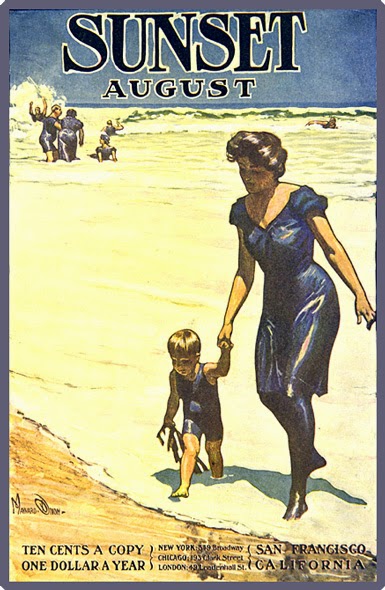
Maynard Dixon, Dorothea Lange & Camouflage

Maynard Dixon, Sunset magazine, cover illustration
Recently we were able to watch on Public Television a two-hour American Masters film about the life of American photographer Dorothea Lange (1895-1965). Like so many people, we are well-acquainted with Lange's documentary photographs, notably her Depression-era images for the Farm Security Administration (FSA). But somehow we hadn't remembered that her first husband (for fifteen years) was the Southwestern Modernist painter Maynard Dixon (1875-1946).

Born in Fresno CA, Dixon was descended from a prominent Confederate family from Virginia. He may have been related to the British surveyor Jeremiah Dixon, whose name is one half of the boundary that divides North from South, the so-called Mason-Dixon Line. It is also sometimes claimed that the nickname "Dixie" for the South was derived from the same family name. Whatever, Maynard Dixon is not typically linked with the South, but with the Southwest and West, especially New Mexico and California.

For the moment, we haven't found any evidence that Dixon was a camouflage artist. But we have found indications that some of his artist-friends were camoufleurs in San Francisco during World War I, and that in 1917 he was among the founding members of the American Camouflage Western Division in San Francisco. Although he apparently did not design camouflage, his awareness of the practice can be assumed by the fact that among his associates were Santa Fe-area artists William Penhallow Henderson (1877-1943) and (Swedish-born) Bror Jullius Olsson Nordfeldt (1878-1955), both of whom were ship camoufleurs in San Francisco. For more information on Maynard Dixon, see Donald J. Hagerty's The Life of Maynard Dixon (Smith Gibbs, 2010).

Cover of The Life of Maynard Dixon (2010)


The American Camouflage Western Division was a spin-off of the New York-based American Camouflage group (aka the New York Camouflage Corps), founded by Barry Faulkner and Sherry Fry. The purpose of the Western branch, whose designated founder was A. Sheldon Pennoyer, was the recruitment of "painters, sculptors, scene painters, house painters and all others interested in the application of protective coloration and devices for the deception of enemies and the rendering invisible of our own forces." That text excerpt appeared in the August 1917 issue of Western Architect and Engineer, in an article titled "San Francisco Architects and Artists as Camoufleurs" (p. 58), as did a roster of those who had by that time joined the Western camouflage unit, among them Maynard Dixon. Here's the list—

Chairman: Mr. Arthur Brown, architect. Assistant Chairman: Mr. Bruce Nelson, artist. Secretary: Mr. A. Sheldon Pennoyer, artist. Executive Members: Mr. John I. Walter, president, San Francisco Art Association; Mr. Edgar Walter, sculptor; Mr. E.S. Williams, scene painter Alcazar theatre; Mr. Ralph Nieblas, scene painter Columbia theatre; Mr. Warren C. Perry, instructor in architecture, University of California; Mr. Maynard Dixon, artist; Mr. Lee [Fritz] Randolph, director California School of Fine Arts.

In addition there is mention of experiments in ship camouflage, of which it is said "that the results obtained by the use of several colors in small squares, maplike patches, serpentine lines and similar methods have rendered our ships more invisible than those of any other navy treated in this manner."

In the January 18, 1919, issue of the El Palacio (Journal of the Museum of New Mexico), there is the following note about "Talk on Ship Camouflage"—

William Penhallow Henderson, the Santa Fe artist, who was a camoufleur on the Pacific Coast, one of the three in charge of the camouflage work in the western ship yards, gave an illustrated and instructive talk on Ship Camouflage on Museum Night, January 7. Besides blackboard drawings, a model of a camouflaged ship made by O.T. [sic] Nordfeldt, was used to illustrate the lecture.

Wednesday, June 26, 2013

San Francisco Camouflage Artists

Chameleons, German book illustration (1897)
We've recently located a 1919 news article that describes the return to San Francisco from the war in France of twenty-five American camoufleurs, all but two of whom were from San Francisco. They arrived on the evening of February 12, and the news story (including three photographs) appeared on the front page of the San Francisco Chronicle the following day. The headline reads (in part): S.F. SOLDIER ARTISTS BACK FROM FRONT. Detachment of Camoufleurs From 20th Engineers Return to City. It mentions in particular Sergeant Frank W. Swain, who "was a well-known art student of San Francisco before he joined the camouflage section. He studied at the University of California School of Fine Arts, and later under [Frank] Duveneck, the great American artist of Cincinnati." Here is the article's list of the twenty-five men in the unit—

Lieutenants [Richard S.] Meryman and Jack [Gage] Stark [neither one from San Francisco]; Sergeant Nishan Tooroonjian, sculptor; Sergeant Jack L. Osthoff, artist; Sergeant Frank W. Swain, artist; Sergeant Louis De Wald, artist; Sergeant Marcus M. Meherin, Jr, artist; Sergeant Joseph Kopersky, designer; Sergeant Sam Macloud, painter; Stanley Long, painter; Sergeant Albert [Sheldon] Pennoyer, artist; Corporal Clifford Neil, artist; Sergeant William R. Moran, mechanic; Sergeant Frank Duncan, artist…

…All of the men wore on their left shoulder a yellow chameleon—nature's own camoufleur, and emblematic of the soldiers' work in colors to deceive and mislead.

Some of these names are familiar. The lieutenant in charge, Richard S[umner] Meryman, was a student of Abbott H. Thayer in Dublin NH, and had collaborated with Thayer and (his son) Gerald H. Thayer prior to 1909 in illustrating their influential book on Concealing Coloration in the Animal Kingdom (available online). 

In two earlier blog posts, we've also talked about A. Sheldon Pennoyer, who was one of the founders of the pre-war organization called the American Camouflage Western Division. There is mention of Pennoyer in an earlier column called "Artists and Their Work" by Anna Cora Winchell (San Francisco Chronicle, November 23, 1917), which reads as follows—

A greeting from artists and the camouflage corps comes from Camp Lewis, Washington, through A. Sheldon Pennoyer. It will be remembered that he was the dominating spirit, previous to being drafted, in organizing the camouflage in San Francisco.

••

 From R. Tripp Evans, Grant Wood: A Life. New York: Knopf, 2010—

During World War I, [Grant] Wood was stationed in Washington DC, where he worked for the American Expeditionary Force Camouflage Division…Given his penchant for self-effacement it is equally fitting, as [his sister] Nan records, that he kept a pet chameleon in his studio.

additional sources


Saturday, April 21, 2012

Kissel Kar Kamouflage

This is a newspaper ad for a 1917 Kissel Kar ("Every Inch a Car"), manufactured by the Kissel Motor Car Company in Hartford WI. The company was founded in 1906 by Louis Kissel and his sons, who were owners of the firm until 1930. In addition to motor cars, the Kissels manufactured trucks (see below), hearses, fire trucks, taxis and utility vehicles.

During World War I, a news article in Motor West (October 15, 1917, p. 8) announced that W.L. Hughson (president of the Pacific Kissel Kar branch)—

has donated the famous Kissel military scout car, recently used to blaze the 'three nation run,' to the government department having the new operations of 'camouflage' in its charge. A committee of three prominent San Francisco artists will paint this car with color patches, which suggests nothing except the surrounding earth, trees, grain fields, sky, etc., making an exact facsimile of the cars now being used by the allies along the various war fronts.

In an issue of the Oakland Tribune ("Artist Are to Paint Motors, Plan 'Camouflage Carriages'," September 2, 1917, p. 32), it was stated that the three "prominent artists" on the Kissel Kar camouflage committee were architect Arthur Brown Jr, and artists [Ernest] Bruce Nelson and A. Sheldon Pennoyer. They were chairman, assistant chairman, and secretary, respectively, of the American Camouflage Western Division, as reported in "San Francisco Architects and Artists as Camoufleurs" in The Architect and Engineer of California (Vol 1 No 2, August 1917, p. 58).

In a later issue of the Oakland Tribune ("First Camouflage Auto Is Let Loose," October 28, 1917, p. 45), a second article reported on the progress of the touring camouflaged Kissel Military Highway Scout—

America's first camouflaged automobile has been let loose, and is now on the war path. The inhabitants of the Pacific Coast from Seattle to San Diego swear they are 'seeing things.' A sheriff who has a record for pinching speeders is out after the camoufleurs who committed 'camouflage' to prove that America's automobiles are as chameleon-like while on the war path as those in Europe.

For be it known that the military scout Kissel Kar of 'three-nation-fame' has emerged from the hands of the artists and is now keeping the sheriffs, police and judges sitting up nights planning how they can capture a thing they cannot see.

Reports from different points along the Pacific highway are to the effect that the car is practically invisible at a short distance. Its peculiar grassy marks blend in with its surroundings. Spots of green and pink with dabs of brown and red give such a mottled effect that no matter what speed it is going as far as the eye is concerned it registers 'here it comes and there it goes.'

That automobilists are taking a keen interest in the art of camouflaging is evident from the way the Kissel Motor Car Company is being besieged by inquiries from motorists for further information relative to painting automobiles so that they will not be discernible at a distance…

Small town constables through whose municipalities the car has gone, have sworn that they thought the whole scenery was rolling in on them, and were so astonished and surprised that they did not realize the car had passed them at a Ralph DePalma clip…


There are a handful of 1917 photographs here (mistakenly dated "1920s," and claiming to be "copyright protected") of the touring Kissel Military Highway Scout, dressed in disruptive camouflage garb.

We have also found a photograph (below) of trucks produced by Kissel, with camouflage applied, being shipped to Europe. The camouflage pattern on each is unique.


WWI camouflaged Kissel trucks

Sunday, October 16, 2011

Camouflage Artist | Sheldon Pennoyer

American artist A(lbert) Sheldon Pennoyer (1888-1957) was originally from California. In 1913, he was living in Paris, where he was a student in the Architectural Section of the École des Beaux Arts. When his interests turned to art, he enrolled at the Académie Julian. Soon after, World War I broke out, and he returned to California.

In 1954 he wrote, “World War I found me in the 40th Engineers Camouflage Corps that was forming at Camp American University, Washington DC.” He recalls that one of the major events in the winter of 1917 was “the famous Camoufleurs’ Ball at the New Willard Hotel,”  for which Pennoyer was assigned by his commanding officer, Captain Aymar Embury II, “to build a model of a railroad field gun [shown here] which he wished to use as a centerpiece for his dinner table when he entertained a number of his officers and men before the opening of the ball… Sash pulleys for wheels, heavy cardboard mailing tubes for the gun barrel, plenty of quick-drying camouflage paint and moss representing the grass along the roadbed, tied in fairly closely with all we could see in a photograph we had of a railway gun in France. It had a fake realism quite in keeping with all the deception we, as camoufleurs, were attempting at the time.”•

That same winter, Pennoyer’s unit sailed to France, then traveled by train to Dijon. There, he and several others (with Sherry Edmundson Fry in the lead) were assigned by Embury to function as a liaison to the French camouflage section. In that capacity, one of his most challenging requests was to camouflage a massive fourteen-inch naval railway gun, with a firing range of up to thirty miles.

A lifelong railroad enthusiast, Pennoyer was especially known for his depictions of subjects related to railroads.

• Pennoyer, Sheldon (1954), Locomotives in Our Lives: Railroad Experiences of Three Brothers For More Than Sixty Years, 1890-1951. New York: Hastings House, pp. 26-34.