Thursday, June 27, 2019

WWI Camouflage Artist | Bror Julius Olsson Nordfeldt

B.J.O Nordfeldt (c1900)

Above One of my favorite photographs is a portrait of Swedish-born American artist Bror Julius Olsson Nordfeldt, ca. 1900 / unidentified photographer. Bror Julius Olsson (B.J.O.) Nordfeldt papers, Archives of American Art, Smithsonian Institution.

Nordfeldt designed ship camouflage for the US Shipping Board during World War I, in San Francisco. He was a fascinating character, with an all but unbelievable range of interests and capabilities. The newspaper article below provides an account of the wartime camouflage work he did with William Penhallow Henderson, Maynard Dixon, A. Sheldon Pennoyer, Edgar Walter and others.

•••

SHIP CAMOUFLAGE in Albuquerque Journal (Albuquerque NM). January 12, 1919—

Most delightful as well as instructive was the talk on “Ship Camouflage,” given by William Penhallow Henderson at the new museum [New Mexico Museum of Art in Albuquerque] on Tuesday evening before a really distinguished audience that included Lieutenant Governor and Mrs. [Benjamin] Pankey and other state officials, playwrights, poets, painters, scientists, educators and the social set. Col. Ralph E. Twitchell presided and cleverly introduced the speaker who illustrated his talk with the model of a camouflaged ship made by [Bror Julius Olsson] Nordfeldt, and with blackboard drawings. Mr. Henderson and Mr. Nordfeldt had been in charge of the work of camouflaging the ships on the Pacific coast at San Francisco and shipyards north and were so successful in developing the technique and devising patterns that their work became standard for the rest of the country. It was a significant statement that up to two weeks before the signing of the armistice not one ship camouflaged according to the method adopted was sunk. Mr. Henderson described how the first theory adopted, that of low visibility, proved unsatisfactory because of its limited application. It was followed by a brief period of experiments with a transition method of “impressionism,“ which was succeeded by the successful “cubist” or “distortion” patterns. Four basic patterns for that method were adopted on the Pacific coast, a combination of several of these being developed into the most successful patterns by Mr. Nordfelt and Mr. Henderson. The latter described how practical steps were taken to save the government large sums on paint and labor developing an efficiency which permitted them to accomplish with three men what it elsewhere took sixty to do. It was explained that the enemy submarine made three observations in order to get the range for the torpedo, these observations being taken at a distance of from 2,000 yards to several miles. For the last and nearest observation only eight seconds, at the most, were available to the submarine observation officer and if he was deceived by the camouflage pattern as to the location of his third sighting point, the location of the vitals of the ship and its superstructure, then the object for which the ship was camouflaged was attained for the torpedo was certain to go wild or at the most would strike only such portion of the ship as was amply protected by bulkheads. Mr. Henderson made his talk doubly interesting by the relation of incidents at the shipyards and detailed explanations of the science of camouflage which gave his listeners a far different idea than most of them had formed by casual reading.

Below William Penhallow Henderson and his wife, the writer and editor Alice Corbin. While they were living in Chicago, she was an associate editor for Poetry Magazine, while he was commissioned by Frank Lloyd Wright to design murals for Midway Gardens. He also designed the scenery for an innovative Chicago-based stage production of Alice in Wonderland.* In 1916, when it was determined that his wife Alice had tuberculosis, they moved to Santa Fe NM. After the US entered the war in 1917, Henderson began to work on ship camouflage in San Francisco.

* A dramatic screenplay script rendering of Alice in Wonderland by Alice Gerstenberg; Actress Vivian Tobin; copyright A. C. McClurg & Co., Chicago 1915, Produced by The Players Producing Company of Chicago (Aline Barnsdall and Arthur Bissell), at the Fine Arts Theater, Chicago, 2/11/1915. 

RELATED LINKS    

Dazzle Camouflage: What is it and how did it work? /  Nature, Art, and Camouflage / Art, Women's Rights, and Camouflage /  Embedded Figures, Art, and Camouflage / Art, Gestalt, and Camouflage /  Optical science meets visual art /  Disruption versus dazzle / Chicanery and conspicuousness /  Under the big top at Sims' circus

Monday, June 24, 2019

Canine Stealth | Can you find the cubidachshund?

Can you find the cubist dog?
Above This is one of a series of cubist-themed puzzles that were published in the San Francisco Sunday Call during 1913. This network of lines was published on the entertainment page on May 26, with a challenge to the readers to "find the cubidog" and, more specifically, to "find a cubidachshund" by filling in a certain number of shapes. The solution (posted below) was revealed the following Sunday. This is an embedded figure puzzle, of course, a variant of camouflage. But this example predates World War I, and "camouflage" was not yet an English word. Instead, this is a spin-off from the famous Armory Show which opened in New York in early 1913. It was the American public's first introduction to Cubism. More>>>


Sunday, June 23, 2019

Dazzle Camouflage Picture Puzzle

Cartoon Puzzle, East Hampton Star, February 22, 1929, p. 5

WWI Ship Camouflage Artist | Arthur Turnbull Hill

USS West Zula (1918)
In 1918, The East Hampton Star (East Hampton, Long Island NY) announced its plan to publish a list of residents who were serving in World War I. Among those who replied was an artist named Arthur Trumbull Hill (1868-1929), who had already been employed as a civilian “camofleur” [sic] for several months. He welcomed the opportunity, he said—

to give you some idea—no detailed description is allowable—of the unique and important work the Navy and Shipping Board have done in Marine Camouflage since the United States entered the war.

This was published as a Letter to the Editor on the front page on October 18, 1918. He went on to say—

Everyone, of course, has by this time, seen some of the camouflage ships, but few know that these remarkable, and frequently very handsome, cubistic looking productions in line and color, are the result of a carefully defined system adopted by our navy and only after the most exhaustive tests, and that the designs, far from being a hit or miss proposition, are most carefully worked out and elaborated [in] almost infinite variety under the immediate direction of artists employed solely for this purpose by the Federal Government. In fact, the personnel of the Navy and Marine Camouflage Departments include some of the most talented artists in America.

In signing his letter, Hill listed his affiliation as USSB, EFC—for US Shipping Board, Emergency Fleet Corporation. In other words, he was working for the civilian branch of wartime camouflage, which itself was overseen by the US Navy. In December 1918, four of his paintings were included in an exhibition in New York of war-related art, titled the Allied War Salon. His exhibited works were titled “Camouflage at Robins Dry Dock,” “Camouflaged Ships at Erie Basin,” “Camouflage on the Mystic River,” and “Leaving for Providence.”

These works and those of fourteen others were included in a section in which the artists were described as “Marine Camoufleurs of the US Shipping Board, Second District.” This is the same district (based in New York) for which William Andrew Mackay was the Chief Civilian Camoufleur. The other camoufleurs were Spencer B. Nichols, Hobart Nichols, Alonzo Kimball, Alfred Huty, George E. Harris, Hubert R. Chapin, Henry Davenport, Harry Farlow, Thomas D. Benrimo, Ralph T. Willis, Carol M. Sax, M. McGregor Jamieson, Alon Bement, and George Wright.

Arthur Trumbull Hill died in Brooklyn NY in 1929. Five years later, there was a memorial exhibition of his artwork at the South Gallery, Guild Hall in East Hampton. The majority of the exhibited works were from his wife’s collection. She also wrote the catalog introduction, which included the following statement—

In this collection, as a matter now of historical interest are several pictures of camouflaged ships which my husband painted when he served as a camoufleur in the marine camouflage in the World War.

USS Major Wheeler (1918)
USS Major Wheeler (1918) second view

•••

Sources

A.E. Gallatin, Allied War Salon. Exhibition catalog. New York: American Art Galleries, 1918.

Arthur Turnbull Hill, in National Cyclopedia of American Biography.

Hill, Arthur T. A.T. HILL, CAMOFLEUR. Letter to the Editor. The East Hampton Star (East Hampton NY). October 18, 1918, p. 1.

Local News: MEMORIAL SHOWING OF WORK OF A.T. HILL AT GUILD HALL. The East Hampton Star (East Hampton NY). July 19, 1934, p. 5.


Note The ship photographs on this post are intended merely as examples of WWI dazzle ship camouflage. They may not have any connection with Arthur T. Hill.

Thursday, June 20, 2019

Camouflage Artist | Iowa Artist Halleck J. Finley

Halleck J. Finley (c1944)
Above A magazine photograph of American artist and photographer Halleck J. Finley in the 1940s, at which time he was an advertising artist, photographer and art director in New York. During World War I, he had served in France as a US Army camoufleur.

•••

Finley was born in 1895 in Knoxville IA. He was the son of a school administrator named S.J. Finley, who had moved from Quaker City OH to serve as the school superintendent in Knoxville and Oskaloosa IA. The family apparently also lived in Waterloo IA, as well as in Indianapolis IN, where Halleck graduated from high school. He studied at John Herron Art Institute of Art in Indianapolis for two years, until his family moved to Hollywood CA, where he continued to study art and design. His brother, Harold M. Finley, had joined the editorial staff of The Los Angeles Times in 1909. Around 1915, Halleck Finley began to work for the advertising section of the same newspaper, while still attending classes in the evenings.

In 1916, he was hired as a scenic artist to work on the production of Joan the Woman, an important early silent film, directed by Cecil B. DeMille and produced by Jesse Lasky, with Geraldine Farrar in the role of Joan of Arc. Soon after the US entered the war in 1917, DeMille was appointed to a government committee whose purpose was “to mobilize the theatrical profession for war work.” DeMille’s particular duties, the article continues, “will be to take charge of the recruiting for the camouflage companies.”
Halleck J. Finley in 1917


In 1917 (perhaps at DeMille's suggestion), Halleck Finley and another young artist, a scenic designer named David E. Taylor, volunteered to join the army as camouflage specialists. According to The LA Times, Finley “was the first man to be recruited to this branch of the service in Southern California.” The two men were trained at Camp American University in Washington DC, in preparation for serving in France.

Camp American University (Washington DC)


While in France, excerpts from wartime letters to his family were sometimes published in The LA Times. But they offer little insight into his involvement in camouflage. As an article in that paper surmised—

Whether the censor had deleted passages telling of the camouflage work of the corps at the front, or whether the actual work of making the Germans think a big gun is only a fallen tree has not yet begun, the letters tell of no particular doings yet of the camoufleurs.

•••

Harry A. Williams, MISSOULA MIKE A COLONEL: At Least that is What Every One Calls the Marine Philosopher, in Los Angeles Times, May 27, 1919—

[Williams describes a postwar conversation at the Times Building with a returned US Army veteran, known as Missoula Mike, who had served in France with Halleck Finley. Finley has returned from the war to work at the newspaper, and Mike recognizes him from across the room.] “See that guy with the pensive face humped over a drawin’ desk in Boss Dodge’s department. If that ain’t Halleck Finley who was over there with our camoufleurs, I’m a poor guesser.”

Mike crossed the editorial room for a closer look, and the mutual recognition was plain to the naked ear…

“Last time I saw Finley before this was up in the Argonne. The camouflage boys, at least some of ‘em, when not engaged camouflaging the trenches, roads, barracks an’ one thing an’ another was paintin’ pictures along the front. In other words, they was engaged in picklin’ a world war in oil. Crawlin’ out of the brush one day I comes on Finley all humped up in a shell hole drawing a life-like picture of a battle. About that time a small shell hits in a bucket of red paint an’ splatters it all over the canvas. That gave Finley an idea. Instead of notin’ what a close call he had, he simply remarks that the next time he wants to produce a likeness of a great battle he’s simply goin’ to drop a hand grenade in a bucket of red paint, an’ let the explosion do the rest.”


•••

After returning to Los Angeles c1919, Finley worked for a number of years as a free-lance designer and illustrator. During the mid-1920s, he worked in collaboration with his artist wife, Frances (Mudge) Finley, whom he married in November 1923. They had two children, a son (possibly Harold) and a daughter (Eliza Lee Petofi, born Finley), but the marriage appears to have ended. While working as an art director and illustrator, Halleck Finley “continued to do his own work and many leading advertising accounts boasted Finley color paintings in their ads.”

Halleck Finley magazine illustration

Over time, he became increasingly interested in the possibilities of creating illustrations, not by painting and drawing from photographic image sources, but by using photographs themselves as illustrations. Finley moved to New York, where he was hired by McCall’s magazine to use photographs to illustrate fiction.

In the June 1944 issue of Popular Photography, Finley published an article titled “What’s the Matter with Amateurs?”  in which he characterized amateur photographers as sloppy, undisciplined and preoccupied with gadgets (they were amateurs!). The article caused an uproar, which prompted the magazine to run a lengthy follow-up feature in the August issue, titled “What’s the Matter with Halleck Finley? The Amateurs Answer Back with Pro and Con Letters to the Editor.” In one of those letters, a reader asked (apparently aware of Finley’s Midwest origins) “Where did you see that sloppy print you write about? In Muddy Creek, Iowa?”

•••

In 1975, when Halleck Finley was 80 years old, he called the office of The LA Times, "asking for rights to reprint a piece he did in 1919, soon after he left the army camouflage forces at the end of World War I." Art Seidenbaum, the journalist who spoke with him, went on to talk to him at length about his feelings about growing old. The columnist continues—

We started to talk about old times—his—and how he'd lived in New York and Mexico and parts everywhere during the intervening years. "I never liked old people," he said, "until I woke up one day and found out I was one of them."

There is no mention of where Finley was living at the time of the phone conversation. But he continued on for twelve more years and died in Austin TX in 1987.

•••

SOURCES
 
ABANDONS NEWSPAPER WORK TO ENTER ARMY.  Los Angeles Times, September 30, 1917.


ANGELOS TO GO AS CAMOUFLEURS. Youths Leave for East to Aid in New Division, in Los Angeles Times, September 23, 1917.

CAMOUFLAGE FROM PICTURE STUDIOS. Los Angeles Times, September 22, 1917.

IOWAN WITH "CAMOUFLEURS": Halleck J. Finley, Now of Los Angeles, Accepted in Engineering Corps, in Marshalltown Evening Times Republican (Marshalltown IA), September 28, 1917.

Art Seidenbaum, OLD-TIME DERISION. Los Angeles Times, July 18, 1975.

WHAT'S THE MATTER WITH HALLECK FINLEY?: The Amateurs Answer Back with Pro and Con Letters to the Editor. Popular Photography, August 1944.

Sunday, June 16, 2019

Camouflage Design of USS Indianapolis Cargo Ship

USS Indianapolis dazzle scheme (1918)
Above An attempted restoration of the top half of a nearly full-page article from the front page of the Magazine Section of the Indianapolis Star (Indianapolis IN), 1919. The war was nearly over, and the practice of camouflaging ships had all but ended. The top photograph is a montage of two views of the newly-built USS Indianapolis, showing its dazzle camouflage scheme (two different views of the starboard side). The dazzle plan is Type 17 Design D (thanks to Aryeh Wetherhorn).  This USS Indianapolis, a WWI cargo ship that was launched in 1918 and decommissioned in 1919, is not to be confused with the WWII heavy cruiser of the same name that was sunk in 1945. Of this cargo ship, I haven’t yet found photographs other than this. In the news article, the starboard side of another dazzle-camouflage ship is pictured in an elliptical frame. It is not the USS Indianapolis, which the article does not make clear. Instead, it’s a scheme (Type 3 Design C) that was applied to the USS Matilda Weems, views of which we’ve posted before.


Quoted below is a portion of the same article from the Indianapolis Star. It was written by an Indiana journalist, William Courtney Mattox, who worked for the Emergency Fleet Corporation during WWI.

•••

W. Courtney Mattox, Acting Head of Publications Section, Emergency Fleet Corporation, Philadelphia, BIG SHIP CARRIES FAME OF INDIANAPOLIS OVERSEAS in Indianapolis Star, January 26, 1919—

One Last Camouflage
The picture of the Indianapolis shown here was made just before the vessel left the fitting-out berth at the Pusey & Jones yard. The big ship was dressed in war paint—the camouflage which has played such an interesting and important part in foiling Germany’s submarines. Incidentally, the Indianapolis was one of the last ships to be camouflaged before the armistice.

There has been a great deal of misunderstanding about the purpose of camouflage. The weird painting of seemingly haphazard lines and splashes upon the sides of a ship is not the result of an artist’s fancy. It is not designed to hide the ship from the enemy, as the camouflage on guns, buildings and even roads in France was intended. Sharp contrasts in colors on a ship would serve rather to betray the presence of the vessel than to hide it from the enemy. It has been the popular notion that camouflage at sea had the same purpose as that upon land, but the real reason for the “crazy” painting of merchant vessels was to prevent the pirate hidden beneath the waves from determining speed and direction of the ship.

Painting Tested on Models
The scope of this work of camouflaging ships was much greater than the public ever knew. It is now permissible to tell that in various districts of the United States Shipping Board there were schools of camouflage under the direction of district camoufleurs. In these various districts theaters with periscope devices arranged for the observation of models were in constant use by the student camoufleurs. Small ship models were made and they became an important factor in the testing of camouflage designs. These models were painted in accordance with the tested designs of camouflage and then examined through a periscope under conditions very similar to those surrounding a German submarine sighting an allied vessel in the ocean.


 Camouflaged ship models in testing theater


One of the chief points was to get the model on a setting corresponding to the horizon at sea, so that the camoufleur, gazing through the periscope, would see the ship as if it were standing out against the skyline. It is much different to examine a camouflaged ship lying in a river harbor, with a background of buildings or land, than to size up the same ship from a periscope with a background of the sky.

It will be noted that the camouflage on the steamer Indianapolis is very deceptive. It causes the ship to appear much shorter than it really is. The stern is so painted that at first glance one would think that the end of the vessel is not rounded, as is usual with ships, but is built after a freakish design.

The real effect of this, however, would not be apparent until the vessel was seen through a periscope. The peculiar painting of the stern and the shortened or “squatty” effect produced by the design on the sides of the ship would make it almost impossible for an observer to tell what direction the ship is headed.

Friday, June 14, 2019

Kin Hubbard on why NOT to camouflage old age

The Camoufleurs (1918)
Above Cover of an issue of The Literary Digest on January 12, 1918. It shows the land-based camouflage of artillery by French artists (called camoufleurs), a practice they themselves initiated in 1914. The signature of the illustrator is at the bottom left, but the name is unclear.

•••

Kin Hubbard was the pseudonym of an Ohio-born cartoonist, humorist, and journalist named Frank McKinney Hubbard (1868-1930). Will Rogers, America's greatest humorist, called Hubbard "America's greatest humorist."  A few years before he died of a heart attack at age 62, he had this to say about the efforts to conceal one's age through camouflage.

Kin Hubbard, ON AGE CAMOUFLAGIN'. Red River County Review (Clarksville TX), April 8, 1926—

One o’ the’ first things a feller notices after he reaches fifty is how swiftly Saturday night rolls around. He no sooner takes a bath till he begins t’ lay out his underwear for another one. He no sooner shaves th’ snow from his chin till it’s white agin. Th’ weeks an’ months an’ years dart by like a one-reel comedy. He no sooner gits used t’ a straw hat with a polka dot band till it’s time t’ look around for a rakish green hat. Th’ day’s gone ferever when he could git by with a youthful face an’ sparklin’ eyes, an’ th’ time t’ camouflage has arrived. Th’ never endin’ battle agin relentless old age is on. Th’ barber, th’ messeur, th’ tailor, th’ presser, an’ cleaner, th’ shoemaker, th’ osteopath an’ th’ toupee maker must all be drafted int’ his service an’ he starts forth t’ conquer an unseen foe. But why should a feller try t’ hide th’ fact that he’s fifty? Surely ther’s room enough on this earth for people o’ fifty. Who’s he tryin’ t’ fool? What’s he tryin t’ put over? He has started over th’ top an’ a talcumed face an’ tan spats won’t hold him back! A polka dot hat band an’ gray hair won’t mix! A peeled gray head an’ a green hat only excite comment! I don’t mean t’ say that a feller should begin t’ unravel and wither at fifty. If there’s anything I hate t’ see worse’n a peeled gray badger in a pinch-back suit, it’s a reconciled feller o’ sixty sittin’ around fumblin’ a two-column board when he ought t’ be [unreadable]. A feller ought t’ be tickled t’ death t’ reach fifty! He ought t’ be proud of it! What I’m drivin’ at is that a feller ought to stay in his class. A toupeed feller kin never look like anything but a restorer ad! Bright colors only emphasize ole age. If you’re spared till fifty, take advantage o’ ever’ moment from then on, but do it leisurely an’ gracefully. Don’t try t’ look like you’ve been born agin. You kin be youthful in spirit without shavein’ all th’ time an’ smellin’ like Florida water! Talk about th’ golden days o’ youth! What’s th’ matter with th’ diamond-studded years beyond fifty? At fifty we should quietly apply th’ brakes an’ leisurely descend the slope with seasoned muscles, ripe judgment, shorn of illusions, rich in experience, filled with sweet memories, grateful fer havin’ successfully weathered th’ adventurous years o’ youth, with a keen appreciation o’ ever’ precious hour an’ with th’ knowledge that ther’s no new sensations. Let’s stop camouflagin’ an’ leave th’ pinch-back clothes an’ zebra shirts t’ youth. Let’s bathe ever’ Saturday as usual, but let’s not worry about our chins bein’ white. We’ve had our fling at lady killin’ so let’s sober down an’ resolve not t’ drain our reserve tanks chasin’ after a procession that’s only headed fer where we already are.

Tuesday, June 11, 2019

Connecting the Dots Somewhere in Dijon, France

the puzzle
Above A "connect the dots" puzzle titled DOTS "SOMEWHERE IN FRANCE" by Clifford Leon Sherman, as published in  The Anaconda Standard (Anaconda MT), August 31, 1917. The text beneath the puzzle reads—

DEAR FOLKS: We had a lot of fun today watching one of the men in the camouflage department ["somewhere in France"] matching up his paints and decorating the ambulances and ammunition wagons, so they could not be seen easily against the background. One of the boys in my company asked him why he didn't paint himself so as to be invisible. He replied in a joking way, "My dear friend, I don't want to waste any time on myself. And there is no use wasting any time on you, for I can't help it if you look naturally like a ________" [the missing word is in the completed drawing below].

•••

We live in Iowa, not far from an architectural firm called StruXture Architects. It was founded in 1934 by David B. Toenjes, who was the first person to earn an architectural degree at Iowa State University in Ames. He also served in France during World War I, where he was stationed at Dijon ("somewhere in France"), which was also the location of a major American camouflage production facility.

We recently found this brief news article, titled TEN YEARS AGO IN THE SERVICE, in The Waterloo Courier, September 8, 1928—

"I was stationed at Dijon, France, 10 years ago," said David B. Toenjes [of Waterloo IA]. "Our company had charge of getting supplies up to the front from Dijon base." Toenjes was first sergeant of Company C, 309th machine shop repair unit, MTC. 

"At Dijon there was a camouflage park, where papier mache goats, cows and everything else were made. I went over one day to look around. Everything looked natural, but when I sat on a log, things weren't so natural. It was made of paper.

Armistice Day the boys put on a big celebration. The last one trailed in four days later with a woman's fur around his neck." 

the answer

Monday, June 10, 2019

Hurried Vibrations | Has Futurism Found Its Place?

USS Rinia with dazzle camouflage pattern (c1918). Public domain.
Laura Bride Powers ART. Oakland Tribune (Oakland CA). June 23, 1918, p. 24—

FUTURIST ART ON SHIPS  

At last the futurists have found themselves. Rather has the world found them.

Their theories and practice are adopted by the navy department to camouflage the ships that go down to the sea, as witness the good ship that rode in the harbor during the week, a potpourri of colored angles, lines and geometric forms that recall visions of that famous room at the Palace of Fine Arts during the Exposition—the “My God Room.” You remember it? *

Dynamism—movement—is what the perpetrators of the pictures were striving for, movement as opposed to a static state.

And is not that the thing sought for by the navy—a movement of objects that are disassociated with ships to the consternation of the gunners who roam the sea?

Objects in movement multiply themselves, becoming deformed in pursuit of each other, like hurried vibrations. This does thus does the law work out for the protection of the ships of the allies, justifying the theories of Balla, Picasso, Picabia and the rest.

The stories of Courbet, and Manet, and Monet and Degas are fresh in mind—the concept of the people; then their acceptance of the innovators, followed by their standardization, by which the rest of the world of art is measure. Such is the psychology of the art of the mediocre.

Shall the war vindicate the theories of Balla and his confreres? more>>>


•••

* For more about the "My God Room," see Michael Williams, A Brief Guide to the Palace of Fine Arts: Panama-Pacific International Exposition. San Francisco Art Association, 1915.

Room No 67
Here are shown many characteristic examples of the "new notes" in the most modern American art. Here are assembled a breezy company of ultra-radicals; revolutionaries, some of them, mingled with several older men who have definitely won their places. It is said that one of the rooms in the Annex was generally known as the "My God Room!" because the ejaculation—usually a heart-felt cry for help—was drawn from so many visitors by the appalling nature of some of the weird freaks which whirlingly burst upon their stupefied vision. This room, No. 67, cannot of course compete with the room in the Annex, but it certainly has its "My God" spots.

Thursday, May 30, 2019

WWI Camouflage Artist | Frederick Alexander Pawla

Ship Camouflage Scheme (starboard) / Frederick A. Pawla
The surname of Frederick A(lexander) Pawla (1876-1964) rhymes with Paula and is easily misspelled. Most likely that’s one of the reasons why his contributions to World War I ship camouflage are rarely acknowledged.

The facts of his life are at issue as well. It seems that he was born in Wimbledon, England, in 1876 (another source claims Scotland), but left home at age 14 to become a sailor. Various sources make differing claims: Some say that he left home to join the US Navy, but a news article from 1952 states that he left London not for the US but for Sydney AU, where he worked on Australian government ships. He eventually turned to painting and studied there with Australian marine painter William Lister Lister. But “the wanderlust seized him and he came to the United States.” Others claim that he was a scout in the Boer War, that he participated in the first Chino-Japanese war (1894-95), and that he served in the US Merchant Marine.

In that 1952 news article, when he and his wife had recently moved to Santa Cruz CA, Pawla was said to have previously lived on the French Riviera, in Hawaii, Tahiti, and Australia, as well as in various regions of the US.

According to ship modeler Aryeh Wetherhorn, Pawla was a “highly important” marine camoufleur for the US during World War I, but is now “largely forgotten.” On Wetherhorn’s website are screen shots of government documents from the NARA (National Archives and Records Administration), in which Pawla is listed as having originated the “dazzle” camouflage designs for various ships, but is insufficiently credited because he is listed as Paula.

His wartime contributions to camouflage service are noted only briefly in another news article from 1922, when he and his wife had resettled from New York to Tampa FL. It is also stated that he had made a painting of the USS Leviathan, which “earned for the artist an official commendation of the highest kind.”

Following WWI, Benedict Crowell, US Assistant Secretary of War, openly applauded Pawla’s camouflage efforts. In 1921, Crowell wrote an overview of the war. He noted that dazzle-painting was officially adopted in 1917 as standard practice for American ship camouflage, made possible by a consensus among the US Navy, the Shipping Board, and the Embarkation Service of the AEF (American Expeditionary Forces, which at the time was the title for the US Army).

Pawla was in charge of camouflage for the AEF Embarkation Service. He oversaw the camouflage of “many of the army transports, particularly cargo carriers,” and, according to Crowell, was “one of the most valuable men in the Government for this sort of work.” But most accounts of WWI American ship camouflage are focused on the efforts of the Navy and the Shipping Board, and the fact that Pawla was associated with the Army may also explain why his work is infrequently cited. At least two post-war news articles state that he worked for the Army, one of which claims that he “was commissioned as an officer in the infantry, after which he took charge of the inauguration of camouflage in the army transport service.”

If he oversaw the camouflage of cargo ships that transported horses, equipment and other supplies to Europe, it may not necessarily mean that he himself designed the actual camouflage schemes. As Wetherhorn goes on to note—

[Pawla’s role as the New York embarkation officer] involved the scheduling, coordination, and supervision of ships that carried the US Army Expeditionary Force to France. It also meant [that] he managed to schedule the painting of camouflage patterns on all types of ships that were involved. It was Lieutenant Pawla [who] arranged time at the various shipyards for painting camouflage while the vessels were waiting to embark troops or load cargo before joining a convoy to cross the Atlantic.

At the same time, his direct involvement in designing camouflage may be confirmed in other ways. In recent years, concurrent with the WWI Centenary, a limited number of full-color diagrams for WWI ship camouflage schemes (hand-colored in gouache in some cases, or more often as lithographic prints) have been scanned and posted on US government websites. The artists who designed the schemes are sometimes noted in red pencil, and the name Pawla is clearly written on several of those. One of those prints is reproduced at the top of this page.

A duplicate, nearly complete set of the lithographic prints (455 in number) is in the collection of the Fleet Library at the Rhode Island School of Design, but they lack the penciled-in names of the artists who designed them.

While the sources are unlisted, Wetherhorn* provides a list of ships that he credits as having been “camouflaged” by Pawla. With considerable effort, one can find photographs of the majority of these ships, but not when they were covered with dazzle patterns. His list includes the following (when I’ve wondered if ship names were incorrectly listed, I’ve added suggested alternatives in brackets): SS Arcadia, SS Bayano [SS Bayamo?], SS Buford, SS City of Atlanta, SS Duca Degli Abruzzi, SS Hewitt, SS Kilpatrick, SS Montanian [SS Montanan?], SS Munwood, SS Pennsylvanian [USS Scranton], SS Eagle, SS El Occidente, SS El Sol, SS Findland [SS Finland?], SS Floridian, SS George H. Henry, SS Itaska, SS Kentuckian, SS Edward Luckenbach, SS Medina, SS Montosa [SS Montoso?], SS Newton, SS Neches, SS Oregonian, Rondo [SS War Wonder?], SS Panaman, SS San Jacinto, SS Tamayo, SS Tiger, SS Tivies [SS Tivives?], SS Tungus [SS Tongos?] and SS Tyr.

USS Panaman (c1918) in dazzle camouflage

I was able to find a photograph of the dazzle-painted USS Panaman (reproduced above), and there are also online images of several ships that were named after various members of the Luckenbach family, the USS Edward Luckenbach being one. During WWI, the Luckenbach Steamship Company, headed by Edgar F. Luckenbach, supplied at least eight cargo ships for the purpose of transporting troops. In a document dated 1918, Edwin F. Luckenbach is on a list of those who studied ship camouflage in New York under William Andrew Mackay.

Based on material online, especially historic newspapers, Pawla may have accomplished considerably more as a ship camoufleur than he did as an artist in subsequent years. As a civilian artist, according to the 1952 news article, “His greatest work, in point of both magnitude and interest, is a cyclorama of [the Battle of] Chateau-Thierry, which has been exhibited in many of the large cities in the US.” This may be the same cyclorama that was installed at Luna Park in Coney Island in 1927. News reports in Brooklyn described it as follows—

fifty feet high and three hundred [and] sixty-five feet in circumference. There are more than one thousand sheets of galvanized iron, eight feet long, weighing seven and one-half tons. There are two thousand electric lamps with fifteen thousand additional watts to produce the varied effects.…As you stand on an elevated platform, you see the war fields, machine gun nests, snipers, heavy artillery and airplanes in action, in one of the world’s most exacting struggles.

An earlier cyclorama had recreated the Battle of Gettysburg, but this one for Chateau-Thierry, a journalist claimed, was “the most sensational and educational attraction ever brought to this famous resort” and “has broken all records for attendance.” Regrettably, neither Pawla nor any other artists are mentioned as being responsible for the cyclorama.**  ***

Pawla’s other artwork is not so illustrious. In California, he is credited with having created three murals (the main panel is seventy feet wide) about California history for installation at the high school in Burlingame CA. For years, these were said to have been commissioned by the government as Depression-era WPA (Works Progress Administration) public artworks. But several contemporaneous news articles make it clear that the murals were completed in 1934 and purchased by the school itself, using funds raised by the students.

•••

* Another interesting post by Wetherhorn (not on his website but on the Naval History Blog) is a brief account of the camouflage contributions of the well-known American artist Arthur B. Carles and his sister Sara Elizabeth Carles. His post provides considerable insight into the activities of Sara Carles and other American women in connection with ship camouflage. Reproduced on the page are several Reports on Camouflaged Ships, indicating that these women were land observers (not designers of camouflage schemes) who were stationed at various harbors and assigned to making colored drawings/paintings of any camouflaged ships that they observed, both US and others. As we have blogged about earlier, Thomas Hart Benton had the same assignment at Norfolk, as did other artists.

** Update (same day as original post): Having now searched further in online newspapers, I am increasingly hesitant about crediting Pawla with the Chateau-Thierry cyclorama. I have found no mention of his name. Instead, I have now discovered reports that say it was an "imported cyclorama" and that the actual painting required the skills of "eighteen French painters." At the same time, how many Chateau-Thierry cycloramas can there be? Perhaps he supervised the project and/or its installation at Coney Island.

*** In an essay published a few years ago, titled "Setting the Stage for Deception: Perspective Distortion in World War I Camouflage" (full text online), we talked about the relatedness of the use of forced perspective in cycloramas and ship camouflage.

Sources
Anon. Recollections of… Brooklyn Life and Activities of Long Island Society (Brooklyn NY), May 14, 1927, p. 19.

Anon. The cyclorama… Brooklyn Life and Activities of Long Island Society (Brooklyn NY) , August 13, 1927, p. 16.

Anon. MURAL ARTIST IN TAMPA TO OPEN STUDIO: WAS IN CAMOUFLAGE DEPARTMENT. The Tampa Tribune (Tampa FL) November 3, 1922, p. 7.

Anon. PAWLA PAINTINGS ON EXHIBIT SOON AT BURLINGAME HI. San Mateo Times (San Mateo CA), April 20, 1934.

Crowell, Benedict. The Giant Hand: Our Mobilization and Control of Industry and Natural Resources, 1917-1918. New Haven CT: Yale University Press, 1921.


Hanifin, Ada. Paintings by Pawla on View: Soldier-of-Fortune and Veteran of Many Wars Holds One-Man-Show of Ships at Gumps, in San Francisco Examiner, Sunday, February 4, 1934.

Rawson, Laura. FAMED MARINE ARTIST FREDERICK PAWLA NOW LIVING IN SANTA CRUZ in Santa Cruz Sentinel-News, November 7, 1952, p. 2.

Wednesday, May 22, 2019

Camouflage Artifacts at Spencer Museum of Art

Above Photograph of the interior of a World War I British submarine under construction. The intense exterior lighting is casting shadows on the workers inside, and providing an apt demonstration of the disruption of shapes using shadows. This photograph was published in France in Le Miroir magazine on February 10, 1918, with the following caption—

The British fleet, which was by far the most powerful in the world during peacetime, has increased its superiority since the beginning of the war thanks to the strengthening of its ordnance. It is not possible, of course, to offer precise information on this subject. The fact that the German fleet remains in the port indicates that our enemies are not fooled by the results of naval combat. Our allies have launched many submarines. Here is one of them under construction.

•••

On March 2, 2019, an exhibition opened at the Spencer Museum of Art on the campus of the University of Kansas in Lawrence. It continues through June 9, but unfortunately I found out about it only recently and won't be able to see it. Titled Camouflage and Other Hidden Treasures, it includes a selection of artifacts from the Eric Gustav Carlson WWI Collection, which includes nearly 4,000 items from the Great War. The current exhibition includes only about 1/60th of the full collection.

Over the years, Kansas and Missouri have increasingly become prime locations for research pertaining to art, architecture and design in connection with camouflage. In Kansas City MO (as we mentioned in an earlier blog), there is the National WWI Museum (formerly the Liberty Memorial), which features what remains of a huge WWI diorama, called the Pantheon de la Guerre. Completed by French artists in 1918, it originally included about five thousand full-length figures, including identifiable images of some of the French army's camoufleurs.

Also of significance is the Missouri State Capitol Building in Jefferson City MO. It was designed by New York architects  Evarts Tracy and Egerton Swartwout in 1917. When the US entered WWI that year, Tracy was among the first officers in the American Camouflage Corps. Prior to that, one of the co-founders of a civilian forerunner to that unit was Iowa-born sculptor Sherry Edmundson Fry, who was commissioned to create the figure of Ceres that stands on top of the building's dome. Inside the building, in the House Lounge, are the famous Missouri history murals by Thomas Hart Benton, who was a US Navy camoufleur during WWI. Also inside is a mural (with two camouflaged ships in the background) titled The Navy Guarded the Road to France. It was painted in 1921 by US naval camoufleur Henry Reuterdahl, whom we've often blogged about.

There's yet another option: The Ulrich Museum of Art at Wichita State University in Wichita KS owns what may be the largest collection of paintings and other artworks by Frederick Judd Waugh, who was a prominent American ship camoufleur during WWI.

Monday, May 13, 2019

Camouflage Artist \ Theatre Designer Victor H. Martin

Above World War I US Army camoufleurs applying chalk lines to military equipment in advance of painting camouflage.

•••

So here’s another puzzling find. In its official activities report in 1920,  the Free Public Library of Elizabeth NJ included the following statement—

An interesting exhibition of Naval Camouflage work of the US Shipping Board was held in the library, October 5th to 8th [1920]. The models, perfect replicas of actual vessels, about twenty-five in number including a submarine, were prepared by Mr. Victor Martin of Elizabeth, who, with a large number of assistants during the War [WWI] was entrusted with the duty of camouflaging great numbers of mercantile vessels. Several of the models were examples of the Martin School of Camouflage marking, while others exhibited the French and English types. The periscope, theatre, and mechanism were made and set up by Captains Bickel and Grauss of our Elizabeth Fire Department and the entire exhibit was a very finished one.

Marking out color areas with chalk lines
Born in New York in 1877, Victor H. Martin appears to have worked as a scenic artist (theatre designer) in the years prior to WWI, with a studio at 145 East 56th Street in New York. During the war, he contributed to the camouflage of merchant ships, apparently as a civilian under William Andrew Mackay, head of the Second District of the US Shipping Board. His name appears on a 1918 listing of sixty-four camoufleurs who were associated with Mackay. After the war, he returned to theatrical design, for which he joined the Pauline MacLean Stock Company at Celeron Park in Jamestown NY for the summer of 1919. He taught commercial art (graphic design) at the Baron de Hirsch Trade School* in New York until his retirement in 1941. He died on June 23, 1944, in Elizabeth NJ.

Ship with incomplete camouflage, showing chalk lines


The library’s account of his wartime responsibilities is confusing. We have not found any other mention of a “Martin School of Camouflage,” but there are numerous claims about Mackay having founded a camouflage school. Equally bewildering is the use of the term “camouflage marking” instead of “camouflage painting.” It’s puzzling because it could refer to the use of chalk lines to “mark out” color zones on the surface of the ship in advance of the actual painting. Over the years, we have discovered text references to this method of “marking out” color boundaries as well as various photographs of chalk lines being applied to ships, tanks, and other vehicles. Some of these accounts have been posted on this blog.

USS Gretavale with chalk lines, in process of being painted


* The Baron de Hirsch Trade School (on East 64th Street in Manhattan) was set up in 1891 for the purpose providing free vocational training for Jewish men, especially to immigrants from Russia and Romania. It is of peripheral interest that this is the school attended by two of the Three Stooges, the brothers Shemp and Moe Howard. Shemp studied plumbing and Moe was an electrician, but they abandoned those ambitions to become vaudeville entertainers in 1922.

Wednesday, May 8, 2019

Stinemetz Knew Stieglitz | WWI Ship Camouflage

Alfred Stieglitz, Hands of Helen Freeman (c1920)
Everyland, an American monthly periodical published by Christian missionaries, was self-described as "a magazine of world friendship for boys and girls." Among its various activities, it sponsored drawing contests. In its June 1920 issue (Vol 11 No 6), it included the following paragraph—

Morgan Stinemetz…is our Art Editor. During the war, he was in the camouflage service of the navy. It is he who will judge the results of the drawing contests, so look out for him!

So who was Morgan Stinemetz? In addition to that page in Everyland, I've found two other sources. One is a multi-page article by Louise Davis, titled ARTIST'S RETREAT: Morgan Stinemetz, who dropped an illustrator's career to become Methodist Publishing House art editor, is a man who finds joy in country life. Published in The Nashville Tennessean Magazine on September 7, 1952 (pp. 6-7, 18-19), it was illustrated by eight photographs of the artist and his artwork, interwoven with interview excerpts. I also found a newspaper obituary that was featured in the Nashville Tennessean on August 20, 1969 (p. 23). He had died at a nursing home in Nashville two days earlier.

Stinemetz was born in Washington DC in 1886. His grandfather, Major Thomas P. Morgan, was one of the first DC police commissioners. His father-in-law was an important DC publisher. As a child, Stinemetz had been interested in animals, as well as in painting and drawing. He studied at the Corcoran School of Art in DC, the National Academy of Design in New York, and the Pennsylvania Academy of Fine Arts in Philadelphia with Thomas P. Anshutz, a student and later a colleague of Thomas Eakins.

From Philadelphia, Stinemetz returned to New York, where (these are Louise Davis' words) "cubism and other various other 'isms' that startled the new century were taking a firm hold. He experimented with all of them and had his paintings in numerous shows, including the first International Art Show at the Armory in New York in 1913, when Matisse and Picasso were first shown in this country."

He became interested in the literary excursions of Gertrude Stein, and developed a friendship with Alfred Stieglitz, photographer, gallery owner, and the publisher of Camera Work. In 1916, Stieglitz met the painter Georgia O'Keeffe, and soon after they became a pair. It is interesting to note that in the years just prior to this, O'Keeffe had studied with an art educator (and an advocate of the theories of Arthur Wesley Dow) named Alon Bement, who had been her greatest influence. During World War I, Bement was a major contributor to American ship camouflage.

As for Stinemetz, he soon became disillusioned with Modernism. Quoting Davis, he became "fed up with the artificiality of the whole movement." At gallery openings, when he mingled with those in attendance, "he overheard them 'interpreting' things into his work that he had never thought of. …They analyzed every brush stroke, he said, and he was sick of it. He gave up painting on the spot," and turned instead to a new career as a book and magazine illustrator. In subsequent years, he became a well-known illustrator for a variety of popular magazines, among them Collier's, Cosmopolitan, Good Housekeeping, Outdoor Life, and others. He especially enjoyed animal illustrations, and eventually became well-known for his drawings and prints of Scottie dogs. Over the years, he moved from the East Coast to Cincinnati, then settled in Nashville TN as the art director for the Methodist Publishing House.

The US entered WWI in 1917, and soon after artists, designers and architects were encouraged to use their expertise in the development of wartime camouflage. Stinemetz was one of those who contributed to naval camouflage. The article by Davis states that "he served in the navy, capitalizing on the tricks of cubism to camouflage our ships so that enemy submarines would miscalculate their aim."  The obituary simply notes that "he designed camouflage for ships of the US Navy." But he may have remained a civilian, since the Navy and the US Shipping Board worked with both military and civilian artists in designing, testing and painting "dazzle" camouflage patterns on ships, both military and commercial (called merchant ships).

Until these references were found, I had never heard of Morgan Stinemetz, much less about his service as a ship camoufleur, so it may be wise to be skeptical of the claim (stated first in the Davis article, then repeated verbatim in the obituary) that "so effective were his distortions of perspective that a record of his camouflage patterns was filed in various museums." Obviously, if such documents still exist, it would surely be helpful to find them.

Postscript (added May 10, 2019): I was mistaken. I had heard of Morgan Stinemetz. A couple of years ago, I gained access to a list (dated September 26, 1918) of sixty-four artists who had studied ship camouflage in New York with William Andrew Mackay. Stinemetz's name is on that list of American Shipping Board camoufleurs from the Second District. This suggests that Stinemetz was a civilian, and most likely not in the Navy.

Frank Lloyd Wright Meets Camoufleur Barry Faulkner

Frank Lloyd Wright poster © Roy R. Behrens (2017)
Above Frank Lloyd Wright's City National Bank and Park Inn Hotel in Mason City Iowa. Poster by Roy R. Behrens (2017).

•••

In the Iowa City Press-Citizen (Iowa City IA), on April 21, 1932 (p. 8), there was an entry in Charles B. Driscoll's column "The World and All," in which he reported on a recent experience in New York with American architect Frank Lloyd Wright. Here's an excerpt—

Recently I attended a delightful party in honor of Frank Lloyd Wright at the studio of Barry Faulkner in East Seventy-Second Street. I found the guest of honor one of the most distinguished gentlemen I have met in moons.

Barry Faulkner's studio? Really. Those who know about the origins of the WWI American Army Camouflage will recognize that name. Faulkner, from New Hampshire, was Abbott H. Thayer's cousin. In collaboration with his friend, Iowa-born sculptor Sherry Edmundson Fry,  he co-founded the American Camouflage Corps, comprised of civilian artists and architects.

Driscoll continues—

To Mr. Wright, I ventured to put this question: "Why do your building designs so persistently emphasize the horizontal line?"

I had observed in pictures of the buildings designed by Wright the long roofline, the veranda or porch paralleling the roofline, and other efforts to squelch the vertical.

"Because," he replied, "the horizontal is the restful line, the line of repose and domesticity. It is what we need in this country."

"Then you must not think well of our New York architecture, with its emphasis on the vertical?" I asked.

"Is there architecture in New York?" replied the distinguished guest.

And I went hunting for another sandwich.

Sunday, May 5, 2019

Englishwomen's Clothing Styles Go Bang in 1921

Above Pablo Picasso, Three Musicians, oil on canvas (1921). Philadelphia Museum of Art. Wikipedia (public domain).

•••

LONDON FROCKS TO DAZZLE U.S. in Wisconsin State Journal (Madison WI), April 16, 1920, p. 8—

LONDON—This summer will find Englishwomen “dazzle-painted.”

A society dressmaker announces that the coming frocks will reveal the mostly startling color London has ever seen. Hitherto Englishwomen have shown a decided preference for clothes of the neat-but-not-gaudy type.

Many an American, commenting on the clothes which adorn England’s fair sex, has remarked: “But they’re so drab. I’ve never seen an Englishwoman wearing a color which goes bang!”

Well, this summer Americans are going to witness all the explosions in women’s garb that futurist inspiration can devise. Dresses will be fantastic, materials will be dyed to resemble the patchwork quilts with which the Victorian grand-dame was wont to camouflage her beds and sofas.

Chintz, too, is to be worn quite a lot. Curtains and cushion covers will be torn from their moorings and converted into little “coatees,” and the housewife will look like one of her own pieces of furniture—decked out in summer coverings.

All those futurist artists who saw the war in streaks and splashes are busy painting dazzle designs of the same nature for the cloth manufacturers.


Harlequin Beetle

Cave Canem | How To Camouflage Your Dog

How to camouflage your dog
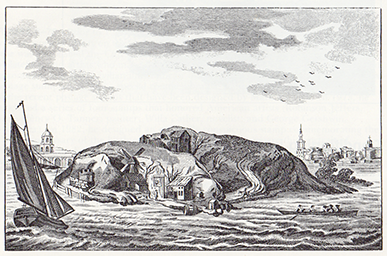
Artist unknown. Catchpenny print, 18th century "puzzle picture" titled The Isle of Dogs.

•••

Anon, THE MAGIC OF CAMOUFLAGE in Edmonton Journal (Edmonton, Alberta, Canada), September 19, 1918, p. 6—

An American artist has discovered a new use of camouflage. He has a favorite dog which his neighbors have been kicking out of their way whenever the animal chanced to stray there.

He had been admiring the great camouflaged battleships on the Hudson River and reading of eminent members of the British Royal Academy, garbed as colonels, directing painters on the Western Front how to camouflage a gun emplacement into a village school or a poultry run.

A happy idea struck him: he would camouflage his dog—all but the tip of his tail. So he has, with the result that the dog now looks like something else, and enjoys complete immunity from the attentions of his neighbors, for he moves about as a beautiful cloud effect.