
Tuesday, October 13, 2026
Just out / new version of online film on Gertrude Stein
Monday, October 5, 2026
Twenty years ago I flat-out wouldn't have believed you

A couple of years ago, for example, I took on the problem of designing eight large format panels for a traveling exhibition (including a banner and the shipping container) about the life and work of an Iowa-born novelist and short story writer named Ruth Suckow. Through the efforts of Iowa scholar Barbara Lounsberry (President of the Ruth Suckow Memorial Association), the exhibit has had enormous success, resulting in its installation at numerous libraries, history centers and other Iowa venues. It is currently on view at the German American Heritage Museum (Davenport IA), as shown above in a view of the installation space.
More recently, I agreed to design a full-color folded brochure for the Dysart Historical Society in Dysart IA. Screen shots of the unfolded outside and inside page layouts are reproduced below. It is a pleasure to take these on, but of course they are also a source of frustration at times, since one has to comply with the client's intentions for the function of the finished design (its content), while producing a visual solution (its form) that is beautifully and effectively made—not merely "slop" that pays the rent.
As Bob Dylan famously said, "the times they are a-changing." A daunting profusion of ugly tattoos (mindless graffiti on youthful architectural skin) are ruining otherwise beautiful forms—of which the deaths of democracy and the rule of law are easily the most frightening. I thought of that just recently as I once again watched one of the best designed films of our era, No Country for Old Men (2007). Here is the salient passage:
"You know, if you'd have told me 20 years ago I'd see children walking the streets of our Texas towns with green hair and bones in their noses, I just flat-out wouldn't have believed you."


Thursday, October 1, 2026
Del Ames, Ballet Mécanique & WWI ship camouflage
 |
| online video link |
Regrettably, I've never been happy with the third video in that series. The voice-over narration was awful. Finally, after years of wanting to replace it, I've now been able to reconstruct that third segment. The new version is greatly improved, and I have posted it online (the link is above), although it has now been retitled as Adelbert Ames and Anamorphosis / New Version / Part 3. It is entirely free to watch and to share with others.
Ames served in the US Army Signal Corps, and was involved in research that pertained to optics and vision. As far as I know, he did not contribute directly to the development of wartime camouflage, but as this video explains, he did have some connection to camouflage, in part because an artist / friend (who designed frames for Ames' paintings) named Hermann Dudley Murphy was an inspector of ship camouflage for the US Shipping Board.
 |
| Hermann Dudley Murphy |
Another surprising link is this: Murphy's son was Dudley Murphy, a young Hollywood filmmaker, and an expert on lenses and cameras, who (at his father's suggestion) was hired as Ames' technical assistant at Dartmouth College during the summer of 1921.
The younger Murphy then moved on to Europe. In the UK, he befriended the poet Ezra Pound and the Vorticist photographer Alvin Langdon Colburn. In France, he met the Surrealist artist Man Ray and the French painter Fernand Léger. It was Murphy and Léger (not just Léger, as if often mistakenly claimed) who made the famous experimental film called Ballet Mécanique.
This video tells the story of that, and ruminates about the link between that film and Ames' later experiments in vision. It's really quite interesting.
 |
| Ames distorted room |
Monday, September 21, 2026
Picasso, Gestalt, Dazzle Camouflage / Missing Links

•••
•••
André Salmon, “Letter from Paris” in Apollo: A Journal of the Arts. November 1929. Vol 10 No 59, p. 281—
The torpedo boat? It was Picasso who influenced the torpedo boat. To him is due the naval camouflage used during the war, and I remember a letter that my friend Picasso wrote to me at the front after a massacre of “red trousers,” in which he expressed the desire of seeing us all dressed like harlequins if there were any chance of finding us alive after the victory. It was not his fault that khaki won the day.…
André Salmon, “Letter from Paris” in Apollo: A Journal of the Arts. November 1929. Vol 10 No 59, p. 281—
The torpedo boat? It was Picasso who influenced the torpedo boat. To him is due the naval camouflage used during the war, and I remember a letter that my friend Picasso wrote to me at the front after a massacre of “red trousers,” in which he expressed the desire of seeing us all dressed like harlequins if there were any chance of finding us alive after the victory. It was not his fault that khaki won the day.…
•••
Fritz Heider, a prominent German-American psychologist, wrote about the possible link between Picasso's Cubist paintings and the vision research of Max Wertheimer, a co-founder of Gestalt psychology. Picasso and Wertheimer were contemporaries, born one year apart, and there are lookalike factors in their perception-based experiments. But it does not mean that Picasso invented Gestalt theory or that Wertheimer was a Cubist. I wrote an article on this many years ago (online here) and discussed it in a video talk about Art, Design and Gestalt Theory, also free to watch online.

Wednesday, September 9, 2026
Stevens and Merilaita book about Animal Camouflage

In the last decade, research on the previously dormant field of camouflage has advanced rapidly, with numerous studies challenging traditional concepts, investigating previously untested theories and incorporating a greater appreciation of the visual and cognitive systems of the observer. Using studies of both real animals and artificial systems, this book synthesizes the current state of play in camouflage research and understanding. It introduces the different types of camouflage and how they work, including background matching [figure-ground blending], disruptive coloration [dazzle] and obliterative shading [countershading]. It also demonstrates the methodologies used to study them and discusses how camouflage relates to other subjects, particularly with regard to what it can tell us about visual perception. The mixture of primary research and reviews shows students and researchers where the field currently stands and where exciting and important problems remain to be solved, illustrating how the study of camouflage is likely to progress in the future.
•••
Wednesday, September 2, 2026
WWI mishap / making a cast of the carcass of a horse
 |
| WWI magazine illustration |
Charles Burchfield, Charles Burchfield's Journals: The Poetry of Place. Albany NY: State University of New York Press, 1993—
It was Capt [William] Yarrow's (the camouflage commander) idea to model a dead horse, which being hollow would be used for a periscope outlet over a dugout, an ingenious idea. Pearson was given the job, as he was a budding sculptor. He thought it would be simpler and more realistic to make a cast from a dead horse itself. Dead horses were not easily procured, and so after a two weeks wait, they had to content themselves with a dead mule secured from a nearby farm. The mule was already two days on the way toward disintegration; nevertheless, Pearson and his helpers, who had requisitioned a truck for the errand, sat on the mule as they went thru the camp, and sang ribald songs, at the tops of their voices, much to the amazement of lookers on.
Pearson's work proceeded slowly, and the odor of the mule grew more frightful with each passing hour (Eskridge & I were sure that Pearson brought it to the barracks with him, and treated him accordingly)—One afternoon, Pearson said—he and his helper Peck, were busily working, when all at once, as one will often do, he realized that for some time someone had been calling him, but it had not completely penetrated his consciousness. Turning he beheld this major (his name eludes me, but he was some rich man's spoiled brat) at some distance, on his horse, gesticulating wildly with one hand, and holding his nose with the other—Pearson hurried over and saluted—
"What the [hell] have you got over there" the major roared—
"A dead mule, sir" was Pearson's reply, with as much sang froid as he could muster—
"A dead mule—You know it's against the regulations to allow a dead animal to lie in the camp—Who gave you permission to bring it here?"
"Capt Yarrow sir?"
"Where the hell is he?"
"I presume over in the woods there, sir" (some of the camouflage work took place in a pine grove near at hand)—
"Well, I'll show him whether he can bring dead mules into the camp," and putting spurs to his horse, he rode furiously off, only, a few minutes later, to plunge thru the artificial [camouflaged] hill, which had been so skillfully constructed that few would know it was not real, unless they had been told. It threw him from his horse, and by the time, with the aid of whatever soldiers were around, he had extricated himself, he was speechless with rage.
•••
Wednesday, August 26, 2026
camouflaged American soldier emerges from stump

World War I American soldier (digital animation)
Henry Berry (American artist / camoufleur), in Make the Kaiser Dance. New York: Doubleday, 1978, p. 207—
I picked Harry Hull [Howard Hull], the brother of Henry Hull, the actor, as my [US Army camouflage] partner, and we went to work. We decided to put together a fake stump, the kind that you move around and hide just about anything in…First we took some real bark off a tree and wired it to a cage we had. When we actually planted it in an area that had a lot of other stumps—really, you couldn't tell the damn thing from the others. We even had a little trap door on the bottom that you could crawl in or out of.

•••
FALSE COLORS: Art, Design and Modern Camouflage
CAMOUPEDIA: A Compendium of Research in Art, Architecture and Camouflage
SHIP SHAPE: A Dazzle Camouflage Sourcebook
Lowest price / three book bundle with free shipping

Tuesday, August 25, 2026
aimed to distort the lines and to warp the perspective
 |
•••
Matthew Luckiesh, Visual illusions, their causes, characteristics and applications. New York: Van Nostrand, 1922, pp. 225-227—
Many optical illusions have been devised and studied by scientists. In fact, some of these tricks are well known to the general reader. Straight lines may appear broken, convergent, or divergent by providing certain patterns or lines intermingled with them. [Beginning in World War I] Many of these were applied to models in laboratory experiments and it has been shown that confusion results as to the course of the vessel. The application of these on vessels has resulted in the grotesque patterns to be seen on ships during the latter stage of the war. It is well known that these illusions are most effective when the greatest contrasts are used, hence black and white patterns are common. Color has not been utilized as definitely as pattern in confusibility, although there is a secondary aim of obtaining low visibility at a great distance by properly balancing the black, white, and other colors so that a blue-gray results at distances too great for the individual patterns to be resolved by the eye. Color could be used for the purpose of increasing the conclusion by apparently altering the perspective. For example, blue and red patterns on the same surface do not usually appear at the same distance, the red appearing closer than the blue.
Such apparently grotesque patterns aimed to distort the lines of the ship and to warp the perspective by which the course is estimated. This was the final type of marine camouflage at the close of the war. Besides relying upon these illusions, ships zigzagged on being attacked and aimed in other ways to confuse the enemy. No general attempt was made to disguise the bow, because the bow-wave was generally visible. However, attempts have been made to increase it apparently and even to provide one at the stern. In fact, ingenuity was heavily drawn upon and many expedients were tried.
Many optical illusions have been devised and studied by scientists. In fact, some of these tricks are well known to the general reader. Straight lines may appear broken, convergent, or divergent by providing certain patterns or lines intermingled with them. [Beginning in World War I] Many of these were applied to models in laboratory experiments and it has been shown that confusion results as to the course of the vessel. The application of these on vessels has resulted in the grotesque patterns to be seen on ships during the latter stage of the war. It is well known that these illusions are most effective when the greatest contrasts are used, hence black and white patterns are common. Color has not been utilized as definitely as pattern in confusibility, although there is a secondary aim of obtaining low visibility at a great distance by properly balancing the black, white, and other colors so that a blue-gray results at distances too great for the individual patterns to be resolved by the eye. Color could be used for the purpose of increasing the conclusion by apparently altering the perspective. For example, blue and red patterns on the same surface do not usually appear at the same distance, the red appearing closer than the blue.
Such apparently grotesque patterns aimed to distort the lines of the ship and to warp the perspective by which the course is estimated. This was the final type of marine camouflage at the close of the war. Besides relying upon these illusions, ships zigzagged on being attacked and aimed in other ways to confuse the enemy. No general attempt was made to disguise the bow, because the bow-wave was generally visible. However, attempts have been made to increase it apparently and even to provide one at the stern. In fact, ingenuity was heavily drawn upon and many expedients were tried.

Monday, August 24, 2026
ship camouflage / as dazzling as Frisco pousse-café

Barred, striped, blotched, smudged, ring streaked with vivid pinks, arsenic greens, blowsy reds, violent blues, they looked like—like nothing in the world unless it be that most poisonous of drinks, a Frisco pousse-café. All of the giraffes, zebras, leopards and tigers ever assembled in the "World Greatest Aggregation" exhibit conventional patterns in comparison with this destroyer camouflage.


Germans more adept at using WWI camouflage tricks

Sunday, August 23, 2026
WWI oil camouflage with views of ship in harbor
 |
| USS Lake Pleasant (1918) |
•••
OIL CAMOUFLAGE OF U-BOAT CAPTAINS IS EXPOSED BY ALLIES, Instead of Sailing on, Destroyers Drop Many Depth Charges Near Floating Oil in The Tulsa Weekly Democrat (Tulsa OK) July 25, 1918—
Tricky German U-boat commanders have concelved a new plan destined to deceive crews of the Allled submarine destroyers in the game of hide and seek in European waters. When a depth bomb is discharged and does not cripple or destroy the German under-sea boat, as sometimes happens, a quantity of oil is released by some device of the submersible and quickly rises to the water's surface.
The hope of the German U-boat captain is that the commander of the destroyer will see the oil, believe that the submarine has been wrecked and drop no more depth charges. Meanwhile, the German is endeavoring to escape.
Amerlcan and British commanders of destroyers and submarine chasers discovered the scheme some time ago and since then have been dropping depth bombs in greater number-than previously, using the oil as a guide to the general location of their target.
"Oil camouflage" the Amerlcans and British navymen call this Iatest German submarine trick.

Thursday, August 20, 2026
British Army Tank Camouflage / WWI Strategic Testing

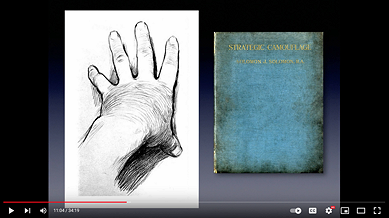
I haven't yet seen the actual book, although copies are for sale online. I was initially pulled in by the image on the cover. In a further search, I found a website sponsored by St Edmundsbury, titled The Great War of 1914 to 1918 Picture Gallery of Bury St Edmunds and Surrounds. There is a caption on that site that provides more information about the image on the cover. It reads as follows:
The artist Solomon J Solomon was enlisted to design camouflage for the new weapons. He visited Elveden and also went to France to study the soil and vegetation there. In June 1916 Solomon began painting the first tanks in a mixture of pink, grey, green and brown blotches. This picture shows a modern attempt to reproduce this camouflage, which was soon replaced by a uniform khaki brown once in the field in France.
Those who follow this blog will most likely recognize the name of Solomon J. Solomon, who was the first commander of the British Army's camouflage section, and who wrote one of the earliest books (perhaps the first) on infantry camouflage, titled Strategic Camouflage. He is also featured in a free, online video talk I made several years ago (see link below).
Tuesday, August 11, 2026
that artists should be placed in charge of camouflage
 |
| False Colors: Art, Design and Modern Camouflage |
It is fitting that military men should have turned to the artist-naturalists for information on camouflage, and should have placed artists in charge of military camouflage, not the United States alone, but in England and France as well, and I believe also in Germany. In this country the camouflage, both naval and land, is being done largely by artists with the assistance of men of kindred professions, such as the stage and architecture…
•••
FALSE COLORS: Art, Design and Modern Camouflage
CAMOUPEDIA: A Compendium of Research in Art, Architecture and Camouflage
SHIP SHAPE: A Dazzle Camouflage Sourcebook
Lowest price / three book bundle with free shipping
•••
Below Drawing by Charles Livington Bull with the following caption: Perhaps the best known of all the camouflage tricks is the dead horse made of papier maché, or even of steel, so arranged that the sniper or lookout can hide in it and keep watch of the enemy.

Monday, August 3, 2026
the unknown role of Iowa artists in modern camouflage


Saturday, August 1, 2026
ship camoufleurs George Musaphia / B.R. Campbell
 |
| George Musaphia illustrations |
RECORD CLAIMED BY CAMOFLEURS Two Seattle "camofleurs"—the men who paint the zig-zag stripes on ships returned recently from Portland OR, where they spent six days supervising the camouflaging of six vessels being built for the Emergency Fleet Corporation. The total of six ships in six days is believed a camouflaging record.
The two are George Misaphia [sic], formerly a New York portrait painter, and B.R. Campbell, who, in peace times, is a Boston theatrical scenery decorator.
That's it. I've searched for both artists, Musaphia (not Misaphia, unless I'm mistaken) and Campbell, the latter of whom is possibly a New England artist named Brooks R. Campbell (1898-1977), who worked as a sign painter in Manhattan. It seems likely that the other man was George (or Georges) Musaphia (1894-1979), but I could be wrong.
One thing about Musaphia that seems certain is that he was affiliated with the theatre, and that he worked in Boston (in advance of World War I) as an illustrator for theatre reviews. Maybe that's how he met Campbell, who is described as a "Boston theatrical scenery decorator."
The six Musaphia illustrations that I have found so far were all published in 1913. I've scanned and reproduced them here. They are stylistically consistent, but the attribution is also clear because he signed his name in an unusual way, part symbol and part letters. They were published in the Boston American on the following dates (from top to bottom) September 7, October 12 and 19, and November 2, 9 and 30. He probably was a portrait painter because his theatre illustrations are, without fail, essentially portraits of the actors as they appear in costume.
Tuesday, July 28, 2026
Seymour Reit / cartoonist, animator, writer, camoufleur

Since early childhood, I have known about Casper the Friendly Ghost, a cartoon character who first appeared in comic books in the late 1940s. But it may have been forty years later that I learned about Seymour Reit (1918-2001), the American animator and children's book author who may (or may not, since there has long been some dispute) have been the person who came up with Casper's character.
As an adult, although Reit was short (he was five foot four), he was larger than life in terms of all his accomplishments. He began his career as an animator for the famous Fleischer Brothers, and in his final decades he was a prolific contributor to MAD Magazine. But that is the tip of the iceberg: as a writer or cartoonist, he was also affiliated with Will Eisner, Archie, Little Lulu, Gulliver's Travels, Popeye, Betty Boop, and Captain Kangaroo.
But he also had two wartime links: First, he was born in New York on Armistice Day on November 11, 1918, the day that marked the ending of World War One, with the result that his parents named him Seymour Victory Reit. And then, when the US entered World War Two, he enlisted in the Army Air Force as a lieutenant, and served as a camoufleur.
I suspect that I first heard about Reit in 1978, when I ran across a copy of a book that he had written, titled Masquerade: the amazing camouflage deceptions of World War II (New York: Hawthorn Books). At the time, I had been researching and writing about art and camouflage for about a decade, and his book was enormously helpful in learning about the varieties of deception in World War Two. It is still of considerable value, even though quite a few other volumes on the same subject have more recently been produced.
 |
| Seymour Reit |
NOTE: For more on cartooning, animation, shapeshifting, metamorphosis and camouflage, see this online video talk.

RELATED LINKS
Dazzle Camouflage: What is it and how did it work? / Nature, Art, and Camouflage / Art, Women's Rights, and Camouflage / Embedded Figures, Art, and Camouflage / Art, Gestalt, and Camouflage / Optical science meets visual art / Disruption versus dazzle / Chicanery and conspicuousness /